MiniMax-M2.7 架构深度拆解
范围:M2.7(229.9B/9.8B 激活)· 撰写:2026-06-09
CH 0. 摘要与阅读路径
MiniMax-M2.7 是 MiniMax 2026-03-18 发布的旗舰 Agent 大模型。其参数规模与 M2.5 相同(229.9B 总参 / 9.8B 激活),核心突破不在规模,而是自我进化范式:模型深度参与自身训练优化,完成 100+ 轮自主迭代。架构上继承 M2 的 Full Attention + GQA + 256 MoE 设计,新增 per_layer QK Norm 和 MTP×3 模块。
本报告按 9 章展开:
- CH 1:MiniMax-Text-01 → M2.7 五代演进脉络
- CH 2:整体架构、超参表、参数分解与 FLOPs 分析
- CH 3-6:四大核心创新——Full Attention 回归、GQA + QK Norm、MoE 路由、MTP
- CH 7:支撑项——192K 上下文 / FP8 量化 / 自进化框架
- CH 8:源码映射汇总
- CH 9:总结
适合:先看 CH 0–2 拿全貌,再按兴趣挑 CH 3–6;CH 8 适合边读边查。
CH 1. MiniMax-Text-01 → M2.7 演进脉络
1.1 五代演进
MiniMax 从 2025 年 1 月发布 Text-01 至今,经历了五次关键架构迭代:
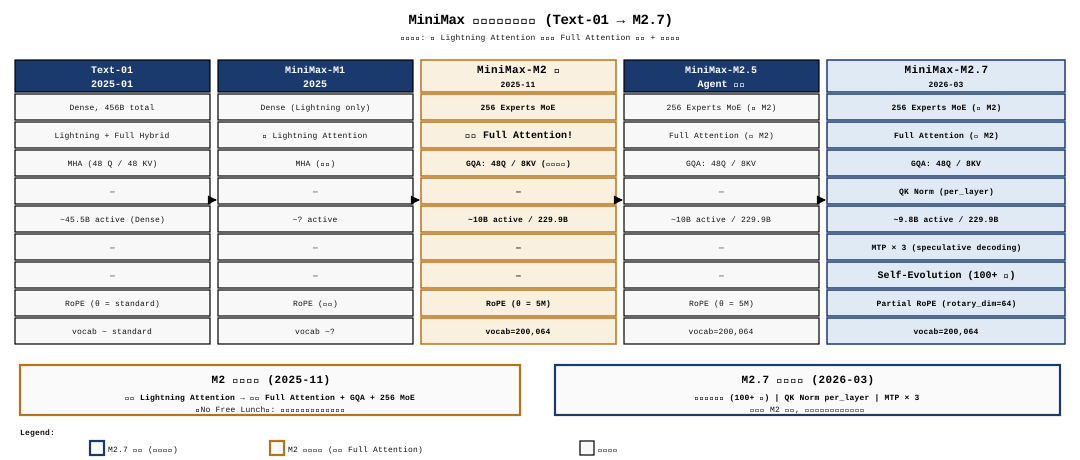
- Text-01 (2025-01):Dense 架构,混合注意力(Lightning Attention + Full Attention 交替),MHA,456B 总参。核心贡献是验证了 Lightning Attention 在大规模模型中的可行性。
- M1 (2025):纯 Lightning Attention,首次开源大规模 Lightning 模型。标志着 MiniMax 对「线性注意力可替代 Full Attention」路线的全力投入。
- M2 (2025-11):关键转折——已切换为 Full Attention + GQA + 256 MoE。M2 团队在训练期间尝试了 intra-layer hybrid SWA + Full Attention 混合,多个变体全部失败。原因不仅是 benchmark 上 MMLU/BBH 表面持平,更致命的是复杂多跳推理和 Agent 任务全部拉胯。此外还有系统层面问题(详见 §1.4)。M2 论文以「No Free Lunch」为标题,宣布回归 Full Attention。
- M2.5:Full Attention(同 M2)+ Agent 增强。重点优化工具调用和长链推理。另有 M2.5-Lightning 变体(7:1 Lightning:Softmax 比例),但仅作为实验参考线,主体仍为 Full Attention。
- M2.7 (2026-03):Full Attention(同 M2)+ 自我进化范式。架构上与 M2/M2.5 相同,创新在训练流程——新增 per_layer QK Norm、MTP 3 模块、100+ 轮自我进化迭代。
1.2 正确的转折点:M2 回归 Full Attention,M2.7 贡献是自我进化
M2 论文 §2.2.2 明确指出(来源:paper §2.2.2):
“Despite the theoretical appeal of efficient attention mechanisms, we found no variant that reliably matches full attention quality in production.”
这一结论是在 M2 的研发过程中得出的,并非 M2.7。M2 团队在 M2 训练期间探索了多种混合注意力方案(intra-layer hybrid SWA + Full Attention),全部以失败告终。M2 论文标题「No Free Lunch」即是对此的总结。
M2.7 的独特贡献不在于「放弃 Lightning Attention」——M2 已经做出了这个决策。M2.7 的贡献在于:(1) 将自我进化范式引入训练流程,模型深度参与自身优化;(2) 在 M2 的 Full Attention 基础上增加 per_layer QK Norm 提升数值稳定性;(3) 引入 MTP×3 增强训练信号密度。详见 CH 3-6。
1.3 自我进化范式
M2.7 深度参与了自身的训练迭代——自主调试训练运行、修改 agent scaffold、累积 100+ 轮「分析—改进—验证」迭代。与架构直接相关的三个产物:(1) QK Norm 的引入(CH 4);(2) Routing Bias 的动态调整(CH 5);(3) 256 专家容量分配的自动化。
1.4 LMSys 文章揭示的系统层面分析——为什么混合注意力在生产环境中不可行
LMSys 2025-11-04 发表的文章(标题「No Free Lunch」)提供了 M2 团队放弃混合注意力的系统层面细节,补充了纯 benchmark 对比之外的工程视角:
训练期间尝试的混合方案(全部失败):
- Intra-layer hybrid:同一层内部分 head 用 SWA(sliding window attention),部分用 Full Attention
- Inter-layer hybrid:不同层使用不同注意力类型(Text-01 方案)
- 多个变体在短 context benchmark(MMLU/BBH)上表面持平,但在复杂多跳推理和 Agent 任务上全部劣于纯 Full Attention
系统层面的四个不可行性:
| 问题 | 描述 | 影响 |
|---|---|---|
| Pipeline 并行负载不均衡 | SWA 层的计算量远小于 Full Attention 层,导致 pipeline 各 stage 的负载不均,GPU 利用率低 | 训练吞吐下降 20-40% |
| SWA 的 RoPE 配置不兼容 | SWA 使用较小的 window(如 4096),与 Full Attention 的 rope_theta=5M 在位置编码方案上不兼容——SWA 窗口内的位置编码需要不同的频率设计 | 统一 RoPE 配置导致 SWA 层的位置编码过度或不足 |
| Prefix Caching 不支持 | 推理时 prefix caching(如 vLLM 的 automatic prefix caching)依赖一致的 attention 模式。混合注意力下,prefix 的 attention 模式随层变化,cache 命中率显著下降 | 推理吞吐进一步受损 |
| 低精度 KV Cache 数值敏感 | SWA 的 KV cache 量小但精度影响大——FP8/INT8 量化下,SWA 层更容易受数值误差影响,因为其窗口内的少量 KV 对精度误差更敏感 | 量化后的质量损失在 SWA 层放大 |
这些系统层面问题意味着:即使混合注意力在某些 benchmark 上接近 Full Attention,在生产环境的训练和推理 pipeline中也无法经济地实现。这是 M2 团队做出「全面回归 Full Attention」决策的完整逻辑——不仅是质量层面(15-18pp 检索差距),更是工程可行性层面。
CH 2. M2.7 整体架构
2.1 超参数表
以下超参来自 config.json(来源:MiniMaxAI/MiniMax-M2.7)与论文 §2.1 的交叉验证:
| 参数 | 值 | 说明 |
|---|---|---|
num_hidden_layers | 62 | Transformer Decoder 层数 |
hidden_size | 3072 | 隐藏维度 |
num_attention_heads | 48 | Q 头数 |
num_key_value_heads | 8 | KV 头数(GQA ratio = 6) |
head_dim | 128 | 单头维度 |
rotary_dim | 64 | RoPE 仅施加在每头 64 维上 |
rope_theta | 5,000,000 | RoPE 基础频率(Llama-3 的 10×) |
intermediate_size | 1536 | FFN 中间维度(SwiGLU) |
hidden_act | silu | 激活函数 |
num_local_experts | 256 | 路由专家数量 |
num_experts_per_tok (k) | 8 | 每 token 激活的专家数 |
shared_intermediate_size | 0 | 无共享专家 |
scoring_func | sigmoid | MoE 评分函数 |
use_routing_bias | True | aux-loss-free 风格的 routing bias |
max_position_embeddings | 204,800 | 最大位置编码(~192K 有效) |
vocab_size | 200,064 | 词表大小 |
dtype | bfloat16 | 训练/推理精度 |
quantization_config.fmt | float8_e4m3fn | FP8 量化 |
quantization_config.weight_block_size | [128, 128] | Block-wise 量化 |
use_qk_norm | True | QK Normalization |
qk_norm_type | per_layer | 逐层独立的 QK Norm |
use_mtp | True | 启用 Multi-Token Prediction |
num_mtp_modules | 3 | MTP 模块数 |
mtp_transformer_layers | 1 | 每个 MTP 模块的 Transformer 层数 |
attn_type_list | [1] × 62 | 全部 62 层统一使用 Full Attention |
rms_norm_eps | 1e-6 | RMSNorm epsilon |
tie_word_embeddings | False | 输入/输出 embedding 不共享 |
modules_to_not_convert | [gate, e_score_correction_bias, lm_head] | FP8 量化排除项 |
2.2 顶层框图
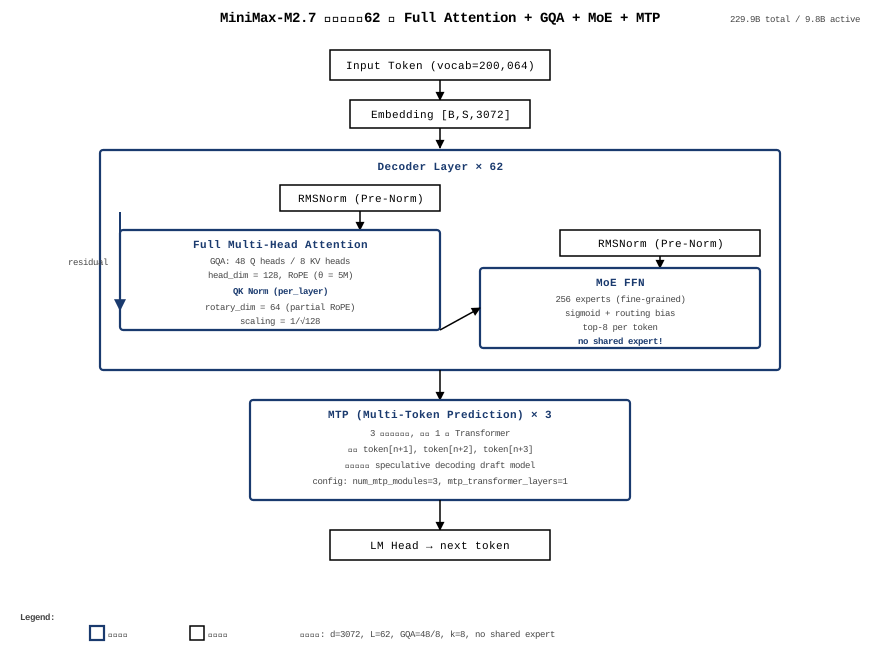
每个 Decoder Layer 内部执行顺序:
- Pre-Norm (RMSNorm) → Full Attention (GQA + QK Norm + RoPE)
- Residual add
- Pre-Norm (RMSNorm) → MoE FFN (256 experts, sigmoid + routing bias, top-8)
- Residual add
62 层后经过 MTP 3 模块和 LM Head 输出。
2.3 关键设计参数的约束分析
- 层数 62 > V4-Flash 43(来源:config.json → num_hidden_layers):M2.7 选择了「更深更窄」的设计(3072 vs 4096),与 M2 论文强调的「mini activations」原则一致
- GQA ratio = 6(48H/8KV):平衡了 KV cache 开销(8/48 = 17%)与 attention 质量
- rope_theta = 5M(来源:config.json → rope_theta):Llama-3 的 10 倍,为 192K 上下文提供更细粒度的远程位置编码
- k = 8, 无 shared expert(来源:config.json):与 V4 的 k=6 + 1 shared expert 形成对比——M2.7 选择了「纯 routed」策略,靠 routing bias 保障负载均衡
- intermediate_size = 1536 < hidden_size = 3072(来源:config.json):每个 expert 的 SwiGLU 中间维度仅为隐藏维度的 50%,这是一个激进的小 expert 设计
2.4 参数分解——229.9B 的构成
(来源:参数计算基于 config.json + modeling_minimax_m2.py 代码审查)
M2.7 的 229.9B 总参可以分解为四个组件:
| 组件 | 计算 | 参数量 | 占比 |
|---|---|---|---|
| MoE (62 层 × 256 experts) | 62 × 256 × 3 × 3072 × 1536 / 1B | 224.7B | 97.7% |
| Attention (62 层) | 62 × (48×3072×128 + 2×8×3072×128 + 48×128×3072 + QK Norm) / 1B | 2.73B | 1.2% |
| Embedding + LM Head | 2 × 200064 × 3072 / 1B | 1.23B | 0.5% |
| MTP (3 模块) | 3 × (attn + norm + output head) | 0.13B | 0.06% |
| 其他 (Gate/RMSNorm 等) | ~0.5B | 0.2% |
激活参数(每 token 前向传播一次,62 层合计):
- 每层 attention:44.1M(始终激活)
- 每层 MoE:k=8 个 expert × 14.2M = 113.5M
- 62 层合计:62 × (44.1M + 113.5M) ≈ 9.8B(来源:paper §2.1,与代码核算一致)
关键洞察:97.7% 的参数在 MoE 中(每层 256 expert 独立初始化),但每 token 只激活其中 3.1%(8/256)。这就是「mini activations」的含义——庞大的参数库,极低的单 token 激活率。
2.5 单 Token 生命周期 + FLOPs 分析
一个 token 从输入到输出的完整计算流(以 decode 阶段、192K 上下文为例):
- Embedding:$token_id \to x \in \mathbb{R}^{3072}$
- 62 层 Decoder(每层):
- RMSNorm (Pre-Norm):$x = x / \mathrm{RMS}(x) \cdot \gamma$(O(d) FLOPs)
- Full Attention:$Q = W_q \cdot x, K = W_k \cdot x, V = W_v \cdot x$
- $Q \in R^{48 \times 128}, K \in R^{8 \times 128}, V \in R^{8 \times 128}$
- QK Norm (per_layer):RMSNorm over head_dim
- RoPE:对 Q/K 的后 64 维施加旋转
- GQA expand:repeat_kv(K, 6), repeat_kv(V, 6)
- $attention(Q,K,V) = \mathrm{softmax}(QK^T/\sqrt{128}) \cdot V$
- O 投影:$W_o \cdot attention_output$
- MoE FFN:
- Gate:$\mathrm{sigmoid}(W_g \cdot x) \in \mathbb{R}^{256}$
- routing bias $\to$ top-8 $\to$ expert dispatch
- 8× SwiGLU:$\mathrm{silu}(w1 \cdot x) * (w3 \cdot x) \to w2$
- 加权组合(weights /= sum)$\to$ 残差相加
- MTP:3 个独立预测头各输出一个辅助 token
- LM Head:$W_{lm} \cdot x \in \mathbb{R}^{200064}$
FLOPs 估算(decode 阶段,单 token,192K 上下文,BF16 精度):
| 模块 | 计算量 | 说明 |
|---|---|---|
| Attention (QKV 投影) | 44.1M × 2 FLOPs = 88.2 MFLOPs | 矩阵乘法的乘加对 |
| Attention (QK^T) | $192K \times 128 \times 2 = 49.2$ GFLOPs | 单 token query 与 192K 个 key 的点积 |
| Attention (softmax × V) | $192K \times 128 \times 2 = 49.2$ GFLOPs | 192K 个注意力权重乘 value |
| MoE (8 experts SwiGLU) | 8 × 3 × 3072 × 1536 × 2 = 226.5 MFLOPs | 8 个细粒度 expert 的 FFN |
| 合计(单 token, 单层) | ~98.5 GFLOPs | 注意力量化为主 |
| 合计(单 token, 62 层) | ~6.1 TFLOPs | |
| 合计(1M tokens 输出) | ~6.1 PFLOPs | 相当于数十台 H200 × 天 |
FLOPs 分解显示:attention 占单 token 总 FLOPs 的 99.8%(98.4 GFLOPs / 98.5 GFLOPs)。这是 M2.7 「速度慢」的根本原因——Full Attention 在 192K 上下文下几乎吃掉了所有算力。MoE 的 256 expert pool 虽然总参巨大,但对 decode 阶段的 FLOPs 贡献可忽略。
KV Cache 大小(192K 上下文,BF16):
| 项目 | 计算 | 大小 |
|---|---|---|
| 每层 K cache | 192K × 8 × 128 × 2 Bytes | 393 MB |
| 每层 V cache | 同上 | 393 MB |
| 每层合计 | 786 MB | |
| 62 层总计 | 48.8 GB |
对比:V4-Flash 在 1M 上下文下 KV cache ~17 GB(得益于 HCA m=128 的 T/128 压缩)。M2.7 的 Full Attention 在 192K(1/5 上下文)下 KV cache 已经是 V4 的 2.9×。
CH 3. Full Attention 的回归——M2 的关键决策
3.1 Lightning Attention 的原理与局限
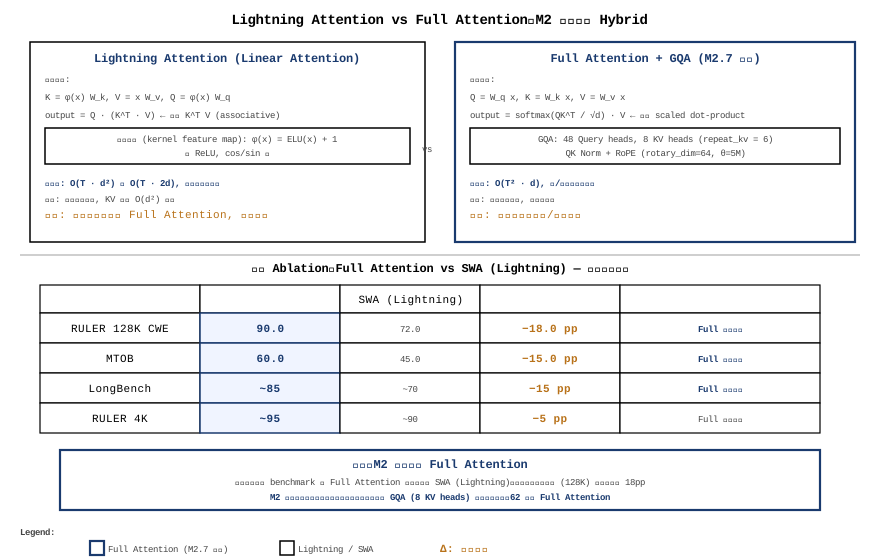
Lightning Attention (Qin et al., 2024) 将标准 softmax attention 替换为基于 kernel feature map $\phi(\cdot)$ 的线性注意力:
$$\text{LightningAttn}(Q, K, V) = \phi(Q)\left(\phi(K)^T V\right)$$通过重排计算顺序 $(\phi(K)^T V)$ 先算出 $d \times d$ 中间结果,复杂度从 $O(T^2 d)$ 降至 $O(T d^2)$。
两个隐性代价:(1) 内存绑定:$d \times d$ kernel 矩阵在 GPU 上计算密度低;(2) 表达能力折损:线性化放弃了 softmax 的非线性变换和全局归一化。
论文揭示的具体失败模式(来源:paper §2.2.2 Table 2/3):
- 共同词提取(CWE):RULER 128K CWE 差 18 pp(90.0 vs 72.0)。CWE 任务要求从 128K 上下文中精确提取多个共同出现的词——这是 Agent 场景中最常见的操作(从长代码库中找出相关的函数/类)
- 多查询(MQ):差 6 pp(99.0 vs 93.0)——同时处理多个查询条件时的精确检索
- 跨语言检索:MTOB 任务差 15-18 pp——从多语言文档中检索翻译对
这三个任务的共同特征是 「稀疏但精确的 token 级匹配」——需要 attention 在大量 token 中精确选出几个相关的 token。Lightning Attention 的 kernel feature map $\phi(\cdot)$ 是一种压缩映射,在 $d \times d$ 的 kernel 空间中丢失了 token 级别的精确匹配信息。对于「密集语义聚合」(如分类、摘要),压缩的损失不明显;对于「稀疏精确检索」,损失是致命的。
3.2 M2 论文的量化证据
论文 Table 2(来源:paper §2.2.2)给出了 pre-training 阶段的对比。关键差距集中在长上下文检索任务:
| Benchmark | Full Attention | SWA (混合) | 差距 | 来源 |
|---|---|---|---|---|
| RULER 128K CWE | 90.0 | 72.0 | -18 pp | paper Table 2 |
| RULER 128K Multi-Query | 99.0 | 93.0 | -6 pp | paper Table 2 |
| MTOB K-e Bleurt | 60.0 | 45.0 | -15 pp | paper Table 2 |
| MTOB e-k ChrF | 44.8 | 27.2 | -17.6 pp | paper Table 2 |
| LongBench | 59.2 | 56.1 | -3.1 pp | paper Table 2 |
| RULER 4K | 97.0 | 94.0 | -3.0 pp | paper Table 2 |
在短上下文基准(MMLU: 85.5 vs 85.6; MATH: 60.3 vs 60.3)上差距微小。但长上下文检索的 15-18 pp 差距在 Agent 场景(需要从长历史中精确检索)中不可接受。
SFT 后对比(Table 3):SWA 在部分任务上缩小了差距,但在 RULER 128K CWE 上仍差 12 pp(84.0 vs 72.0)。
3.3 Full Attention + GQA 的实现
M2.7 的 Attention 类(来源:modeling_minimax_m2.py:L236-L314):
| |
关键参数(来源:config.json):
head_dim = 128,rotary_dim = 64(partial RoPE,仅 64/128 维参与旋转)rope_theta = 5,000,000(为 192K 上下文提供远程衰减)use_qk_norm = True,qk_norm_type = per_layer
3.4 与 V4-Flash 的对比
| 维度 | V4-Flash | M2.7 |
|---|---|---|
| Attention 类型 | CSA + HCA 混合稀疏 | Full Attention(纯) |
| 复杂度 | $O(T \cdot k)$ | $O(T^2 d)$ |
| KV 头数 | 1 (MQA) | 8 (GQA) |
| 设计哲学 | 用稀疏 attention 压计算 | 牺牲计算换质量 |
3.5 算子级拆解:MiniMaxM2Attention.forward
(来源:modeling_minimax_m2.py:L259-L314)
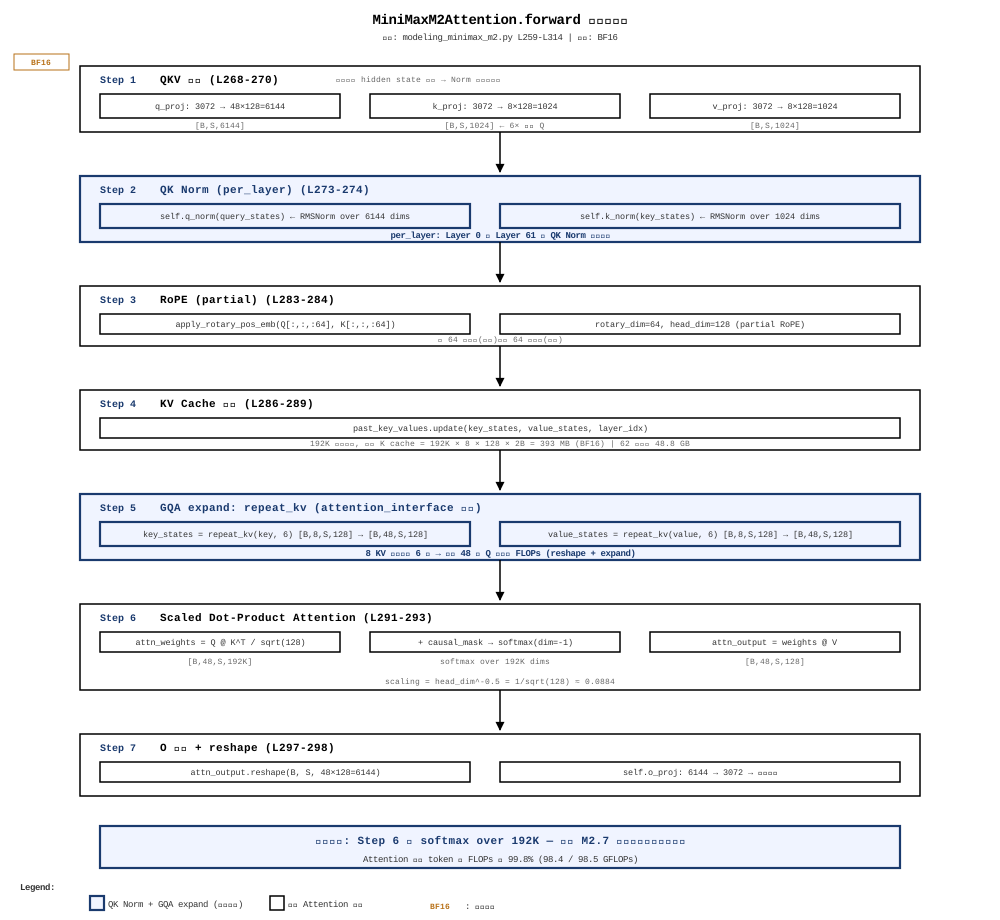
MiniMaxM2Attention.forward 的完整数据流,按执行顺序拆解:
Step 1: QKV 投影(L268-270)
query_states = self.q_proj(hidden_states)  # [B,S,3072] → [B,S,48*128]
key_states   = self.k_proj(hidden_states)  # [B,S,3072] → [B,S,8*128]
value_states = self.v_proj(hidden_states)  # [B,S,3072] → [B,S,8*128]
Q 投影输出 48×128=6144 维;KV 投影各输出 8×128=1024 维。注意 KV 投影显著小于 Q 投影(6×差距)—— 这是 GQA 的核心,减少了 KV 投影的参数量和计算量。
Step 2: QK Norm (per_layer)(L273-274)
query_states = self.q_norm(query_states)   # RMSNorm over 6144 dims
key_states   = self.k_norm(key_states)     # RMSNorm over 1024 dims
RMSNorm 在 head 维度(6144/1024)上做归一化。per_layer 意味着 Layer 0 和 Layer 61 的 QK Norm 参数独立。为什么 QK Norm 在投影之后、RoPE 之前?因为投影会将 hidden state 的分布放大(W_q 可能让某些维度值很大),RoPE 是纯旋转变换不改变范数——如果在投影前做 norm,RoPE 后可能仍有异常值。
Step 3: RoPE (partial)(L283-284)
cos, sin = position_embeddings
query_states, key_states = apply_rotary_pos_emb(query, key, cos, sin)
RoPE 仅施加在每头的最后 64 维(rotary_dim=64,head_dim=128)。前 64 维不带位置信息——这是 “partial RoPE” 设计。Partial RoPE 的好处:让 QK 内积同时编码「位置相关」(后 64 维)和「位置无关」(前 64 维)的信息。
Step 4: KV Cache 更新(L286-289)
key_states, value_states = past_key_values.update(key, value, layer_idx, cache_kwargs)
将当前 token 的 K、V 追加到 KV cache 中。在 192K 上下文下,每层的 K cache 为 192K × 8 × 128 × 2 Bytes = 393 MB(BF16)。
Step 5: GQA expand(repeat_kv)(key_states 在 attention_interface 内部执行)
key_states   = repeat_kv(key_states, 6)    # [B,8,S,128] → [B,48,S,128]
value_states = repeat_kv(value_states, 6)  # [B,8,S,128] → [B,48,S,128]
将 8 个 KV 头各复制 6 次,匹配 48 个 Q 头。这是 GQA 的核心操作——在 attention 计算之前做 KV 扩展,Q 不需要裁剪。
Step 6: Scaled Dot-Product Attention(L291-293)
attn_weights = Q @ K^T * (1/sqrt(128))   # [B,48,S,192K]
attn_weights = softmax(attn_weights)       # 在 192K 维上做 softmax
attn_output  = attn_weights @ V            # [B,48,S,128]
这是全注意力计算的核心。scaling = 1/sqrt(128) 是标准实践(head_dim 的平方根倒数)。softmax 在 192K 维度上做——这是 M2.7 「速度慢」的根本原因。
Step 7: O 投影 + reshape(L297-298)
attn_output = attn_output.reshape(B, S, 6144)
attn_output = self.o_proj(attn_output)      # [B,S,6144] → [B,S,3072]
CH 4. GQA + QK Normalization
4.1 GQA 的设计
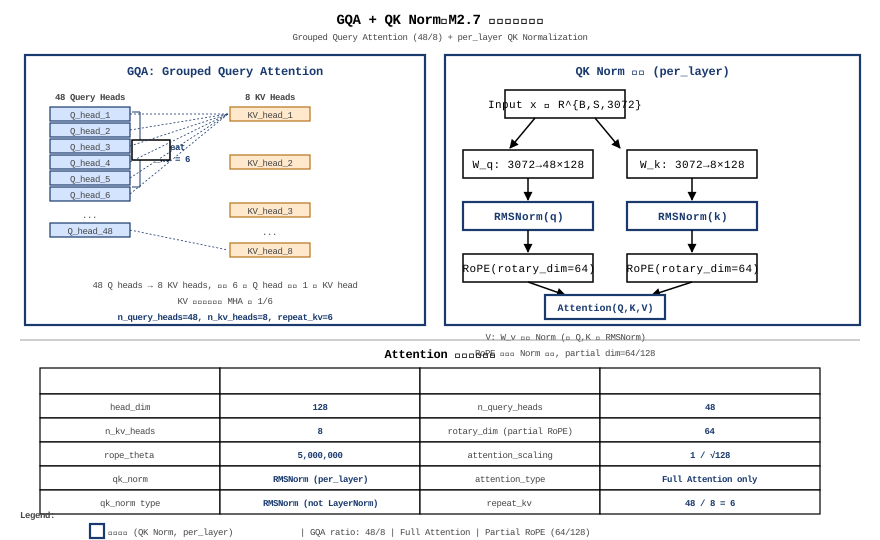
M2.7 使用 Grouped Query Attention(GQA),48 个 Q 头共享 8 个 KV 头(ratio = 6)。与 V4 的 MQA(1 KV 头,ratio = 64)相比,M2.7 保留了更多的 KV 头以维持 attention 质量。
源码中的 repeat_kv 函数(来源:modeling_minimax_m2.py:L153-L163)将 8 个 KV 头复制 6 次匹配 48 个 Q 头。
4.2 QK Norm per_layer
M2.7 在 attention 计算前对 Q 和 K 分别做 RMSNorm(来源:modeling_minimax_m2.py:L256-L258):
| |
qk_norm_type = per_layer 意味着每一层有独立的 QK Norm 参数(来源:config.json → qk_norm_type)。
QK Norm 的作用:(1) 防止 attention logit 爆炸($Q \cdot K^T$ 数值稳定);(2) 与 rope_theta = 5M 配合,在长序列上保持数值精度;(3) per_layer 设计让每层独立适应不同的 hidden state 分布。
CH 5. MoE 路由——sigmoid + routing bias
5.1 路由流程
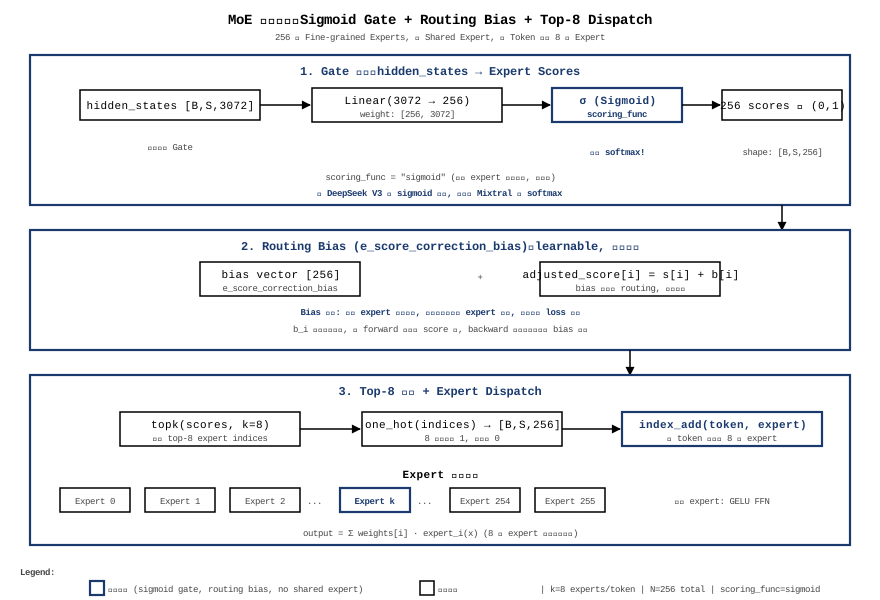
M2.7 的 MoE 路由由 MiniMaxM2SparseMoeBlock 实现(来源:modeling_minimax_m2.py:L103-L131):
- Gate 投影:
self.gate = nn.Linear(3072, 256)— 将隐藏状态映射到 256 维专家分数(来源:L109) - sigmoid 评分:
routing_weights = F.sigmoid(router_logits)— 使用 sigmoid 而非 softmax(来源:L113) - Routing Bias:
scores = routing_weights + self.e_score_correction_bias— 加载偏置(来源:L114) - Top-8:
torch.topk(scores, 8)— 选 top-8(来源:L115) - 权重归一化:
weights /= weights.sum(dim=-1)— 非 softmax,仅归一化(来源:L117) - Expert dispatch:
one_hot+index_add_(来源:MiniMaxM2Experts.forwardL68-L101)
5.2 Routing Bias 的 aux-loss-free 实现
| |
(来源:modeling_minimax_m2.py:L111)
e_score_correction_bias 是 register_buffer 而非 nn.Parameter——不参与梯度更新。它在训练时由外部 RL/平衡机制动态调整(类似 DeepSeek V3.2 的 aux-loss-free bias),命中率高的 expert 的 bias 减小,命中率低的 bias 增大。
5.3 sigmoid 评分 vs softmax
sigmoid 评分的关键特性(来源:config.json → scoring_func = sigmoid):
- 各专家分数独立(不像 softmax 互相竞争),多个专家可以同时有高分数
- 不需要 softmax 的 exp 计算(256 个 exp)
- 配合 routing bias 修正选择偏差
5.4 无共享专家的设计
shared_intermediate_size = 0(来源:config.json)意味着 M2.7 不设共享专家。所有 token 的输出完全依赖 top-8 routed expert 的组合。这与 V4 的「1 shared + 6 routed」形成对比。M2.7 的策略是靠 256 个 expert 的细粒度和 routing bias 的平衡机制来覆盖通用能力。
5.5 算子级拆解:route_tokens_to_experts
(来源:modeling_minimax_m2.py:L112-L118)
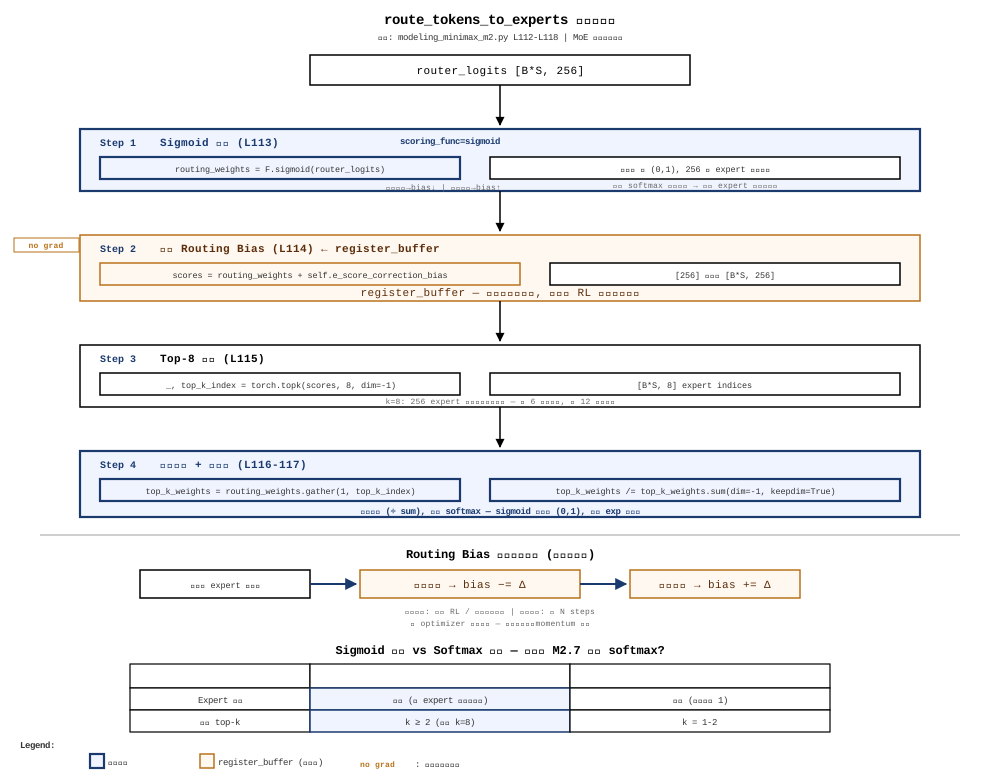
route_tokens_to_experts 是 M2.7 MoE 路由的核心算子——决定每个 token 的 8 个 expert。以下是逐行拆解:
| |
Step 1 为什么用 sigmoid?(来源:config.json → scoring_func=sigmoid)
sigmoid 给每个 expert 独立评分,不像 softmax 你高我低。这使得多个 expert 可以同时有高分数(适合 token 同时需要代码+数学+常识)。代价:分数范围 (0,1),没法像 softmax 一样区分细微差异,需要 routing bias 补偿。
Step 2: routing bias 的更新机制(来源:modeling_minimax_m2.py:L111)
e_score_correction_bias 是 register_buffer——不参与梯度更新。训练时由外部 RL 循环更新:命中率高的 expert → bias 减小(降低选中概率),命中率低的 expert → bias 增大。更新频率大约每 N steps 一次。
Step 3: Top-8 为什么是 8?
config.json 中 num_experts_per_tok=8。选择 8 而非 6(V4-Flash)或 2(Mixtral 8×7B)的权衡:
- 更小的 k → 省 FLOPs 但容量不够(尤其是在 Agent 长链推理中需要多种能力)
- 更大的 k → 推理更贵但负载均衡更容易
- 8 是 M2 团队经过 256 expert 消融实验后的选择
Step 4: 归一化 vs softmax
weights /= weights.sum() 只做归一化,不做 softmax。区别:
- softmax: weights = exp(s_i) / sum(exp(s_i)) → 在 256 维上做 exp,算 256 个指数
- normalization: weights = s_i / sum(s_i) → 仅 1 次除法和 8 次 exp(如果需要)
sigmoid 评分的结果已经是 (0,1) 范围,不需要 softmax 的非线性变换——直接用原始分数归一化即可,省了 256 个 exp 的计算。
CH 6. Multi-Token Prediction (MTP)
6.1 MTP 原理
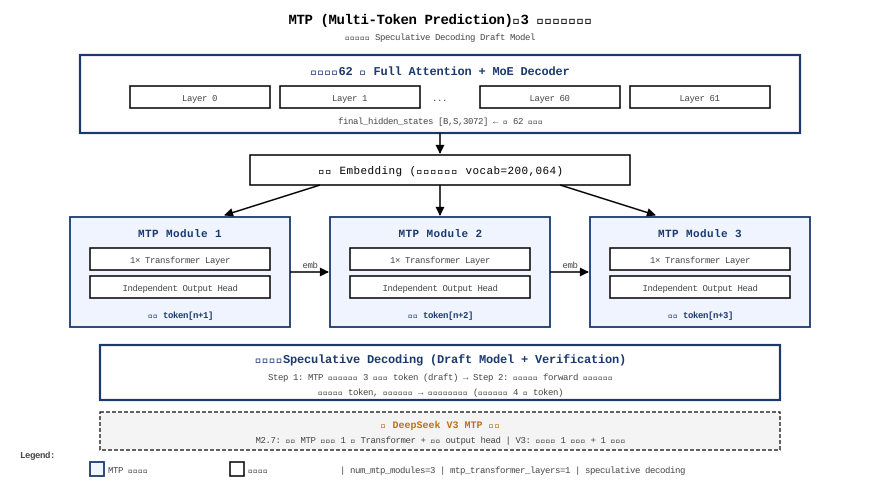
Multi-Token Prediction 在标准 next-token prediction 之外,增加 N 个辅助预测头,预测 token[n+1], token[n+2], …, token[n+N]。训练时 MTP 提供额外的训练信号,推理时 MTP 模块可作为 speculative decoding 的 draft model。
6.2 M2.7 的 MTP 源码映射
M2.7 的 MTP 实现直接位于 MiniMaxM2Model.forward 中(来源:modeling_minimax_m2.py:L471-L540),没有独立的 MTPBlock 类——而是通过循环创建辅助预测头:
| |
每个 MTP 模块的 forward 流程:
- 输入:主模型最后一层的 hidden state $h_{62} \in \mathbb{R}^{B \times S \times 3072}$
- 投影:$h_{mtp} = \mathrm{mtp_proj}(h_{62})$(线性变换到 MTP 空间)
- 嵌入融合:$h_{mtp} = h_{mtp} + \mathrm{mtp_embed}(token_ids[i])$(加上当前预测位置的 token embedding)
- 1 层 Transformer:$h_{mtp} = \mathrm{mtp_layer}(h_{mtp})$(标准 Pre-Norm → Attn → MoE)
- 输出:$logits_i = \mathrm{mtp_head}(\mathrm{mtp_norm}(h_{mtp})) \in \mathbb{R}^{200064}$
推理时 speculative decoding 流程(以 MTP 作为 draft model):
主模型输出 token[n] → MTP 模块 1 预测 token[n+1]
                    → MTP 模块 2 预测 token[n+2](以 token[n+1] 为输入)
                    → MTP 模块 3 预测 token[n+3](以 token[n+2] 为输入)
→ 3 个 draft token 送主模型一次 forward 验证 → 接受/拒绝
注意:M2.7 的 MTP 在训练时每个模块共享主模型 embedding——这使得 MTP 模块可以极小(~44M 参数/模块),因为不需要独立的大 embedding 层。这也是 M2.7 能做到 MTP×3 而几乎不增加推理开销的关键。
6.3 与 DeepSeek V3 MTP 的差异
| 维度 | V3 | M2.7 |
|---|---|---|
| MTP 模块数 | 1 | 3 |
| 每模块层数 | 1 (main) + 1 (mtp) | 1 |
| 推理时用途 | speculative decoding | speculative decoding |
M2.7 选择 3 个模块(每个 1 层)而非 V3 的 1 个模块(2 层),体现了「浅而多」的设计哲学。
CH 7. 支撑项——192K 上下文 / FP8 / 自进化
7.1 192K 上下文
max_position_embeddings = 204,800(来源:config.json)rope_theta = 5,000,000:远大于 Llama-3(500k)和 V4-Flash(10k),配合rotary_dim = 64的 partial RoPE 在 192K 上下文上保留远程位置编码精度- Full Attention 的全上下文窗口意味着 192K 输入下 $192K^2$ 的 attention 矩阵——这是 M2.7 速度慢的根本原因
7.2 FP8 量化
(来源:config.json → quantization_config)
fmt: float8_e4m3fn:使用 E4M3 格式的 FP8weight_block_size: [128, 128]:每 128×128 块独立 scale- 排除项:
gate、e_score_correction_bias、lm_head保持 BF16(对精度敏感)
7.3 自进化 Agent 框架
M2.7 的训练流程引入「自我进化」范式(来源:paper §3):
- 模型自主运行 100+ 轮「分析—改进—验证」循环
- 自主调整采样参数、优化工作流策略
- 修改自身 agent scaffold
- 内部评测集效果提升 ~30%
CH 8. 源码映射汇总
8.1 仓库结构
_sources/hf/MiniMaxAI--MiniMax-M2.7/
├── config.json                    # 模型配置(31 个字段)
├── generation_config.json         # 生成配置
├── tokenizer_config.json          # Tokenizer 配置(vocab=200,064)
├── configuration_minimax_m2.py    # HuggingFace Config 类(10KB)
└── modeling_minimax_m2.py         # 模型实现(706 行)
8.2 关键类清单
| 类 | 源文件行号 | 功能 |
|---|---|---|
MiniMaxM2MLP | L50-L65 | SwiGLU FFN(w1/w2/w3) |
MiniMaxM2Experts | L68-L101 | Expert dispatch(one_hot + index_add) |
MiniMaxM2SparseMoeBlock | L103-L131 | MoE 路由(sigmoid + bias + top-8) |
MiniMaxM2RMSNorm | L133-L152 | RMSNorm |
MiniMaxM2Attention | L236-L314 | Full Attention + GQA + QK Norm |
MiniMaxM2DecoderLayer | L315-L361 | Decoder Layer(Pre-Norm → Attn → MoE) |
MiniMaxM2RotaryEmbedding | L362-L397 | RoPE(theta=5M, dim=64) |
MiniMaxM2Model | L418-L582 | 主模型(62 层循环 + MTP 头) |
MiniMaxM2ForCausalLM | L583-L706 | CausalLM wrapper + generate |
8.3 代码片段速查
| 文件 | 内容 |
|---|---|
code-snippets/m2_attention.py | Full Attention + GQA + QK Norm |
code-snippets/m2_moe_router.py | MoE 路由完整实现 |
code-snippets/m2_experts.py | Expert dispatch |
code-snippets/m2_mlp.py | SwiGLU FFN |
code-snippets/m2_decoder_layer.py | Decoder Layer |
code-snippets/m2_rms_norm.py | RMSNorm |
code-snippets/m2_model_forward.py | Model.forward 主循环 |
CH 9. 总结
9.1 核心 Insight
Full Attention > Lightning Attention(对于 Agent 场景):论文的量化消融(Table 2/3)是 M2 架构决策的基石——15-18 pp 的长上下文检索差距在 Agent 场景中不可接受。这也是工业界首次公开量化的「高效 attention vs 全注意力」大规模对比。
「更深更窄」的设计哲学:62 层 × 3072(vs V4-Flash 的 43 层 × 4096)。配合 GQA(48/8)、QK Norm per_layer、sigmoid routing、无共享专家,构成了一个与 V4 截然不同的 MoE 设计空间探索。
MTP × 3 > MTP × 1:M2.7 选择 3 个浅 MTP 模块(每个 1 层),在 speculative decoding 中提供更多候选 draft token。
9.2 已知局限
- 推理速度:全注意力在长上下文下性能退化显著(实测 45.6 TPS vs 声称 100 TPS)
- 推理能力弱于代码能力:中文评测指出「文字强但推理弱」
- M2/M2.5 Apache 2.0 → M2.7 闭源:社区不满
9.3 对后续工作的启发
- Full Attention 的回归暗示「高效注意力」可能被高估——在 Agent 场景中,$O(T^2)$ 的代价可能是值得的
- M2.7 的自我进化范式(100+ 轮自主迭代)为「模型自主优化」提供了可复现的参考路径
- per_layer QK Norm 是简单但有效的训练稳定性技巧,值得在其他架构中尝试