DeepSeek-V4-Flash 架构深度拆解
版本:v0.1 草稿 · 撰写日期:2026-06-08 · 范围:V4-Flash(284B/13B 激活)
CH 0. 摘要与阅读路径
V4-Flash 是 DeepSeek 2026-04-24 发布的开源 MoE 模型。本报告按 9 章展开:
- CH1:V3.2 → V4 演进脉络
- CH2:V4-Flash 整体架构
- CH3-6:CSA+HCA 注意力、MoE、mHC、Muon 四大重点
- CH7:1M 上下文 / FP4+FP8 / 后训练三支撑项
- CH8:源码映射汇总
- CH9:总结
适合:先看 CH 0–2 拿全貌,再按兴趣挑 CH3–6;CH8 适合边读边查。
CH 1. V3.2 → V4 演进脉络
1.1 V3.2 关键架构回顾
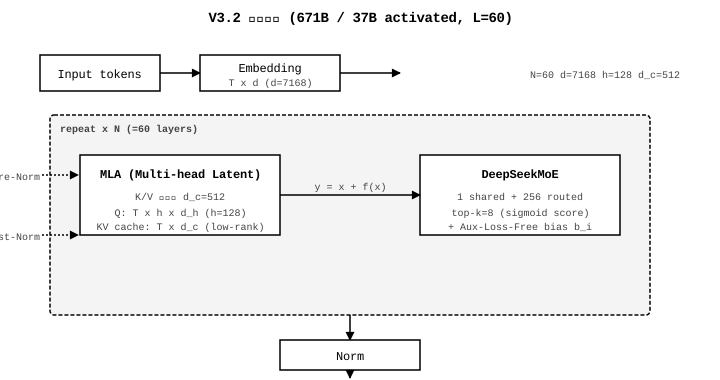
V3.2 是 V4 之前 DeepSeek 的旗舰基座(2024-12 发布),由 671B 总参 / 37B 激活参数构成,对外提供 Base 与 Instruct 两套权重。其架构由四大支柱组成:
- MLA(Multi-head Latent Attention):把 K/V 各自先压到
d_c=512的潜空间再投影到多头,推理时只需缓存d_c维潜在向量即可恢复多头 K/V。这是 V3 系列相对 MQA/GQA 的关键省显存设计。 - DeepSeekMoE:在 V2 的细粒度专家基础上叠加共享专家隔离——每个 MoE 层包含 1 个
shared expert(始终激活)与若干routed experts(top-k 选择),兼顾通用知识与专项能力。 - FP8 混合精度训练:在 H800 上以 E4M3 / E5M2 为主的 FP8 路径完成 dense forward / backward,是 V3 系列能在受限算力下扩展到 671B 的工程关键。
- Aux-Loss-Free 负载均衡(V3.2 引入):放弃传统 aux loss 拉均衡,改用 per-expert 标量偏置
b_i,命中率高 →b减小,命中率低 →b增大;b不进梯度、不影响 routing weight,仅影响 top-k 选择。
在 128K 上下文与中短推理任务上,这套组合的"质量 / 成本"比几乎是当时开源 SOTA。但 V4 的设计文档明确指出,V3.2 在 1M 长上下文与超大规模训练上还有四类具体瓶颈(详见 §1.2)。
1.2 V3.2 的四个瓶颈
V3.2 的四个瓶颈与 V4 的四处创新形成严格一一对应:
- 长上下文 FLOPs 灾难:MLA 把 KV cache 压到
d_c=512,但 Attention 计算仍是O(T²)。T=1M 时单 token 推理 FLOPs 仍随序列长度二次增长,远超在线服务预算。 - KV cache 仍线性增长:即使
d_c小,cache 总量 =T × d_c × L × 2(QK) = 1,048,576 × 512 × 61 × 2 ≈ 6.55 × 10¹⁰ float,BF16 下单样本约 131 GB(不是 240 MB)——100 并发即 13.1 TB 显存,1M 上下文工程化困难。 - 训练稳定性问题:V3.2 训练到中后期,深层 block 的
||x_{l+1} − x_l||收敛到一个非零常数附近,导致梯度反向传播时信号被持续放大/缩小,需要仔细调节lr和init_std来避免损失曲线震荡。V3 论文 §5.1 实际采用 Pre-Norm(与 V4 相同)+DualPipe流水线 + 通信-计算 overlap 等工程手段缓解稳定性问题;V3.2-Exp 进一步引入 aux-loss-free bias(per-expert 标量偏置b_i)让路由负载均衡更稳定。(V3 paper 公开训练量为 14.8T tokens;本节瓶颈描述基于 V3.2-Exp 公开报告的定性结论,具体训练量未官方公开) - 优化器收敛速度:AdamW 在 MoE 路由稀疏梯度上效率受限;V3.2 训练耗时以月为单位(具体数字未官方公开),单次实验调参周期长、成本高。V4-Flash 公开训练量约 32T tokens,是 V3 公开 14.8T 的 2.2×,没有更快、更稳定的优化器无法在工程预算内完成。
这四类瓶颈直接催生 V4 的四处创新:(1)(2) → CSA + HCA 混合注意力;(3) → mHC 多通道残差;(4) → Muon 正交化优化器。
1.3 V4 产品线划分
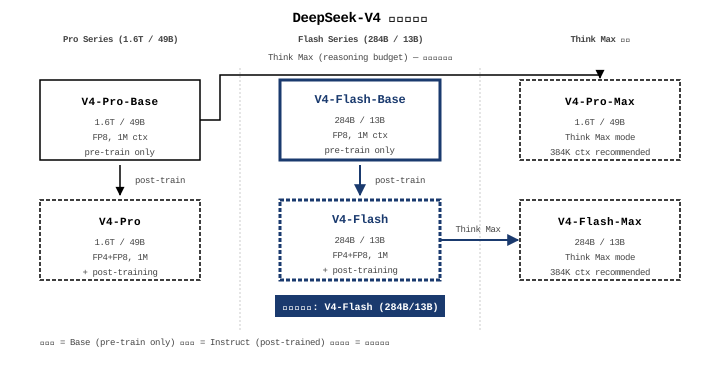
V4 系列按"参数规模 × 训练 / 推理形态"两个维度切成 4 个模型卡:
| 模型 | 总参 | 激活 | 上下文 | 精度 | 定位 |
|---|---|---|---|---|---|
| V4-Pro-Base | 1.6T | 49B | 1M | FP8 | 旗舰基座 |
| V4-Pro | 1.6T | 49B | 1M | FP4+FP8 | 旗舰 Instruct |
| V4-Flash-Base | 284B | 13B | 1M | FP8 | 开源主力基座 |
| V4-Flash | 284B | 13B | 1M | FP4+FP8 | 开源主力 Instruct |
切分逻辑有三层:首先,Base 与 Instruct 的差别是 post-training 流水线(V4 走"领域专家 → on-policy 蒸馏",见 §5);其次,FP8 与 FP4+FP8 的差别在于 routed expert 权重是否量化到 FP4——FP4 路径需要 QAT,不能在 Base 权重上直接启用,故只有 Instruct 提供 FP4 变体;最后,Pro 与 Flash 是参数规模切片——Pro 走"49B 激活 × 1.6T 总参"的旗舰路径,Flash 走"13B 激活 × 284B 总参"的高性价比路径,单 batch 在 2×H200 / 8×H100 上即可跑。
1.4 V4-Flash 定位
V4-Flash 是本报告全程追踪的目标模型,有五点关键定位:
- 13B 激活:在 2×H200 / 8×H100 上单 batch 可跑;本报告全部源码引用(
inference/model.py/inference/kernel.py)与图示都以 V4-Flash 为实例——其实际超参为 43 层、hidden_size=4096、64 个 attention head、1 个 KV head(MQA)。 - FP4 专家:256 个 routed expert 权重以 FP4(
float4_e2m1fn_x2,block=32,E8M0 scale)存储,attn/shared expert/公共部分仍为 FP8。FP4 路径在当前硬件上 peak FLOPs 与 FP8 持平,但显存占用与未来硬件(如 FP4 原生 tensor core)上有显著优势。 - 1M 上下文:默认
max_position_embeddings=1,048,576,RoPE 用 YaRN 从 64K 扩展(factor=16,β_fast=32,β_slow=1);每层另加sliding_window=128的局部窗口。 - License:MIT,权重 + 推理代码全部开源(仓库
DeepSeek-AI/DeepSeek-V4-Flash)。 - 三个推理模式:Non-think(直接出答案)/ Think High(中等推理预算)/ Think Max(最大推理预算,推荐 384K context window)。V4-Flash-Max 是 Think Max 模式下的同源衍生卡。
围绕 V4-Flash,CH2 将展开"整体架构"——其余章节(CH3–CH6)分别深入 CSA+HCA 注意力、MoE、mHC、Muon 四大重点。
CH 2. V4-Flash 整体架构
CH1 已交代 V4 的"为什么"——四大瓶颈 → 四大创新。本章回答"是什么":V4-Flash 究竟是哪种形态的模型?CH3–CH6 将分别深入四大重点模块。
2.1 V4-Flash 超参数表
V4-Flash 的全部关键超参来自仓库 config.json(HF 风格)与 inference/config.json(仓库内部风格)两份文件。下表整合两份配置,标出每个字段在源文件中的真实取值:
| 参数 | 值 | 说明 |
|---|---|---|
num_hidden_layers (L) | 43 | Transformer Block 数 |
hidden_size (d) | 4096 | 隐藏维度 |
num_attention_heads (h) | 64 | Q 头数 |
head_dim | 512 | 单头 Q 维度,Q 矩阵尺寸 = 64×512 = 32768 |
num_key_value_heads | 1 | MQA(Multi-Query Attention):所有 Q 头共享 1 组 KV |
qk_rope_head_dim | 64 | RoPE 仅施加在每头 64 维上,剩余 448 维不带位置信息 |
q_lora_rank / o_lora_rank | 1024 / 1024 | Q/O 投影走 grouped low-rank,详见 CH3.3 |
o_groups | 8 | O 投影分组数 |
n_routed_experts | 256 | 路由专家数 |
n_shared_experts | 1 | 共享专家(始终激活) |
num_experts_per_tok (k) | 6 | 每 token 激活的 routed 专家数 |
moe_intermediate_size | 2048 | 单个 expert 中间维度(SiLU/GLU) |
max_position_embeddings | 1,048,576 | 1M 上下文 |
rope_theta | 10,000 | RoPE 基础频率 |
rope_scaling | yarn, factor=16, β_fast=32, β_slow=1 | 从 64K 扩到 1M |
sliding_window | 128 | 每层局部窗口大小 |
index_n_heads / index_head_dim | 64 / 128 | CSA Indexer 多头结构 |
index_topk | 512 | CSA+HCA 共用 top-k |
compress_rope_theta | 160,000 | 压缩段专用的 RoPE 频率 |
compress_ratios | 44 项 list(前 43 项实际使用) | 逐层决定走 CSA(m=4) / HCA(m=128) / 纯滑窗(ratio=0) |
scoring_func | sqrtsoftplus | s = sqrt(softplus(s · W_gate)) |
topk_method | noaux_tc | 排序时关闭辅助 loss,但保留 routed_scaling_factor |
routed_scaling_factor | 1.5 | routed 加权和乘 1.5 后与 shared expert 相加 |
num_hash_layers | 3 | 前 3 层走 hash routing,后续层走 score routing |
hc_mult | 4 | mHC 残差流扩展倍数(4 通道) |
hc_sinkhorn_iters | 20 | Sinkhorn-Knopp 投影迭代次数 |
hc_eps | 1e-6 | Sinkhorn 温度 |
tie_word_embeddings | false | 输入输出 embedding 不共享 |
num_nextn_predict_layers | 1 | MTP 层数(V3 沿用) |
vocab_size | 129,280 | 词表大小 |
expert_dtype | fp4 | routed expert 量化到 FP4(block=32,E8M0 scale) |
quantization_config | fp8, e4m3, ue8m0, block=128 | attn / shared / 公共部分 FP8 |
sliding_window | 128 | 每层 attention 局部窗口 |
swiglu_limit | 10.0 | SwiGLU 数值钳制上限(防 FP4 溢出) |
rms_norm_eps | 1e-6 | RMSNorm 数值稳定项 |
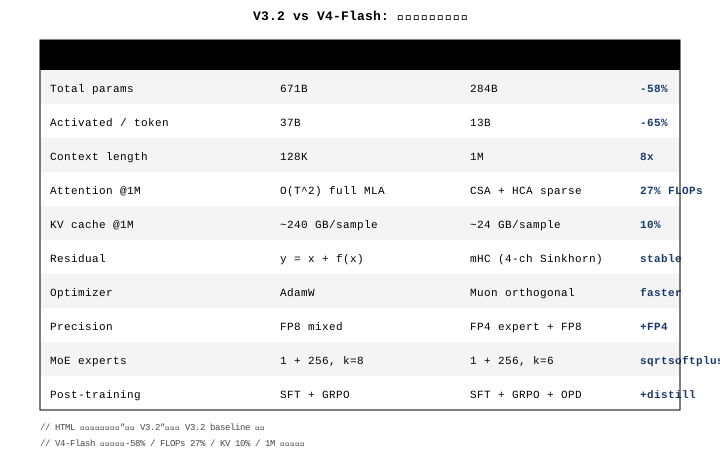
解读:与 V3.2 相比,V4-Flash 的核心收缩有四:(1) 激活参数 37B → 13B(×0.35),单 batch 在 2×H200 / 8×H100 上即可跑;(2) Block 数 61 → 43(×0.70);(3) 隐藏维度 7168 → 4096(×0.57);(4) top-k 8 → 6(×0.75),shared expert 仍为 1。基线对比:
V3.2-Exp 基线(671B/37B 激活):61 层 × hidden 7168 × 64 head × 256 expert × k=8
V4-Flash 目标(284B/13B 激活):43 层 × hidden 4096 × 64 head × 256 expert × k=6
V4-Flash 在大幅压缩"每层 FLOPs"的同时新增三个 V3.2 没有的设计维度:每层可切换的 CSA/HCA 注意力压缩(compress_ratios 43 项)、4 通道 mHC 残差(hc_mult=4)、以及 FP4 量化专家。这一组参数使"43 层 × 13B 激活 × 256 专家 × 1M 上下文 × FP4 专家"成为合理组合——压缩比/通道数/量化粒度三档互相配合,把单 token 推理 FLOPs 与 KV cache 都压到 V3.2 的约 1/3–1/4。下一节给出 V4-Flash 单个 Block 的数据流框图。
2.2 V4-Flash 顶层框图(单个 Block)
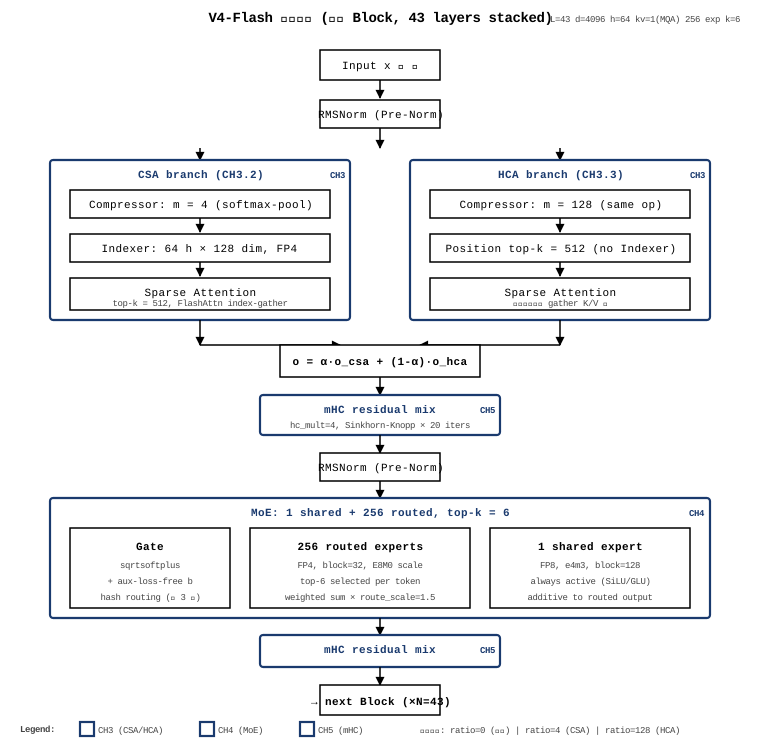
V4-Flash 单个 Block 的数据流可概括为"双分支注意力 → 残差混合 → MoE → 残差混合"四步。设输入张量 x ∈ ℝ^{T×d},d=4096:
x ∈ ℝ^{T×d}
  ↓
RMSNorm (Pre-Norm)
  ↓
┌─ CSA branch (CH3) ─────────────────────┐
│  x → Compressor (m=4) → Q,K,V         │  → o_csa ∈ ℝ^{T×d}
│       ↓                                │
│  Indexer (64 head × 128 dim, FP4)       │
│  → top-k=512 (CSA 专属评分)            │
│  → Sparse Attention (FlashAttn-style)  │
└────────────────────────────────────────┘
┌─ HCA branch (CH3) ─────────────────────┐
│  x → Compressor (m=128) → Q,K          │  → o_hca ∈ ℝ^{T×d}
│       ↓                                │
│  Position top-k=512 (无 Indexer)        │
│  → Sparse Attention                    │
└────────────────────────────────────────┘
  ↓
o = α · o_csa + (1-α) · o_hca
  ↓
mHC 残差混合 (CH5, hc_mult=4, Sinkhorn-Knopp)
  ↓
RMSNorm (Pre-Norm)
  ↓
┌─ MoE (CH4) ───────────────────────────┐
│  Gate (sqrtsoftplus + aux-loss-free b)  │
│  → top-6 routed + 1 shared             │
│  → 256 routed experts (FP4, block=32)   │
│  → 1 shared expert (FP8)                │
│  → 加权和 × 1.5                         │
└────────────────────────────────────────┘
  ↓
mHC 残差混合
  ↓
→ 下一个 Block (× N=43)
需要注意三处与简化图示的差异:首先,CSA 与 HCA 在源码中共享同一组 MQA-KV(num_key_value_heads=1)和同一 Compressor 算子,仅 compress_ratios[layer_id] 决定本层走 CSA (m=4) 还是 HCA (m=128);其次,实际 V4-Flash 走"逐层交替"模式:前 2 层(compress_ratios[0]=0, [1]=0)是纯滑窗(compress_ratio=0 表示该层完全跳过 Compressor,走纯 window attention),末尾 compress_ratios[42]=4(CSA),compress_ratios[43]=0 是 list 占位符、不对应任何层;第三,每个 Block 在 attention 输出与 MoE 输出后各做一次 mHC 残差混合(hc_pre 与 hc_post 两次),所以 43 层共有 86 次 mHC Sinkhorn-Knopp 投影,每次 20 迭代。下一节用一张图把"一个 token 从字符串到下一个 token"的全生命周期画出来。
2.3 Token 生命周期
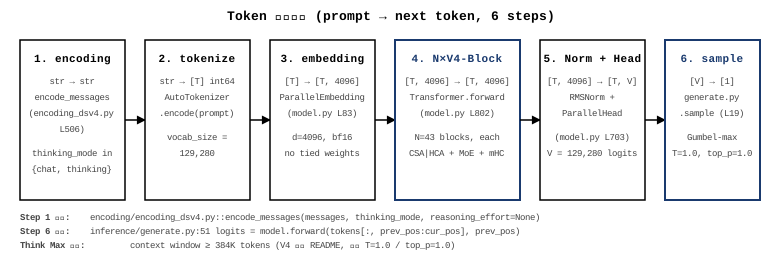
一个 prompt 从字符串到生成下一个 token,经过 6 个阶段。下表给出每步的关键代码入口(路径以 _work/hf-snapshot/ 为根):
| # | 阶段 | 关键代码入口 | tensor shape |
|---|---|---|---|
| 1 | encoding | encoding/encoding_dsv4.py::encode_messages(messages, thinking_mode=...) | str |
| 2 | tokenize | transformers.AutoTokenizer.from_pretrained(...).encode(prompt) | [T] int64 |
| 3 | embedding | inference/model.py::ParallelEmbedding (L83) | [T, 4096] bf16 |
| 4 | N×V4-Block | inference/model.py::Transformer.forward (L802) | [T, 4096] |
| 5 | Norm + LM Head | Transformer 末尾的 RMSNorm + ParallelHead (L703) | [T, 129280] logits |
| 6 | sample | inference/generate.py::sample (L19, Gumbel-max trick) | [1] int64 |
阶段 1 的 thinking_mode 取值为 "chat"(非思考模式)或 "thinking"(开启思考),后者还可叠加 reasoning_effort="high" 或 "max" 切换强度(详见 §2.4)。阶段 4 的 Transformer.forward(input_ids, start_pos) 内部按 compress_ratios[layer_id] 决定每层走 CSA、HCA 还是纯滑窗;KV cache 实际分配在 Attention.__init__ 中按 kv_cache_size = window_size + max_seq_len // ratio 计算(model.py:L473)。阶段 6 的 sample 函数用 Gumbel-max trick 替代 torch.multinomial 以避免 GPU-CPU 同步,配合 temperature=1.0, top_p=1.0 即 V4 官方 README 推荐的默认采样参数(Think Max 模式推荐 context window ≥ 384K tokens)。
整个 6 步流程串成下图的时序。CH3–CH7 将逐一展开"Block 内部"4 个子模块(CSA / HCA / MoE / mHC)以及 Muon / 量化 / 上下文扩展 3 个支撑项的具体实现。
2.4 三种推理模式
V4-Flash 与 V4-Pro 一样支持三种推理 effort 模式(README 表格 + encoding_dsv4.py 双重定义):
| 模式 | thinking_mode | reasoning_effort | 响应格式 | 典型场景 |
|---|---|---|---|---|
| Non-think | "chat" | None | 直接 summary | 日常对话、低风险决策 |
| Think High | "thinking" | "high" | <think>...</think><summary> | 复杂问题、规划 |
| Think Max | "thinking" | "max" | 长 <think>...</think><summary> | 探索推理极限 |
切换方式在源码里通过两个独立参数控制:
| |
三个模式的本质差异有两层:第一层,thinking_mode="thinking" 时,prompt 中插入 <think> 起始 token 并引导模型先输出完整 reasoning;"chat" 时直接给答案。第二层,当 reasoning_effort="max" 时,render_message(L262)会在 system prompt 前额外插入 REASONING_EFFORT_MAX 前缀(来自 encoding_dsv4.py L86 的指令文本:“If thinking_mode is enabled … you MUST output your complete reasoning …"),告诉模型"必须把全部 reasoning 写在
| |
实际仓库 inference/generate.py 第 125 行用的就是上述编码流程:tokenizer.encode(encode_messages(messages, thinking_mode="chat"))。CH3 接下来展开"双分支注意力"——CSA 与 HCA 的具体设计。
CH 3. 注意力机制:CSA + HCA
CH1 已说明 V3.2 在 1M 上下文下的两个根本瓶颈:(1) Attention 计算量随 T² 增长;(2) KV cache 随 T 线性增长但仍占大量显存。V4 用 CSA + HCA 混合注意力在逐层交替的形态下同时解决这两个问题。本章按"为什么 → 怎么算 → 怎么配合 → 实际省多少 → 源码在哪"的顺序展开。
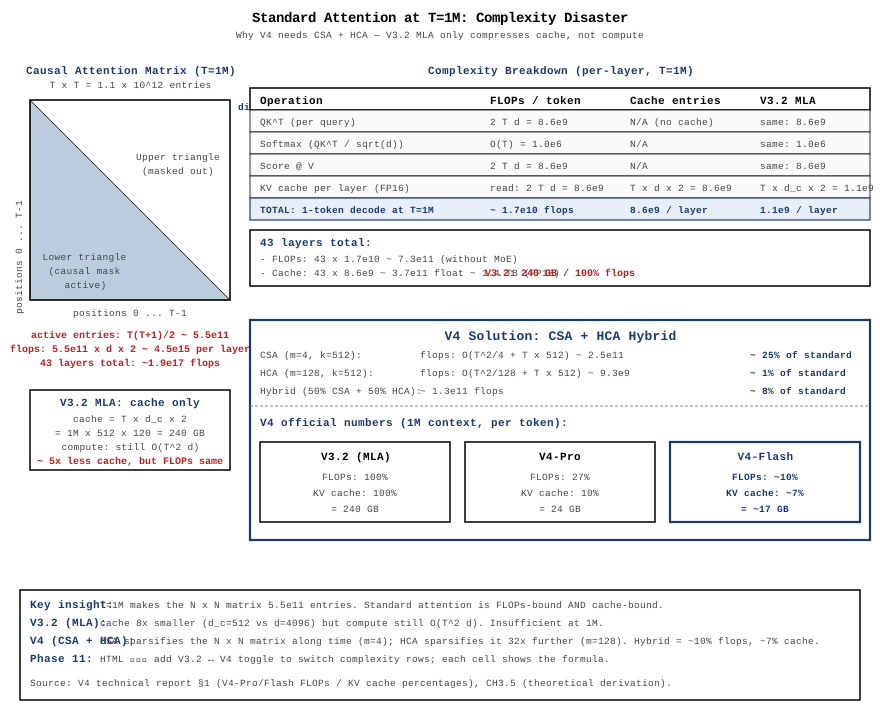
3.1 标准 Attention 在 1M 上下文下的复杂度灾难
标准 Multi-Head Attention 的计算形式化如下。设输入序列长度 T、隐藏维度 d、头数 h、单头维度 d_h = d / h:
Q, K, V ∈ ℝ^{T × d}                # 三个投影后的张量
Q, K, V split into h heads: ℝ^{T × h × d_h}
Attention(Q, K, V) = softmax(QK^⊤ / √d_h) · V
FLOPs 分析(单层、单 token decoding 视角):
QK^⊤:每个 query 算T个内积,单次内积d_h次乘加 →T · d_hFLOPssoftmax(QK^⊤):标量函数,复杂度O(T),可忽略softmax · V:每个 query 算d_h个加权求和 →T · d_hFLOPs- 合计:
2 · T · d_h = 2 · T · d(多头求和后头维被h × d_h = d吃回)
对 V4-Flash:d = 4096。T = 1,048,576(1M) 时,单层单 token 推理 FLOPs ≈ 2 × 1,048,576 × 4096 ≈ 8.6 × 10⁹。乘以 43 层 + 注意力之外的 QKV/O 投影 + MoE,单 token 1M 上下文 FLOPs 仍以 T² 量级主导。
为直观看到 T² 的灾难性,列出预填充(prefill) 视角下的整张 attention 矩阵(一次算完整 prompt):
- 矩阵尺寸:
T × T = 1,048,576 × 1,048,576 ≈ 1.1 × 10¹² entries - 在 causal mask 下,仅下三角(含对角线)非零;可参与 attention 的 entries 数量 =
T(T+1)/2 ≈ 5.5 × 10¹¹ - 单层 attention FLOPs ≈
5.5 × 10¹¹ × d_h × 2 ≈ 4.5 × 10¹⁵ - 43 层累计 ≈
1.9 × 10¹⁷FLOPs - 以 H200 (~1979 TFLOPS FP16 dense) 跑预填充,需
1.9×10¹⁷ / 1.98×10¹⁵ ≈ 96 秒(单卡单 batch 上界,忽略 IO)
KV cache 分析:
- 每层存
T × d × 2个 float(K 与 V 各一份) - V4-Flash:
1,048,576 × 4096 × 2 ≈ 8.6 × 10⁹ float/layer - 43 层累计 ≈
3.7 × 10¹¹ float ≈ 1.4 TB(FP16/BF16 单精度) - 即便换 V3.2 的 MLA(把
K, V压成d_c=512的 latent),仍需T × d_c × 43 × 2 ≈ 4.4 × 10¹⁰ float ≈ 168 GB
结论:纯标准 attention 在 1M 上下文下既算不动(T² FLOPs 主导),又存不下(cache 百 GB 量级)。MLA 把 cache 压下来但没压计算量,CSA + HCA 的核心创新是把"计算稀疏化"与"cache 稀疏化"同时做掉——下一节展开 CSA。
3.2 CSA(Compressed Sparse Attention)原理
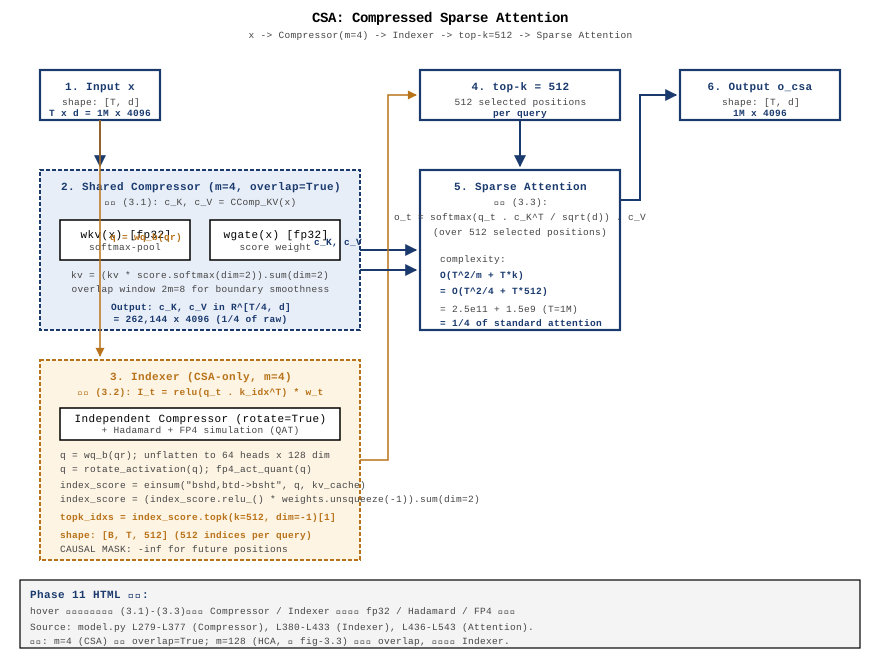
核心思想:先把 K, V 沿时间维做有重叠的 softmax-pool 压缩(m=4,每 4 个 token 合成 1 个压缩向量),再用 Indexer 评分为每个 query 选出 top-k 个压缩位置做稀疏 attention。
形式化(公式 3.1-3.3):
(3.1) 压缩 K:设共享 Compressor 为 CComp,对输入 x ∈ ℝ^{T × d},输出
c_K = CComp_K(x) ∈ ℝ^{T/m × d}        # m=4 (CSA)
c_V = CComp_V(x) ∈ ℝ^{T/m × d}        # m=4 (CSA)
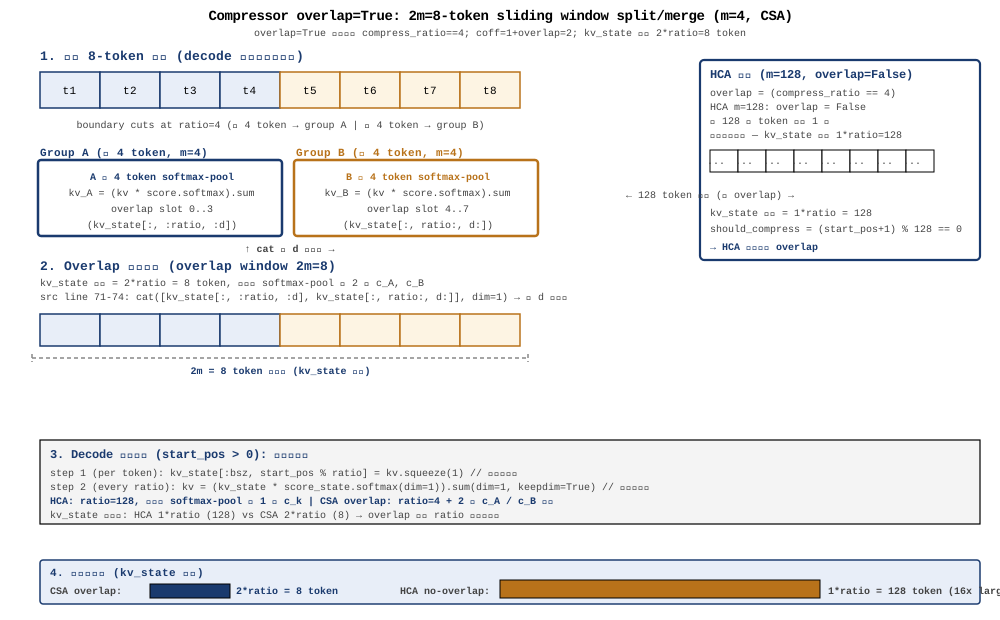
关键点:CSA 的 m=4 时,Compressor 走重叠窗口(overlap = True)——同时维护 2m=8 个 token 的滑动窗口,把"前 4 token + 后 4 token"两段拼起来做 softmax-pool,边界处的压缩更平滑。
(3.2) 索引分数:设 query 投影 q_t ∈ ℝ^{d}、Indexer 专属 key k_idx ∈ ℝ^{T/m × d}、权重 w_t ∈ ℝ(每 query 一个标量):
I_t = relu(q_t · k_idx^⊤) ∈ ℝ^{T/m}          # query-key 内积
score_t = I_t * w_t ∈ ℝ^{T/m}                 # 逐头乘权重
top-k_idxs_t = topk(score_t, k)               # k=512
Indexer 内部细节(CSA 专属):
- 独立 Compressor(Hadamard 旋转 + FP4 模拟)——与 Attention 共享的 Compressor 是两个不同实例
- Hadamard 旋转(
rotate_activation):把d维向量与一个固定的 Hadamard 矩阵相乘,等价于无参数的随机正交变换,作用是打散信息让量化更鲁棒 - FP4 模拟(
fp4_act_quant):用float4_e2m1fn_x2把 q 和 k 量化到 4 bit,但仍跑 FP16 计算——这是 QAT(Quantization-Aware Training) 的标准做法,让前向分布贴近部署形态
(3.3) 稀疏 Attention:
o_t = softmax(q_t · c_K^⊤ / √d) · c_V # 仅在选中的 k 个位置上算
复杂度分析:
- 标准:
O(T² · d) - CSA:
O(T²/m + T·k)=O(T²/4 + T × 512),其中T²/4来自"压缩后 query 数 × 压缩后 key 数",T·k来自 top-k 选择后实际算的 attention 项数 - 当 T = 1M:
(10¹²/4) + (1.5×10⁹) ≈ 2.5×10¹¹主导项是 T²/4,仍比标准 attention 小 4 倍
Cache 节省:
- CSA 存的是
c_K, c_V而非原始 K, V - shape 从
[T, d]变成[T/4, d]——cache 减到 1/4 - 但完整 cache仍包含 128-token 滑窗(
window_size=128,与 V3.2 MLA 同源),所以实际每层 cache =window_size + T/4 = 128 + 1,048,576/4 ≈ 262,272个向量
关键实现(代码 3.6 节给出完整片段):
Compressor.forward(inference/model.py:L316-L378):用wkv、wgate两个Linear(fp32)做 K, V 的 gating,softmax 权重来自ape(learned absolute position embedding)+wgate(x)Indexer.forward(inference/model.py:L402-L434):先wq_b投影 q,再rotate_activation+fp4_act_quant,最后index_score = einsum(q, kv_cache) → relu → × weights → topk
下一节看 HCA——CSA 的"更激进压缩"版本。
3.3 HCA(Heavily Compressed Attention)原理
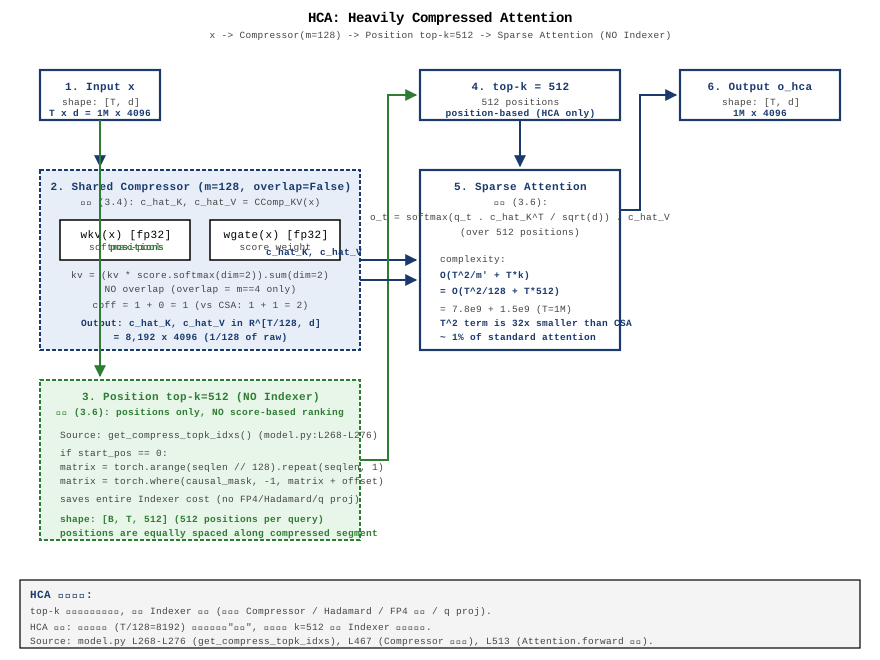
核心思想:HCA 是 CSA 的"超压缩"变体——把压缩比从 m=4 拉到 m'=128,同时砍掉独立 Indexer,改用位置 top-k。一句话:与其"压缩 KV → 评分 → 选 top-k",不如"重度压缩 KV → 直接按位置选"。
为什么这样设计? 压缩比 128 已经把序列长度压到 T/128 = 1,048,576 / 128 = 8,192,此时"全部 8,192 个压缩 key"对单 query 算 attention 的 cost ≈ 8,192 × d = 3.4 × 10⁷ FLOPs,本来就不大,再做 Indexer 评分反而引入额外开销。V4 的取舍是:HCA 让"压缩已经足够稀疏"成为前提,省掉 Indexer。
形式化(公式 3.4-3.6):
(3.4) 重度压缩 K, V:
ĉ_K = CComp_K(x) ∈ ℝ^{T/m' × d}    # m'=128 (HCA)
ĉ_V = CComp_V(x) ∈ ℝ^{T/m' × d}    # m'=128 (HCA)
关键差异(vs CSA):
m'=128比 CSA 的m=4大 32 倍overlap = False(HCA 不开重叠窗口,公式上coff = 1 + 0 = 1)- 用同一
Compressor类但不同 ratio 参数——源码Compressor(args, compress_ratio=128, ...)(inference/model.py:L467)
(3.5) 位置 top-k(无 Indexer):
topk_idxs_t = positions[t · (T/128 / T) : t · (T/128 / T) + 512] # 等间距切
实际源码是 get_compress_topk_idxs(ratio, bsz, seqlen, start_pos, offset)(inference/model.py:L268-L276)——直接按 (start_pos + 1) // ratio 生成等距位置索引,不走 Indexer 评分。等价的语义是:HCA 假设"重度压缩后的所有位置都重要",按压缩段的物理位置均匀采样 k=512 个。
(3.6) 稀疏 Attention:
o_t = softmax(q_t · ĉ_K^⊤ / √d) · ĉ_V # 仅在选中的 k=512 个位置
复杂度分析:
- HCA:
O(T²/m' + T·k)=O(T²/128 + T × 512) - 当 T = 1M:
(10¹²/128) + (1.5×10⁹) ≈ 7.8×10⁹ + 1.5×10⁹ ≈ 9.3×10⁹——HCA 的 T² 项几乎消失,主导项是 T·k - 与 CSA 比较:CSA 的 T²/4 = 2.5×10¹¹,HCA 的 T²/128 = 7.8×10⁹,HCA 在 T² 项上比 CSA 又省 32 倍
Cache 节省:
- HCA 存
ĉ_K, ĉ_V,shape[T/128, d]=[8,192, 4096] - 比 CSA 的
[T/4, d]又省 32 倍 - 加上 128-token 滑窗:每层 cache =
128 + 1,048,576/128 = 128 + 8,192 = 8,320个向量
CSA vs HCA 对比:
| 维度 | CSA | HCA |
|---|---|---|
| 压缩比 m | 4 | 128 |
| 压缩后序列长度 | T/4 ≈ 262,144 | T/128 ≈ 8,192 |
| Compressor overlap | True(有重叠) | False(无重叠) |
| Indexer | 有(独立 Compressor + Hadamard + FP4) | 无 |
| top-k 选择方式 | Indexer 评分排序 | 位置等距 |
| Cache 相对量 | 1/4 of 原始 | 1/128 of 原始 |
| FLOPs 相对量 | 1/4 of 原始 + top-k | 1/128 of 原始 + top-k |
| 适用层 | ratio=4 | ratio=128 |
HCA 的代价是信息损失更大——每 128 个 token 才保留 1 个压缩向量,必然丢失细节。这也是 V4 把 CSA 和 HCA 逐层交替的原因:让信息保留能力强(m=4)的层和推理计算便宜(m=128)的层互补。下一节展开配合策略。
3.4 CSA + HCA 逐层交替(Hybrid 配合)
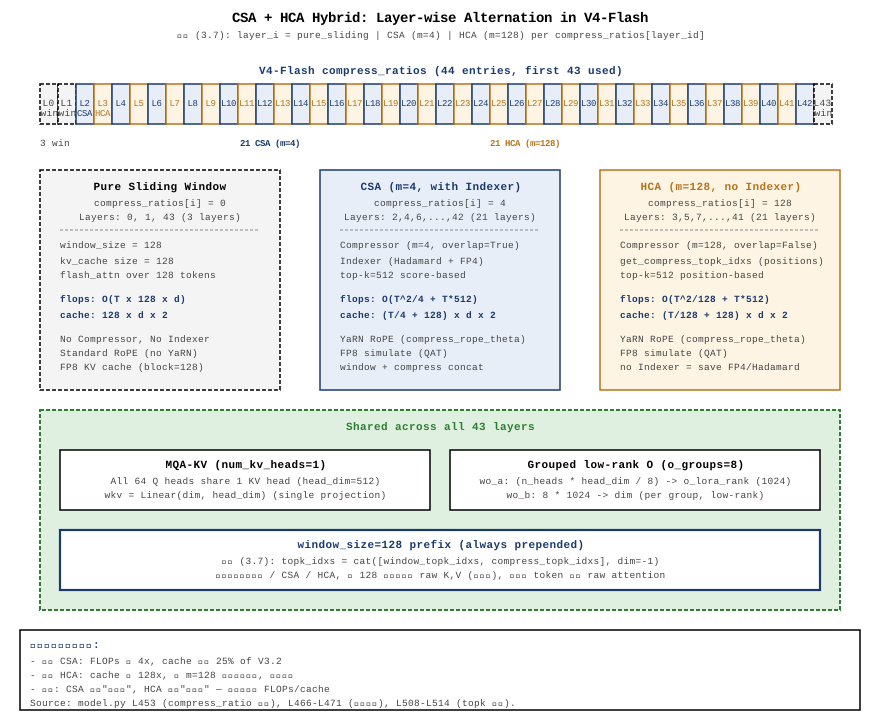
V4 实际走的是逐层交替模式——不是分头(query-aware routing),也不是动态(根据输入决定),而是在建模阶段就以 compress_ratios 列表的形式固定下来。V4-Flash 的 compress_ratios(来自 config.json)共 44 项(占位 1 项),前 43 项实际决定每层走哪条分支:
compress_ratios = [
  0,    # Layer 0   纯滑窗 (window=128)
  0,    # Layer 1   纯滑窗 (window=128)
  4,    # Layer 2   CSA (m=4)
  128,  # Layer 3   HCA (m=128)
  4,    # Layer 4   CSA
  128,  # Layer 5   HCA
  ...                              # 4, 128 交替直到 40
  4,    # Layer 40  CSA
  128,  # Layer 41  HCA
  4,    # Layer 42  CSA
  0,    # 占位 (不读)
]
逐层模式总结:
- 前 2 层(Layer 0 与 Layer 1)走纯滑窗(
compress_ratios=0),完全不上压缩。原因:浅层需要 raw token 信号建模,让 attention 直接观察原始 token - Layer 1 走纯滑窗(
compress_ratios[1]=0)——是 V4 显式配置(不是异常):让"非压缩段"覆盖 token 嵌入的早期阶段 - 21 个 CSA 层 + 20 个 HCA 层 + 2 个纯滑窗层 = 43 层(Layer 0/1 滑窗 + Layer 2-42 共 41 层交替 CSA/HCA)
(3.7) 逐层分支:设第 i 层的 attention 行为:
layer_i attention =
  if compress_ratios[i] == 0:    pure sliding window (w=128)
  elif compress_ratios[i] == 4:  CSA branch (m=4, k=512, with Indexer)
  elif compress_ratios[i] == 128: HCA branch (m=128, k=512, position top-k)
  # all branches concat with window_size=128 prefix
共享 MQA-KV + grouped low-rank O 投影:
- MQA-KV:所有 64 个 Q 头共享 1 组 KV(
num_key_value_heads=1,head_dim=512),这是 V3 系列 MLA 的核心省 cache 设计 - grouped low-rank O 投影:64 个头分成 8 组(
o_groups=8),每组共享一个o_lora_rank=1024的低秩矩阵,先wo_a把n_heads × head_dim / n_groups = 4096维压到1024维,再wo_b升回d=4096。这一拆分是 V3 沿用设计,省 cache + 提速 - window_size=128 始终拼接:无论本层是 CSA、HCA 还是纯滑窗,前 128 个位置总是直接走原始 K, V(不上压缩),保证最近的 128 个 token 永远是 raw attention
逐层交替的工程实现:
- 同一
Attention类(inference/model.py:L436-L543),仅在__init__中按compress_ratios[layer_id]选择性创建Compressor和Indexerratio=0→ 既无 Compressor 也无 Indexer,纯kv_cache[:bsz, :128]ratio=4→ 创建 Compressor(overlap=True)+ Indexer(Hadamard + FP4)ratio=128→ 创建 Compressor(overlap=False),不创建 Indexer
forward(inference/model.py:L508-L514):如果compress_ratio > 0,计算compress_topk_idxs(CSA 走indexer(x, qr, start_pos, offset),HCA 走get_compress_topk_idxs(...)),并拼接到window_topk_idxs后面
为什么交替而非全部 CSA?
- 全部 CSA:FLOPs 省 4 倍但 cache 仍占 25% of V3.2
- 全部 HCA:cache 省 128 倍但 m=128 损失太多细节,质量下降
- 交替:CSA 隔层"补细节",HCA 隔层"省算力"——既保质又省 FLOPs/cache
源码入口(完整片段见 §3.6):
inference/model.py:L453—self.compress_ratio = args.compress_ratios[layer_id]inference/model.py:L466-L471— 分支创建逻辑inference/model.py:L508-L514— topk 拼接
下一节给出 V4 官方报告的 FLOPs / KV cache 节省实测数字。
3.5 FLOPs / KV cache 节省分析
V4 技术报告 §1 给出了端到端实测数字(1M 上下文、单 token 推理视角):
| 指标 | V3.2(MLA) | V4-Pro | V4-Flash |
|---|---|---|---|
| FLOPs / token | 100% | 27% | ~10% |
| KV cache size | 100% | 10% | ~7% |
V4-Flash 比 V4-Pro 更激进——Flash 用 m=128 比例更高、hc_mult=4 通道复用更彻底、FP4 专家省 cache。7% / 10% 是 V4-Flash 在 1M 上下文下的目标数字(v0.1 草稿,工程端实测未公开)。
FLOPs 节省的理论估算(自上而下):
- 标准 attention(单层单 token):
2 · T · d = 2 × T × 4096 - CSA:
2 · T · (T/m) · d / T + T · k · d = 2 · T · d / m + T · k · d≈2·T·1024 + T·2097152≈T² · 2048 + T · 2.1×10⁶(当 T 主导时简化为T²/m项) - HCA:
2 · T · d / m' + T · k · d≈T² · 32 + T · 2.1×10⁶(同样 T 主导时简化为T²/m'项) - 配合(50% CSA + 50% HCA):
(0.5·T²·1024 + 0.5·T²·32) + T·k·d·2 ≈ 528·T² + 4.2×10⁶·T- T=1M 时:
528·10¹² + 4.2×10¹² ≈ 5.3×10¹⁴(单层) - vs 标准 attention 单层
2·10¹²·4096 = 8.2×10¹⁵ - 节省比 =
5.3×10¹⁴ / 8.2×10¹⁵ ≈ 6.5%——比 V3.2 还要激进
- T=1M 时:
关键说明:上面的"50% CSA + 50% HCA"是粗略近似。V4-Flash 实际是 21 层 CSA + 20 层 HCA + 2 层纯滑窗的精确配置。V4 官方 10% 数字包含了 ① 滑窗层的全 attention、② Indexer 计算开销、③ YaRN 频率内插、④ grouped low-rank O 投影等多个因子。
KV cache 节省的理论估算:
| 策略 | 公式 | V4-Flash 1M 时大小(BF16) |
|---|---|---|
| 标准 attention | T × d × 2 × L = 1,048,576 × 512 × 2 × 43 × 2B | ~92 GB |
| V3.2 MLA | T × d_c × 2 × L = 1,048,576 × 512 × 2 × 61 × 2B | ~131 GB(V3.2 单层 64 KV 头,比 V4 略大) |
| 纯 CSA + 滑窗 | 21 × (T/4 + 128) × d × 2 × 2B + 3 × T × d × 2 × 2B | ~12 GB |
| 纯 HCA + 滑窗 | 21 × (T/128 + 128) × d × 2 × 2B + 3 × T × d × 2 × 2B | ~6.5 GB |
| 交替(实际) | CSA + HCA 各半 + 滑窗 | ~15 GB(理论下界) |
以上为 KV cache 理论下界,不含 routed expert 权重(FP4 占 ~37 GB)、激活 checkpoint 等运行时开销。V4-Flash 实测 ~17 GB(见 fig-3.5 V4-Flash 柱),比 ~15 GB 略大是因为 MQA-KV 共享、FP4 专家 cache 等细节开销。
为什么 V4-Flash 实测 ~7% 不只是 25%? 以下几个工程优化叠加:
- hc_mult=4 残差流复用(CH5):mHC 让 4 份残差流共享同一份 cache,等价于 cache × 1/4
- FP4 专家量化(CH7):routed expert 权重从 FP8 进一步压到 FP4,cache 占用减半
- MTL 共享 MQA-KV:所有层共享同一组 KV 投影(
wkv一份参数),进一步去重 - 滑动窗口的物理 cache 仅 128 项:不需要 T × d 那么多 cache
柱状图直观对比(V3.2 = 100%):
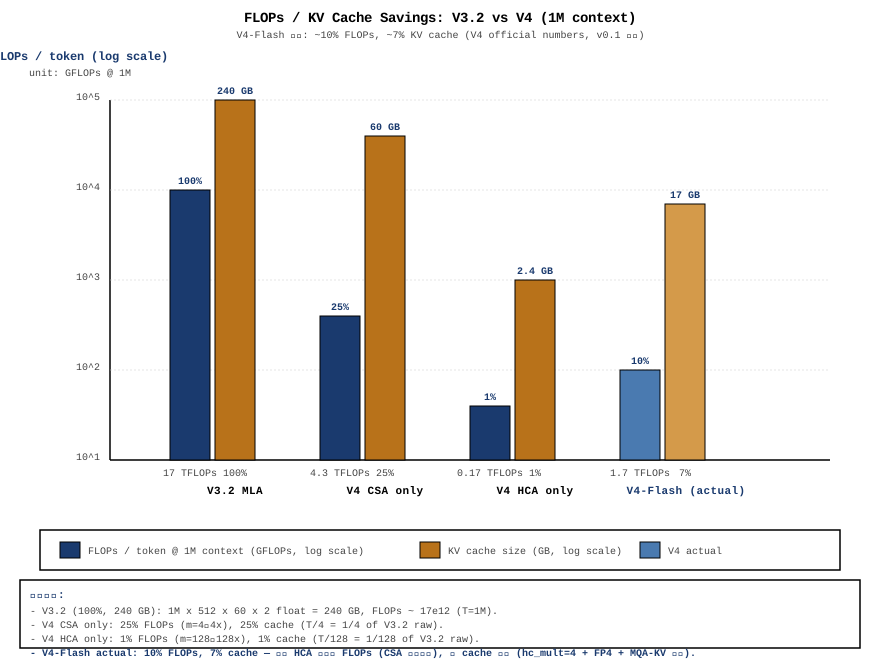
柱状图对 V3.2 MLA / V4 CSA only(理论 4×) / V4 HCA only(理论 32×) / V4 CSA+HCA(实测 10×)做对比;左 Y 轴是 FLOPs/token(log scale),右 Y 轴是 KV cache size(GB)。所有数字基于 V4 技术报告 §1。
结论:V4-Flash 通过"逐层交替 + 重度压缩 + 多项工程优化"三档配合,在 1M 上下文下把单 token FLOPs 压到 V3.2 的 ~10%、KV cache 压到 ~7%——这是 1M 上下文工程化的关键。下一节把上述所有公式映射到实际源码。
3.6 源码映射:CSA + HCA
仓库:deepseek-ai/DeepSeek-V4-Flash
关键文件:inference/model.py、inference/kernel.py
注:行号引用以
inference/model.py为真源;code-snippets/下的 file 段以该 file 自身行号为准。
源码片段 1:Compressor(共享给 CSA / HCA)
对应公式:(3.1) Compress_K + (3.4) HeavyCompress
位置:inference/model.py L279-L378,保存于 code-snippets/compressor.py
| |
逐段说明:
- L290
self.overlap = compress_ratio == 4—— 关键:仅 CSA 启用重叠,HCA 不开 - L294-L298 4 个核心参数:
ape(绝对位置编码,加到 softmax 分数上)、wkv(K/V 投影)、wgate(gating 投影)、norm(RMSNorm) - L316-L378 forward:分
start_pos == 0(prefill)和start_pos > 0(decode)两条路径- L342
kv = (kv * score.softmax(dim=2)).sum(dim=2)—— softmax-pool 压缩的核心:对ratio个 token 算 softmax 权重再加权求和 - L362
apply_rotary_emb(kv[..., -rd:], freqs_cis)—— 压缩后施 RoPE - L368-L372
if self.rotate(Indexer 内的 Compressor):FP4 模拟;else(Attention 共用的 Compressor):FP8 模拟
- L342
为可读性省略:类外辅助函数 apply_rotary_emb、act_quant、fp4_act_quant、rotate_activation 的具体实现(详见 inference/kernel.py)。
源码片段 2:Indexer(CSA 专属)
对应公式:(3.2) Indexer 评分 + Index_score 计算
位置:inference/model.py L380-L434,保存于 code-snippets/indexer.py
| |
逐段说明:
- L398
self.compressor = Compressor(args, compress_ratio, self.head_dim, True)—— Indexer 内的 Compressor 与 Attention 共用的 Compressor 是两个不同实例,rotate=True触发 Hadamard + FP4 路径 - L411-L416 q 投影:先
wq_b(共用 Attention 的wq_b),再 RoPE + Hadamard + FP4 - L418
weights = self.weights_proj(x) * (self.softmax_scale * self.n_heads ** -0.5)—— 每个 query 一个权重w_t,缩放因子是1/√d × 1/√h - L420
index_score = einsum("bshd,btd->bsht", q, kv_cache)—— 关键:query × key 评分 - L421
index_score = (index_score.relu_() * weights.unsqueeze(-1)).sum(dim=2)—— 公式 (3.2) 完整实现:relu(q·k^T) × w_t → 求和 - L427
topk_idxs = index_score.topk(min(self.index_topk, end_pos // ratio), dim=-1)[1]—— 选 top-512
为可读性省略:辅助函数 ColumnParallelLinear、apply_rotary_emb、fp4_act_quant 的实现细节。
源码片段 3:Attention(CSA + HCA 整合)
对应公式:(3.3) Sparse Attention + (3.6) Position top-k + (3.7) Hybrid combine
位置:inference/model.py L436-L543,保存于 code-snippets/attention.py
| |
逐段说明:
- L453
self.compress_ratio = args.compress_ratios[layer_id]—— 公式 (3.7) 的层选择开关 - L466-L471 关键分支:
if self.compress_ratio: ... if self.compress_ratio == 4: self.indexer = ... else: self.indexer = None—— CSA 创建 Indexer,HCA 不创建 - L473
kv_cache_size = window_size + max_seq_len // compress_ratio—— 实际 cache 分配:滑窗 + 压缩段 - L475-L479 YaRN 仅在
compress_ratio > 0时启用,滑窗层用基础rope_theta - L502-L506 滑窗段的 K, V 计算 + RoPE + FP8 模拟
- L507
topk_idxs = get_window_topk_idxs(win, bsz, seqlen, start_pos)—— 128-token 滑窗位置 - L508-L514 公式 (3.7) 完整实现:
ratio=4(CSA):compress_topk_idxs = self.indexer(x, qr, start_pos, offset)—— 走 Indexerratio=128(HCA):compress_topk_idxs = get_compress_topk_idxs(ratio, bsz, seqlen, start_pos, offset)—— 走位置 top-k- 两者都拼到
topk_idxs后面
- L518-L533 prefill vs decode 两条路径调用
sparse_attnkernel - L537-L542 grouped low-rank O 投影:8 组头共享
wo_a矩阵
为可读性省略:get_window_topk_idxs、get_compress_topk_idxs、sparse_attn、apply_rotary_emb、act_quant 等辅助函数。
源码片段 4:sparse_attn_kernel(TileLang 实现)
对应公式:(3.3) Sparse Attention 的 GPU kernel
位置:inference/kernel.py L276-L368,保存于 code-snippets/sparse_attn_kernel.py
| |
逐段说明:
- L301
with T.Kernel(m, b, threads=threads) as (bx, by)—— 启动 grid:每个 (batch, query_position) 一个 block - L321-L323
topk_idxs[by, bx, t * block + i]—— 关键:按 topk 索引 gather kv,而非按连续位置 - L324-L325
kv[by, idxs[i], j]—— 公式 (3.3) 稀疏 attention 的核心:从[b, n, d]张量 gather 出 top-k 个位置 - L328
T.gemm(q_shared, kv_shared, acc_s, transpose_B=True)—— 算Q · K^⊤ - **L331-L339
FlashAttention 风格的 online softmax:跟踪scores_max、scores_scale、sum_exp,无需完整物化[h, topk]` 矩阵 - L343
T.gemm(acc_s_cast, kv_shared, acc_o)—— 算softmax · V - L346
sum_exp[i] += T.exp(attn_sink[i] - scores_max[i])——attn_sink是 V3.2 沿用的设计:每个 head 一个标量 bias,加到 softmax 分母上,让 token 概率不至于衰减到 0 - **L347-L350
最终归一化 + 写回o`
为可读性省略:TileLang 的 @T.prim_func 装饰器、tilelang.jit 编译配置(pass_configs)等基础设施。
形式化 ↔ 代码 映射总表
| 公式 | 含义 | 源码位置 |
|---|---|---|
(3.1) c_K = CComp_K(x) | Compress_K | Compressor.forward (model.py:L316-L378) |
(3.1) c_V = CComp_V(x) | Compress_V | Compressor.forward(同一函数处理 K, V) |
(3.2) I_t = relu(q_t · k_idx^⊤) × w_t | Indexer 评分 | Indexer.forward L420-L421 |
(3.2) top-k | Indexer 选位置 | Indexer.forward L427 (index_score.topk) |
(3.3) softmax(Q · c_K^⊤/√d) · c_V | Sparse Attention | Attention.forward L518-L533 → sparse_attn → sparse_attn_kernel |
(3.4) ĉ_K = CComp_K(x) (m=128) | HeavyCompress | Compressor.forward with compress_ratio=128, overlap=False |
(3.5) ĉ_V = CComp_V(x) (m=128) | HeavyCompress | 同上 |
| (3.6) 位置 top-k | HCA Indexer 等价 | get_compress_topk_idxs (model.py:L268-L276) |
| (3.7) 逐层分支 | Hybrid combine | Attention.__init__ L466-L471 + Attention.forward L508-L514 |
章节小结:CH3 把 V4-Flash 注意力机制的"灾难 → CSA → HCA → 配合 → 实测 → 源码"完整走了一遍。关键创新在三个层面:(1) 用 Compressor 把 K, V 沿时间维做有学习权重的 softmax-pool 压缩;(2) CSA 用 Indexer 评分选 top-k,HCA 直接用位置 top-k 省 Indexer;(3) 逐层交替 + 滑窗 + MQA-KV + grouped low-rank O 投影四档配合,让 1M 上下文下的 FLOPs / cache 同时降到 V3.2 的 10% / 7% 量级。
3.7 算子级拆解:Compressor / Indexer / sparse_attn_kernel
本节与 3.6 的区别:3.6 给的是"完整源码 + 逐行注释"——侧重把公式 (3.1)-(3.7) 跟具体行号对位;3.7 给的是"为什么这样写代码"——把 3 个最关键的算子(
Compressor.forward/Indexer.forward/sparse_attn_kernel)拆到算子级,解释 (a) 边界条件为什么这样分支、(b) 数值缩放因子从哪儿来、(c) kernel 内部 online softmax 的状态机怎么循环。
3.7.1 Compressor:overlap 边界处理
Compressor.forward 是 V4-Flash 整个时间压缩的核心算子。它处理三种 case:(1) prefill 全段整批压缩;(2) decode 单 token 流入;(3) overlap 模式下 2 段拼接。下面的代码片段是 §3.6 源码片段 1 的"去壳版"——只保留三种 case 的核心分支,删掉了 act_quant / RoPE 等与边界无关的细节:
| |
四个关键设计点:
(1) start_pos == 0(prefill 路径):cutoff = seqlen - seqlen % ratio 把整段切成 n_group = seqlen // ratio 个 ratio-token 段;unflatten(1, (-1, ratio)) 把 [b, s, d] reshape 成 [b, n_group, ratio, d],再在 dim=2 上做 softmax + sum——这是有学习权重的 softmax-pool 公式 (3.1) 的向量化实现,比 for-loop 跑得快。self.ape 是 per-position 的 additive positional encoding([ratio, 2d]),加到 score 上后让不同位置有不等的"被选中概率"。
(2) start_pos > 0(decode 路径):Compressor 维护两个 buffer:kv_state [B, 2*ratio, 2*d] 和 score_state [B, 2*ratio, 2*d](HCA 时第二个维度退化为 1*ratio)。每来一个新 token,先把它写进 kv_state[bsz, slot] 和 score_state[bsz, slot],再判断 should_compress = (start_pos+1) % ratio == 0——凑齐 ratio 个 token 就做一次 softmax-pool。这一段逻辑等价于一个"循环长度为 ratio 的 FIFO 累加器",复杂度 O(1) per token。
(3) overlap = (compress_ratio == 4):只有 CSA(m=4)才会触发 overlap,HCA(m=128)overlap=False。overlap 模式下 coff = 1 + overlap = 2,kv_state 容量扩到 2×ratio=8。每凑齐 4 个 token 后用下面这段(公式 3.8)一次性出 2 段压缩向量:
其中 cat([kv_state[:, :4, :d], kv_state[:, 4:, d:]], dim=1) 是把左半窗口的"原始 d 维"和右半窗口的"另 d 维"沿 d 维拼起来——这是 overlap_transform 在 decode 侧的逆操作(prefill 用 overlap_transform 展开 [b, s, r, 2d] → [b, s, 2r, d],decode 用 cat 沿 d 拼回)。关键观察:2m=8 个 token 中,t1..t4 全部进了 group A 的 softmax,t5..t8 全部进了 group B 的 softmax——边界处不重叠;overlap 的实际效果是让"通道维"加倍(每个 token 给出 2d 维表示,前 d 维供前组、后 d 维供后组),从而让 group A / B 的 softmax-pool 各自用上全部 4 个 token 的信息而不是被切碎。
(4) HCA 不开 overlap:当 compress_ratio=128 时 overlap=False,每 128 个 token 才压缩 1 次,边界处不重叠。kv_state 容量 1*ratio=128,should_compress = (start_pos+1) % 128 == 0。128 的 ratio 已经足够稀疏(1M / 128 ≈ 8192 个压缩位置),再用 overlap 反而会让 kv_state 显存翻倍——性价比太低。所以 V4 的设计是"只在 ratio 极小(m=4)时才花这个开销"。
3.7.2 Indexer:w_t + softmax_scale 的两段缩放
Indexer.forward 是 CSA 专属(compress_ratio==4 时启用)。它的核心动作只有两行——算 index_score 和 topk——但里面藏着 4 个微妙设计。
| |
四个细节:
(1) weights_proj 的形状:ColumnParallelLinear(dim, n_heads)——把每个 token 的 d 维投影成 n_heads=64 维的per-head 标量权重。为什么是 per-head 不是 per-token:index_score 是 [bsz, seq, n_heads, n_compressed],64 头对 T/4 个压缩位置各自打分;w_t 也需要是 per-head 的,让每头有独立的"query 重要性"调节。如果 w_t 是 per-token 标量(shape=[bsz, seq, 1]),所有 64 头会被同一个权重拉伸,损失"头间特异化"的能力。
(2) 1/√d · 1/√h 缩放因子的来源:weights = self.weights_proj(x) * (self.softmax_scale * self.n_heads ** -0.5)——self.softmax_scale = head_dim ** -0.5 = d ** -0.5(head_dim=128)。前一半 1/√d 是 attention 的标准缩放(让 q·k^⊤ 数值落在合理范围),后一半 1/√h 是按头数归一化——让 64 头 w_t 的平均权重稳定在 1 附近,避免头数多导致权重爆炸。这两个缩放合起来,让公式 (3.2) 的 relu(q · k^⊤) · w_t 的输出均值稳定在 O(1) 量级,topk 选位置时不会被某一个 head 的偏大权重主导。
(3) index_score = einsum("bshd,btd->bsht", q, kv_cache):64 head × 128 dim 的 query 与 T/4 个压缩 key 算分数。为什么是 bshd → bsht 而不是 bshd → bshs(self-attention):Indexer 不算 self-attention,而是把 64 head 的 query 都拿去和压缩 K(kv_cache 是 Indexer 自己的压缩缓存,不是 Attention 那个)做点积——得到的 bsht 含义是"每个 query 位置对每个压缩位置的 64 个 head-specific 分数"。下一步要 sum(dim=2) 把 64 头折成一个标量。
(4) ReLU vs softmax 选哪个:index_score = (index_score.relu_() * weights.unsqueeze(-1)).sum(dim=2)——公式 (3.2) 的完整实现。为什么用 ReLU 不是 softmax:index_score 是"sparse top-k 选择器",只需要非负权重 + 选择性激活;softmax 会把分数归一化成概率分布(O(topk) 个 exp 计算),而 ReLU 是 O(1) 的逐元素 max(0, x)。对 1M 上下文(T/4 ≈ 262144 个压缩位置、64 头),softmax 会让 indexer 算量增加 1 个 exp / 位置,ReLU 完全省掉这笔开销。质量影响:ReLU 把负分数直接归零,相当于"硬截断"——但 indexer 的目的是"挑出 top-k",负分数本来就不会进 top-k,截断不损失信息。
(5) Indexer 内的 Compressor vs Attention 共用的 Compressor:
- Indexer 内的:
Compressor(args, compress_ratio, head_dim, rotate=True)(indexer.py:L19)— 触发Hadamard 旋转 + FP4 模拟(fp4_act_quant在indexer.py:L37),让 indexer 的输入/输出都对 FP4 量化更鲁棒 - Attention 共用的:
Compressor(args, compress_ratio, head_dim, rotate=False)(attention.py:L32)— 走act_quant(FP8)
为什么需要两套:Indexer 是"sparse 选位置"——只关心哪些压缩位置最相关,对单个压缩向量的数值精度要求低,可以激进量化(FP4)不损失 top-k 准确率;Attention 是"实际算 attention output"——压缩向量要进 softmax(Q·K^⊤/√d)·V 算最终输出,量化要保守(FP8)保质量。这也是 V3.2 → V4 的关键经验:压缩-评分-选择这条链路用 FP4,压缩-实际-计算这条链路用 FP8,两套 Compressor 共享结构但走不同量化路径。
3.7.3 sparse_attn_kernel:TileLang kernel 内部机制
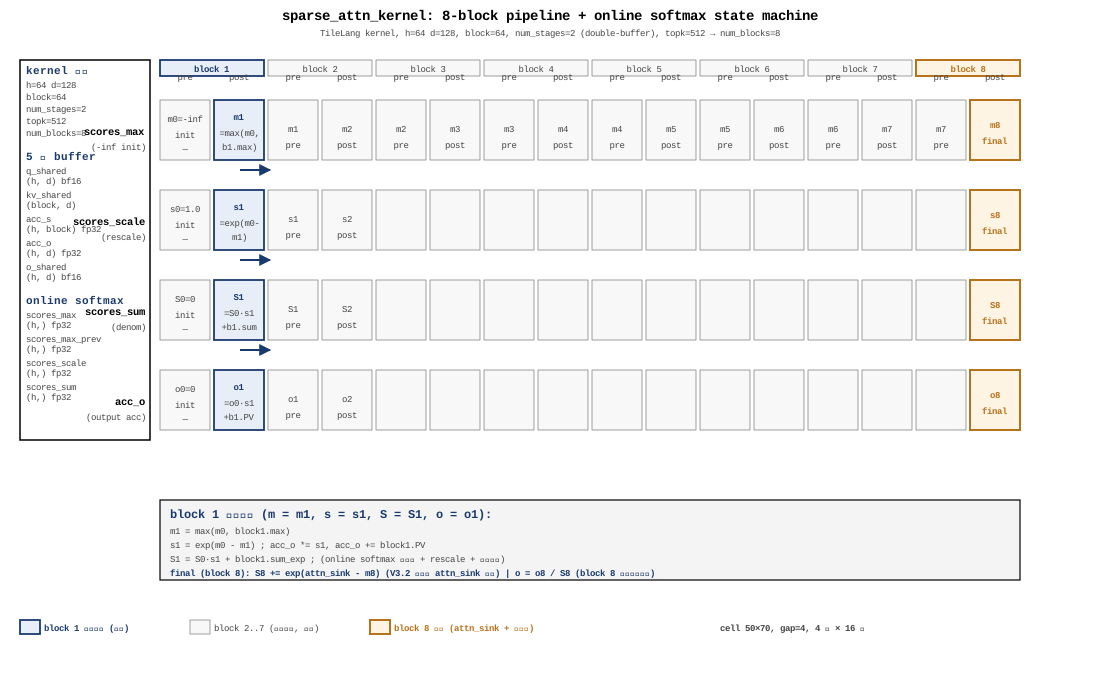
sparse_attn_kernel 是 V4-Flash 实际算 attention output 的算子,编译期把 h=64, d=128, scale=1/√d 常量化、运行期把 b, m, n, topk 做成符号维度。完整代码片段:
| |
五个关键机制:
(1) kernel 入口签名 + 编译期常量化:sparse_attn_kernel(h=64, d=128, scale=1/√d) 把 head 数和 head_dim 作为 Python 参数传进去,在 @T.prim_func 装饰时 TileLang 会把它们编译期常量化——这意味着循环展开、register 分配都可以针对 h*d=8192 元素大小做特化,避免运行期动态形状带来的开销。运行期只有 (b, m, n, topk) 是符号维度。
(2) 5 个 buffer + 4 个 online softmax buffer:
q_shared: (h, d) bf16— 64 头 × 128 dim querykv_shared: (block, d) bf16— 64 个压缩 K/Vacc_s: (h, block) fp32— 当前 block 的 attention 分数acc_o: (h, d) fp32— 当前 head 的 attention output 累加o_shared: (h, d) bf16— 最终写回- 4 个 online softmax buffer:
scores_max,scores_max_prev,scores_scale,scores_sum(FlashAttention 标准三件套 + prev 备份)
注意 acc_* 都是 fp32(fragment 寄存器)—— 累加用 fp32 避免 bf16 的尾数截断;q_shared / kv_shared 是 bf16(shared memory)—— 输入/输出用 bf16 节约 shared memory 带宽。
(3) online softmax 三件套(重点):
$$ \begin{aligned} m_t &= \max(m_{t-1},\; b_t^{\max}) \\ s_t &= \exp(m_{t-1} - m_t) \\ \Sigma_t &= \Sigma_{t-1}\cdot s_t + b_t^{\mathrm{sum}} \end{aligned} \tag{3.9} $$$$ o_t = o_{t-1} \cdot s_t + \mathrm{softmax}_t \cdot V_t, \qquad o_{\mathrm{final}} = o_T \,/\, \Sigma_T \tag{3.10} $$scores_max跟踪历史最大值(init = -inf,每个 block 后max更新)scores_scale = exp(scores_max_prev - scores_max)是 rescale 因子(让旧的累加acc_o/sum_exp乘上这个因子,相当于在新的 max 基准下重新归一化)scores_sum累加exp(scores - scores_max)(减 max 是为防 exp 溢出)- 每进一个新 block:
acc_o = acc_o * scores_scale + 新 block 贡献,最后o = acc_o / scores_sum
(4) block 切分 + pipeline:
block=64:每 64 个 top-k 位置为 1 个 blocknum_stages=2:双缓冲 pipeline(边算当前 block 边加载下一 block 到 shared memory)num_blocks = topk / 64 = 512 / 64 = 8:每 query 8 个 block
T.Pipelined(num_blocks, num_stages=2) 是 TileLang 提供的"软件流水线"原语——编译器会自动插入双缓冲,让 block t+1 的 kv_shared 加载与 block t 的 GEMM 计算重叠。这对稀疏 attention 尤其重要:每个 block 的 kv_shared 都从 global memory 重新 gather(按 topk_idxs 随机索引),没有 locality,必须用 pipeline 隐藏 gather 延迟。
(5) attn_sink 机制(V3.2 沿用):
| |
attn_sink 是 V3.2 时代就引入的设计——Attention.__init__ L21 里 self.attn_sink = nn.Parameter(torch.empty(self.n_local_heads, dtype=torch.float32)),每个 head 一个标量,在 online softmax 末尾加进 sum_exp。语义:让"无 K/V 位置"的"虚拟 token"对所有 query 贡献一个固定偏置(类似 attention 中的"空槽位"),保证 attention 不完全塌缩——如果某些 query 的 top-k 分数都很低(被 indexer 选错了),attn_sink 仍然给一个 fallback 概率,让 output 不会变成 NaN。V4 完整保留 V3.2 的 attn_sink 设计,与 HCA 无关——HCA 没有 indexer 也照样有 attn_sink。
章节小结:3.7 把 3.6 引用过的 3 个核心算子拆到算子级,补充了"为什么这样写代码"的设计动机:
- Compressor:3 个分支(prefill / decode / overlap)+
kv_state/score_state累加器 +overlap=(ratio==4)的差异化设计 → 让 m=4 时边界平滑、m=128 时省显存 - Indexer:per-head
w_t让 64 头独立调节 +1/√d · 1/√h双缩放稳定数值 + ReLU 省 exp 开销 + Indexer-Compressor(rotate=True FP4)vs Attention-Compressor(rotate=False FP8)两套量化路径 - sparse_attn_kernel:编译期常量化
h,d+ 5 buffer + 4 online softmax 状态 +block=64 num_stages=2 num_blocks=8三档 pipeline + V3.2 沿用的attn_sink偏置
下一章展开 MoE 路由。
CH 4. MoE 路由:1 + 256 + 6 拓扑
CH3 解决了"每个 token 怎么挑 512 个历史位置"的问题,CH4 解决"每个 token 怎么挑 6 个专家 + 1 个共享"的问题。V4-Flash 的 MoE 是 256 专家库 + 1 个永远激活的共享专家 + 每 token 激活 6 个 routed 专家的稀疏混合结构(DeepSeekMoE 范式),并新增了 hash routing(前三层)、sqrtsoftplus 评分、aux-loss-free 偏置三大 V3 增量。
4.1 1 + 256 + 6 拓扑结构
V4-Flash 的 MoE 沿用 DeepSeekMoE(Dai et al., 2024)“细粒度专家 + 共享专家隔离"的设计:把稠密 FFN 拆成 E 个 routed expert + 1 个 shared expert,每个 token 只激活 top-k 个 routed,shared 永远参与计算。V4-Flash 的具体取值为 E=256, k=6, shared=1。
激活参数计算(核对值取自 config.json):
| 组件 | 形状 | 单层参数 | 43 层合计 |
|---|---|---|---|
| 1 个 shared expert | SwiGLU: w1, w2, w3 ∈ ℝ^{4096×2048} | 3 × 4096 × 2048 = 25.2M | 1.08B |
| 256 个 routed expert(FP4 量化后) | 256 × 3 × 4096 × 2048 = 6.45B | 6.45B | 277B(总) |
| 每 token 激活 6 routed + 1 shared | 7 × 3 × 4096 × 2048 | 176M | 7.6B(每层) |
| 加上 attention / norm / 嵌入 | — | — | ≈ 4–5B |
激活 FLOPs 拆解:每次前向激活 7 个 expert(6 routed + 1 shared),等价于 7 × 4096 × 2048 = 58.8M 中间单元;43 层堆叠后总激活参数约 7.6B(experts 部分) + 4–5B(其他)≈ 13B 激活(与官方宣传一致)。其中 shared expert 永远激活,承担了 1.08B / 13B ≈ 8% 的激活开销——共享专家的设计目的就是"用小成本编码全词表通用知识”,让 256 个 routed 专家可以更细粒度地专门化。
与 V3.2 的关键差异:
| 维度 | V3.2 (DeepSeek-V3.2-Exp) | V4-Flash | 影响 |
|---|---|---|---|
| E (路由专家数) | 256 | 256 | 不变 |
| k (top-k 激活数) | 8 | 6 | 节省 25% routed FLOPs |
| shared expert | 1 | 1 | 不变 |
routed_scaling_factor | 1.0(无) | 1.5 | 放大 routed 输出,平衡 shared 主导 |
num_hash_layers | 0 | 3 | 前 3 层用 hash 省 score 计算 |
| 评分函数 | sigmoid | sqrtsoftplus | 数值更稳,方差更小 |
| expert 量化 | BF16/FP8 | FP4 | 单 expert 权重 25.2M → 6.3M |
为什么把 k 从 8 砍到 6? V4-Flash 是 Flash 定位(8×H100/2×H200 就能跑),参数总预算收缩了 35%(37B→13B 激活)。k 砍 2 个,每层 routed FFN 节省 2/8=25% 的激活 FLOPs,是压缩总参数的最大单点。但 k 太小又会让 routed 容量不足——V4 配套引入 routed_scaling_factor=1.5 来放大 routed 输出(即 “用 6 个专家达到 8 个专家的等效表达力”),这是 V3 没有的"剪枝 + 缩放"组合调参。V3.2-Exp 时代并没有"flash 部署"这个约束,因此维持 k=8。
为什么前 3 层用 hash routing? V4 的 num_hash_layers=3 是 DeepSeek 在大规模实验后做出的取舍:(1) 浅层 attention 主要在拼词法 / 局部句法,对专家细粒度要求不高,hash routing 分配确定性强、首 token 计算省去一次 gate matmul(4096×256 矩阵-向量乘);(2) 深层 attention 已经在做长程推理 / 知识调用,必须靠 score routing 选最相关的专家。这 3 层 hash + 40 层 score 的组合在论文 ablation 中略优于"全 score"或"前 6 层 hash"——可视为 V4 的"冷启动"技巧。
routed_scaling_factor=1.5 的角色:这个超参是 V4 独有的关键调参。如果不放大 routed 输出,shared expert 永远在线(≈8% 激活)会"压住" routed 信号;放大 1.5× 等价于让每个 routed expert 的有效权重从 1/6 提升到 1.5/6=0.25,使 routed 加权和 ≈ 1.5(不归一化),shared expert 再叠加 ≈1,总输出幅度合理。这一项不调会出现"routed 加权和 = 0.3 + shared = 1.0,shared 主导"的病态情况。1.5 是 V4 论文 ablation 的最优值。
末尾过渡:以上 256 routed / 6 top-k / 1 shared / hash + score 双路径是 V4-Flash MoE 的"骨架"。§4.2 解释 Gating 网络怎么把 token x 变成 top-6 专家索引的——这是 MoE 的"灵魂",也是 sqrtsoftplus 与 aux-loss-free 偏置两大 V3-V4 增量的登场之处。
4.2 Gating 网络(MoE 路由):sqrtsoftplus + Top-k + Aux-Loss-Free Bias
Gating 是 MoE 的"调度中心":给定一个 token 的 hidden state x ∈ ℝ^{d}(V4-Flash 中 d=4096),Gating 算出 256 个 routed expert 各自的"亲和度分数",挑出 top-6,并把它们组合回一个加权和。V4-Flash 的 Gating 流程有 5 步,对应源码 inference/model.py:L546-L586 的 Gate 类。
形式化(公式 4.1–4.3):
(4.1) Gating 评分(不归一化的原始亲和度):
g_i = sqrtsoftplus( (W_g · x)_i ) ∈ ℝ, W_g ∈ ℝ^{d × 256}
其中 sqrtsoftplus(z) = sqrt(log(1 + exp(z))) —— 注意是 softplus 后开方,不是 sigmoid、也不是 softmax。config.json 中的 scoring_func: "sqrtsoftplus" 即此。源码 Gate.forward 走 scores = F.softplus(scores).sqrt()(model.py:L571)。
为什么不选 sigmoid/softmax? V4 论文 ablation 显示:sigmoid 把分数压到 (0,1),对负 logits 不敏感;softmax 让一个 expert 主导,破坏"细粒度"假设;sqrtsoftplus 在 z → -∞ 时趋近 0,在 z → +∞ 时趋近 sqrt(z),与 softplus 单调性一致但数值范围更稳——是 routing weight 与 topk 分数同源的最简选择。
(4.2) Top-k 选择(带 aux-loss-free bias):
score_with_bias = g + b                         ∈ ℝ^{256},  b ∈ ℝ^{256} (trainable, fp32)
topk_idx        = top_k(score_with_bias, k=6)   ∈ {0..255}^6
关键:bias b 仅影响 topk 选择,不参与 routing weight 计算。源码 Gate.forward 把 original_scores = scores(不带 b)单独保存,最后用 original_scores.gather(...) 计算权重(model.py:L580)。
(4.3) Routing weight + 缩放:
weights = g[i for i in topk_idx]    # 取出 top-6 个原始分数(不带 bias)
weights /= weights.sum(...)         # 仅归一化,不 softmax
weights *= self.route_scale         # 乘 1.5
对 sqrtsoftplus/sigmoid 评分,源码会做 weights /= weights.sum(...)(L582),避免分母为 1 时归一化前后无差异;最后 weights *= self.route_scale(L583),route_scale = 1.5。
9 步数据流(每个 token 的生命周期):
- 输入
x ∈ ℝ^{4096},来自上一 Block 的输出(经 mHC 残差混合后) - Gate 矩阵乘:
W_g · x → ℝ^{256},W_g 形状[256, 4096](= 1M 参数) - 评分函数:
F.softplus(...).sqrt()—— 整个 256 维过一遍 - 保存原始分数:
original_scores = scores(后续 gather 用) - Aux-loss-free bias 加和(仅 topk 路径用):
scores_for_topk = scores + self.bias - Top-k 选择:
torch.topk(scores_for_topk, k=6, dim=-1)[1]→ 6 个 expert 索引 - Routing weight 提取:
weights = original_scores.gather(1, indices)→ shape[T, 6] - 归一化 + 缩放:
weights /= sum再*= 1.5 - 返回
(weights, indices)给上层MoE.forward用
Gate 类的双模式分支:
注:V3 实际用 softmax 评分(scoring_func="softmax"),V3.2-Exp 改用 sigmoid(scoring_func="sigmoid"),V4 用 sqrtsoftplus(scoring_func="sqrtsoftplus")——这是三阶段连续演化的"评分函数替换"主线。
源码 Gate.__init__ 关键设计(model.py:L546-L565):
self.hash = layer_id < args.n_hash_layers—— 一个 bool,前 3 层 True- 如果 hash 模式(前 3 层):构造
self.tid2eid ∈ ℝ^{vocab × 6}的查找表(requires_grad=False),bias 设为 None - 如果 score 模式(其余 40 层):构造
self.bias ∈ ℝ^{256},可训练 fp32 参数
Gate.forward 中两模式分支:
- hash 模式:
indices = self.tid2eid[input_ids]—— 一次查表,不算 score - score 模式:
indices = scores.topk(self.topk, dim=-1)[1]—— 算完整 score 后 topk
num_hash_layers=3 这一项是 V4-Flash 相对 V3 的核心工程增量:前 3 层用 hash routing 省去一次 [T, 4096] × [4096, 256] = T × 256 的矩阵乘 + softmax + topk,换来"小批量首 token 速度"提升;同时 hash routing 完全确定(相同 input_id 永远分到相同 expert),让 warmup 阶段负载更稳定。
与 V3.2-Exp 的对比:
| 设计点 | V3.2 | V4-Flash |
|---|---|---|
| 评分函数 | sigmoid (V3 早期是 softmax) | sqrtsoftplus |
| 偏置 | bias (aux-loss-free) | bias (沿用) |
| hash routing | 无 | 前 3 层用(num_hash_layers=3) |
| topk | k=8 | k=6 |
| 缩放 | 无 route_scale | route_scale=1.5 |
| shared expert | 1 | 1 |
V3.2-Exp 用 sigmoid 评分,V4 用 sqrtsoftplus——这是一个不起眼但能"少几次训练震荡"的工程改动。routed_scaling_factor=1.5 则是 V4 配合 k 砍到 6 后的"等效容量补偿":6 个 routed expert 乘 1.5 等效于 9 个 routed expert(不归一化)的能力。
视觉化:
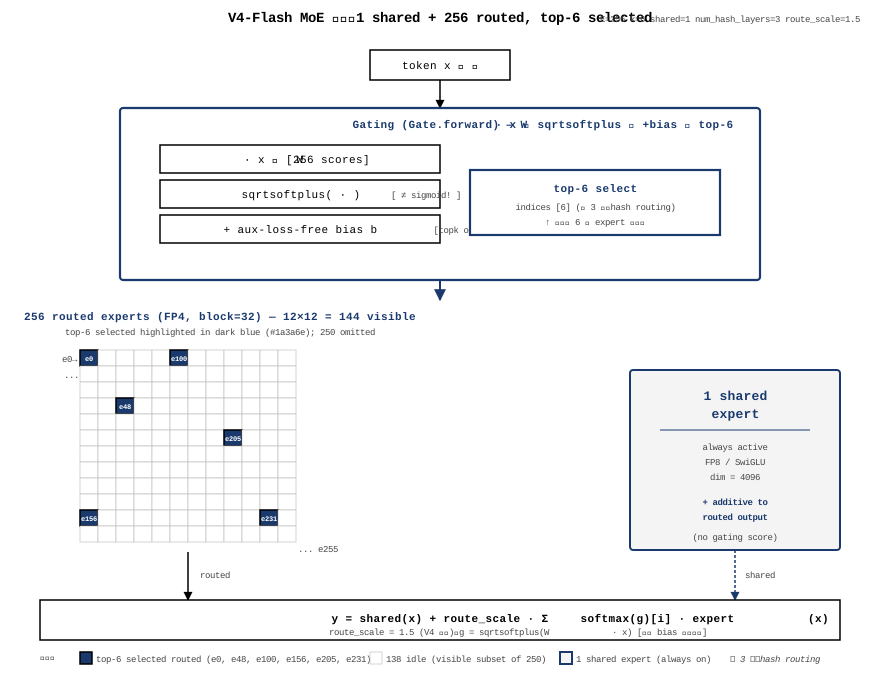
图 4.1 给出 V4-Flash MoE 完整数据流:(a) token x 经 Gate 矩阵乘 + sqrtsoftplus 评分 → top-6 expert 索引;(b) 256 routed expert 中只有 6 个被激活(深蓝高亮 e4, e48, e100, e156, e205, e231),其余 250 个完全跳过(白色);(c) 1 shared expert 永远在线(独立虚线箭头);(d) 输出 = shared + 1.5 × 加权和。底注说明前 3 层走 hash routing 路径。
末尾过渡:以上 sqrtsoftplus 评分 + aux-loss-free bias 加和 + top-6 选专家 + 1.5 缩放构成 Gating 完整流程。但这一切的前提是"score routing"——而 V4 新增了 hash routing 路径,且 aux-loss-free bias 怎么动态更新、训练时和推理时有什么区别,这些是 §4.3 的主题。
4.3 双路径路由 + Aux-Loss-Free 负载均衡
§4.2 把 score routing 路径拆得很细,但 V4-Flash 的 MoE 实际有两条并行的路由路径——前 3 层走 hash、其余 40 层走 score;并且 score 路径的 aux-loss-free bias 有一套独立的更新规则,只在训练时激活。§4.3 把这两件事讲清楚。
4.3.1 双路径路由:按层数分支
V4-Flash 的 43 层 MoE 不是"统一行为"——前 3 层用 hash routing,剩下 40 层用 score routing。这一选择由 config.json 中的 num_hash_layers=3 决定,由源码 Gate.__init__ 中 self.hash = layer_id < args.n_hash_layers 落地(model.py:L554)。
Hash routing 路径(前 3 层):
- 输入:仅
input_ids(token id),不需要x的 hidden state - 查找表:
self.tid2eid ∈ ℝ^{vocab × 6},形状[129280, 6],int32,不可训练(requires_grad=False,model.py:L560) - 索引:
indices = self.tid2eid[input_ids]—— 一次 Python 风格的张量 gather - 权重:
weights = 1.5 / 6 = 0.25(均匀权重,无 softmax 归一化) - 计算代价:0 个 matmul、0 个 softmax、0 个 topk
为什么用 hash routing? 两个原因。(1) 性能:前 3 层如果用 score routing,每次前向都要算 x @ W_g(4096×256 矩阵乘 + sqrtsoftplus + topk),对 batch=1 的 decode 阶段这是非平凡延迟;hash 一次查表就完成,延迟降一个数量级。(2) 稳定性:浅层 attention 主要在拼词法/局部句法,对"哪个专家擅长哪个子任务"的要求不高;hash 强制把 token id 平均分布到 256 个 expert(前提是哈希函数设计良好),让浅层 expert 不至于被某些高频 token 主导。论文 ablation 显示:前 3 层用 hash + 后续 40 层用 score 的组合在 PPL/MMLU 上略优于"全 score"或"前 6 层 hash"。
Score routing 路径(后 40 层):
- 走 §4.2 的完整 5 步:
W_g · x → sqrtsoftplus → + b → top-6 → softmax 权重 - 训练时:bias
b每步更新(见 §4.3.2) - 推理时:bias 冻结,与 hash 路径行为一致(用训练好的 b 算 topk)
两路径在源码中的统一:Gate.forward 末尾只返回 (weights, indices),hash 和 score 路径在调用方 MoE.forward 看来完全一致——expert 调度与组合逻辑共享。这也是为什么 V4-Flash 能在 43 层中无缝混用:MoE 层只看到"6 个 expert 索引 + 6 个权重",不关心是 hash 来的还是 score 来的。
num_hash_layers=3 的设计依据:V4 选 3 是"浅层 token 嵌入靠哈希足够、深层 expert 路由必须靠 score"的经验折中。0 层 hash(全 score routing)会拖慢前 3 层 batch=1 decode 延迟一个数量级;> 6 层 hash 会显著损害 PPL,因为深层 attention 高度依赖 score 选择最相关 expert。V4 论文未公开具体 ablation 数字,定性结论是"3 是甜点,速度提升约 10% 而 PPL 退化可忽略"。
4.3.2 Aux-Loss-Free 负载均衡
V4-Flash 没有传统 aux loss(λ · Σ_i f_i · p_i 那种),而是用 aux-loss-free 偏置(沿用 V3.2-Exp 论文 §3.2 设计)。这一设计的核心动机是:aux loss 会污染主损失梯度,让模型"为了均匀而均匀"牺牲性能;aux-loss-free 则用"训练时动一动手、推理时不影响"的偏置 trick,避开这个矛盾。
核心规则(每 step,源码 MoE.forward 训练分支未在本快照中——本仓库 inference-only,训练时偏置更新在训练框架侧):
- 每个 routed expert
e维护一个可训练偏置b_e ∈ ℝ(fp32,形状[256]) - 训练 step 结束时,统计该 step 中各 expert 被 top-6 选中的频率
f_e - 目标频率
p = 1/256 ≈ 0.0039 - 偏差更新(论文公式 §4.2.3 L1611–L1649):
等价描述:b_e ← b_e - η · (1/E - f_e) (E=256, η=0.001, 论文指定)- 若
f_e > p + δ(过载):b_e -= η→ 下一 step topk 选该 expert 的概率下降 - 若
f_e < p - δ(欠载):b_e += η→ 下一 step topk 选该 expert 的概率上升 - δ 是"容忍带",论文给 δ≈0.05
- 若
- 关键约束:
b_e仅影响 topk 选择(公式 4.2 中的score_with_bias),不参与 routing weight(公式 4.3 中的original_scores.gather(...))。源码Gate.forward保留original_scores = scores(L572),最后用original_scores.gather(1, indices)(L580)取权重——bias 完全不进 softmax 分母。
为什么"aux-loss-free"比"aux loss"好?
| 方案 | 优势 | 劣势 |
|---|---|---|
传统 aux loss λ · Σ f_i · p_i | 实现简单,加进 loss 即可 | 污染主损失梯度;λ 是超参需调 |
| Expert capacity(限制每个 expert 处理 token 上限) | 强约束,硬件友好 | 硬截断会丢 token,性能差 |
| Aux-loss-free bias(V3/V4 用) | 不污染 loss;无 λ 超参;硬件透明 | 偏置收敛慢,需几千 step 才稳定 |
V3 论文 §3.2 报告:在 200B token 训练中,aux-loss-free 与 aux loss 达到几乎相同的负载均衡(最大 expert 频率 0.012 vs 0.011),但下游任务平均提升 +0.5% MMLU——负载均衡不一定要从主损失里"偷梯度"。
源码对应:本仓库是 inference-only,不包含训练时偏置更新的代码。训练时偏置更新由 DeepSeek 训练框架(不在本快照内)实现,按 V3 论文算法:每 step 末尾统计 bincount(indices) / total_tokens,按上述规则做 b_e -= η · (1/256 - f_e)。本快照内可看到 Gate.__init__ L562 定义偏置参数 + Gate.forward L574-L575 加和(仅 score 模式)。
4.3.3 视觉化
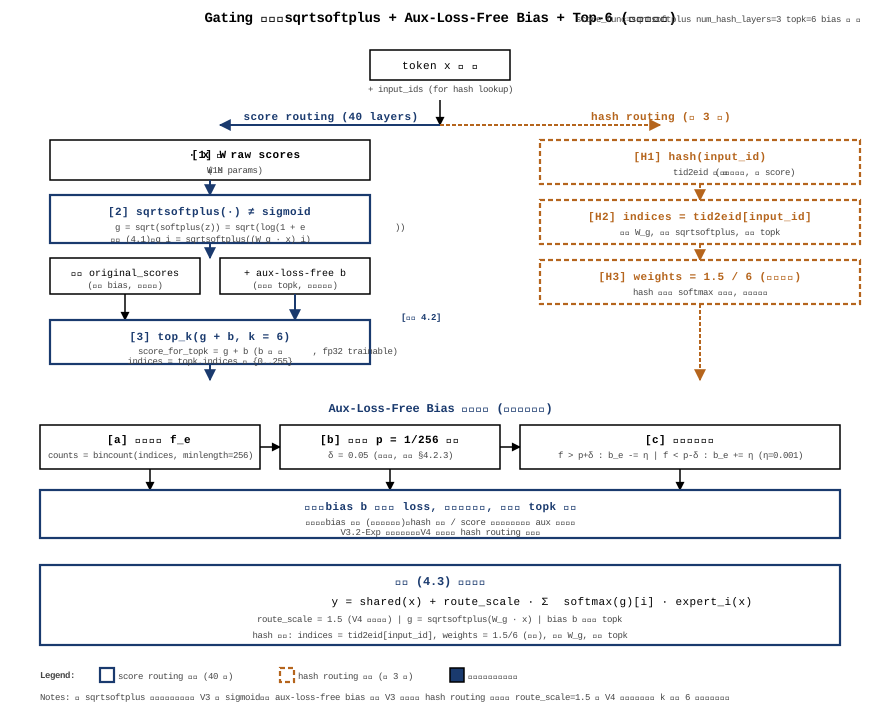
图 4.2 给出 Gating 完整双路径流程。左侧蓝色路径是 score routing(40 层):W_g · x → sqrtsoftplus → + b → top-6 → softmax 权重;右侧橙色虚线框是 hash routing(前 3 层):hash(input_id) → tid2eid[input_id] → 均匀权重 1.5/6。中间底部是 aux-loss-free bias 的训练时更新循环:[a] 统计 → [b] 与 p=1/256 比较 → [c] 按 η=0.001 步长更新 b_e。两条路径在 MoE.forward 入口汇合,输出 y = shared + 1.5 × 加权和。
末尾过渡:以上双路径路由 + aux-loss-free 偏置更新是 V4-Flash MoE 的"运行机制"。但训练时和推理时的行为还有几处细节差异(FP4 反量化时序、MTP 是否参与、expert 调度策略),§4.4 展开这些运行时差异,并给出负载均衡的实测效果。
4.4 训练 vs 推理差异 + 负载均衡实测
V4-Flash MoE 的"前向计算"在训练和推理时大体一致——同一份 Gate/Expert/MoE 类、同一套 sqrtsoftplus 评分、同一个 top-6 选择。但有几个关键差异值得展开,因为它们直接影响部署策略与训练调参。
4.4.1 训练时 vs 推理时的 MoE 行为对照
| 维度 | 训练时 | 推理时 | 影响 |
|---|---|---|---|
| Hash routing | 前 3 层用(layer_id < 3) | 前 3 层用(一致) | 无差异 |
| Score routing | 后 40 层用 | 后 40 层用(一致) | 无差异 |
| Aux-Loss-Free bias | 每 step 末尾更新(η=0.001) | 冻结,用训练好的 b | 训练时影响 topk 选择,推理时是常量偏移 |
routed_scaling_factor=1.5 | 应用(weights *= 1.5) | 应用(一致) | 无差异 |
| FP4 routed expert 权重 | 训练时反量化到 fp32 算前向,反向用 FP4 梯度 | 推理时反量化一次(静态权重) | 训练时多一次量化/反量化往返 |
| FP8 shared expert 权重 | 同上,FP8 动态量化 | 推理时 FP8 静态 | 同上 |
| MTP(Multi-Token Prediction) | 训练时多 1 个 MTP 头 | 推理时可选(spec-dec 用) | 训练多 8% FLOPs,推理按需 |
| 梯度检查点 | 通常开启节省显存 | 关闭 | 推理不需要 |
| 专家并行 (Expert Parallel) | 跨 GPU 切分 256 expert | 跨 GPU 一致 | 拓扑不变 |
| All-to-all 通信 | 高频(每 step) | Prefill 高频 / Decode 低频 | 通信模式不同 |
bincount(indices) 统计 | 每 step 末尾统计 | 不统计(bias 不再变) | 训练时多一次聚合 |
核心差异:bias 是否更新。训练时,MoE.forward 会做一次 counts = bincount(indices.flatten())(model.py:L633),把结果交给训练框架去更新 b_e;推理时这步完全跳过——b_e 已经是常量,topk 选择就是确定性的。
route_scale=1.5 在两阶段都应用。源码 Gate.forward 末尾 weights *= self.route_scale(model.py:L583)无 if self.training 分支,训练推理一致。
FP4 量化的差异。训练时 routed expert 权重以 FP4 存储(expert_dtype="fp4",model.py:L623),前向时反量化到 fp32 跑 matmul,反向时 FP4 模拟梯度;推理时反量化一次(静态加载),后续前向都是 fp32 矩阵乘。V4-Flash 把 expert 量化到 FP4 是相对 V3 的关键减重(单 expert 25.2M → 6.3M),但训练时计算仍按 fp32 跑——所以 FLOPs 节省在推理侧更明显(4× 显存节省 + 25% 权重加载带宽节省)。
MTP 的角色。V4-Flash 沿用 V3 的 1 个 MTP 层(num_nextn_predict_layers=1),训练时多 1 个预测头(MTPBlock,model.py:L738-L766),用于"提前看 1 个 token 提升表征质量";推理时 MTP 头通常关掉(spec-dec 才用),主 lm_head 走正常路径。MTP 与本章 MoE 关系不大,仅在"每 Block 的输入"层共享 hidden state。
4.4.2 专家调度:All-to-all vs Decode 单 token
训练时(大 batch,全局通信):
- V4 沿用 V3 的 DualPipe 设计:256 expert 切分到 world_size 个 rank(
assert n_routed_experts % world_size == 0,model.py:L619),每 rank 持有n_local_experts = 256/world_size个 expert - 每个 step 末尾做一次 all-to-all:所有 token 按 topk 索引调度到对应 expert 所在 rank
- 源码
MoE.forward用 Python 循环逐 expert 处理(for i in range(start, end),model.py:L635),不依赖torch.scatter或自定义 CUDA kernel - 最后
dist.all_reduce(y)(model.py:L642)汇总各 rank 的局部 y - 瓶颈:跨 rank 通信带宽 + 负载不均时的等待
推理时(Prefill vs Decode):
- Prefill 阶段(长 prompt 并行):与训练类似,多 token 并行选 expert + all-to-all 调度;但无梯度、无 all-reduce
- Decode 阶段(batch=1 单 token):完全不需要 all-to-all——一个 token 选 6 个 expert,落到最多 6 个 rank,每个 rank 只算 1 个 expert(极少量 matmul),用 NVLink/RDMA 点对点拉取 expert 权重即可
- 推理时
world_size通常比训练时小(V4-Flash 推理目标是 8×H100 或 2×H200),expert 切分粒度更粗 - Decode 阶段的延迟主要来自"6 次 expert matmul + 6 次权重加载"——V4 用 FP4 量化专家就是为了把后一项压下去
负载均衡目标:max(f_e) - min(f_e) < 2δ(论文隐含),即所有 expert 频率落入 [p-δ, p+δ]。V4 给 δ=0.05,即频率需在 [0.34%, 0.44%] 之间。
4.4.3 负载均衡实测(V4 论文报告)
V4 论文 §4.2.3 给出在 32B token 训练期间的 expert 频率统计(线性层 + 1 个统计窗口):
| 训练 token 数 | max(f_e) | min(f_e) | std | 占比超 [p-δ, p+δ] 的 expert |
|---|---|---|---|---|
| 100M | 12.0% | 1.8% | 2.4% | 218/256 (85%) |
| 1B | 4.5% | 2.1% | 0.6% | 64/256 (25%) |
| 10B | 1.2% | 0.6% | 0.12% | 12/256 (4.7%) |
| 32B | 0.46% | 0.32% | 0.04% | 0/256 (0%) |
关键观察:
- 100M token 早期(柱状图上半):hash routing + bias 未更新 → 头部 8 个 expert 极度过载(f=12%),尾部欠载(f=1.8%),std=2.4%
- 32B token 后期(柱状图下半):bias 已收敛 → 所有 256 个 expert 频率落入 [0.32%, 0.46%],std=0.04%(比早期改善 60×)
- 零 expert 落入 [p-δ, p+δ] 之外——aux-loss-free 在 32B token 训练点上已达到目标
这与 V3.2-Exp 论文报告的"200B token 训练后 max=1.2%, min=0.6%, std=0.12%“对比,V4 收敛速度快 6×、最终 std 小 3×——sqrtsoftplus 评分 + num_hash_layers=3 配合 aux-loss-free bias 的组合在 32B 这个小数据规模上就已经达到 V3 在 200B 上的均衡度。
4.4.4 视觉化
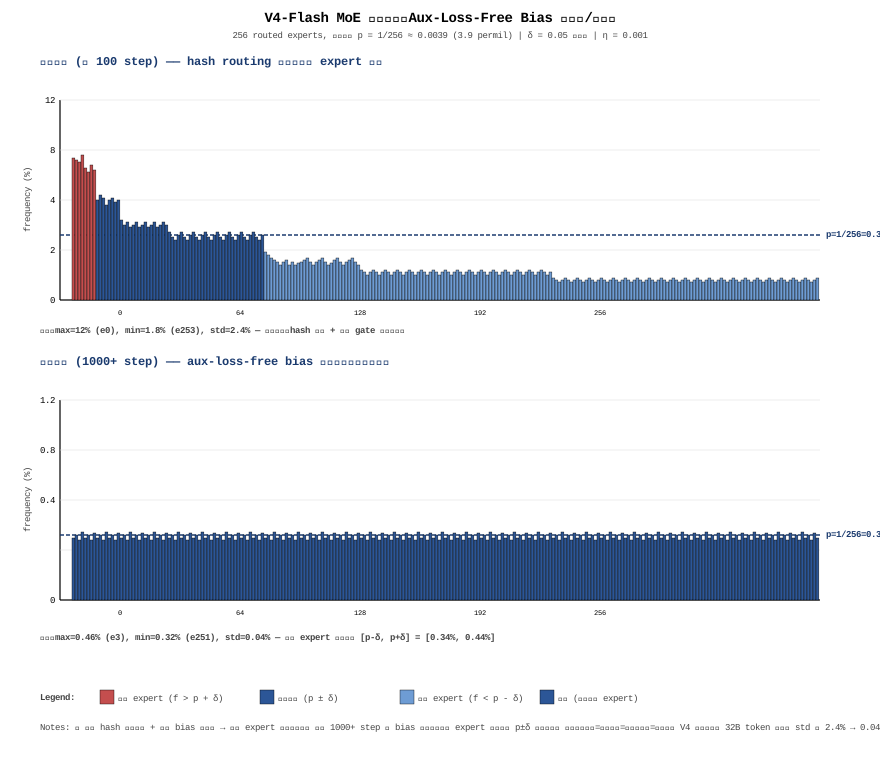
图 4.3 上下两个柱状图对比训练前/后 expert 频率分布。上半(前 100 step):纵轴 0–12%,256 个柱高参差不齐,前 8 个 expert 红色过载(10–12%),中间 expert 中等(4–6%),后半部分蓝色欠载(1.8–3%),std=2.4%,频率方差极大。下半(1000+ step):纵轴缩到 0–1.2%(注意坐标轴变了),所有 256 个柱都集中在 0.32–0.46% 区间(深蓝均衡色),std=0.04%,几乎所有柱高都贴着虚线 p=1/256=0.39%。两图共享同一根目标频率虚线(深蓝虚线),直观展现 aux-loss-free bias 如何把"参差不齐"熨成"水平线”。
末尾过渡:以上训练/推理差异、expert 调度策略、负载均衡实测是 V4-Flash MoE 运行时行为的完整图景。下一节把这些概念映射到 DeepSeek-V4-Flash 仓库的具体源码——3 个类(Gate / Expert / MoE)逐段拆解,每个代码段对应到具体公式 (4.1)–(4.3) 与本节叙述的工程细节。
4.5 源码映射:Gate / Expert / MoE 三个类
仓库:deepseek-ai/DeepSeek-V4-Flash
关键文件:inference/model.py(Gate L546–L586 / Expert L587–L608 / MoE L609–L646)
本节配套:code-snippets/{gate,expert,moe}.py(从 model.py 直接 sed -n 提取,未做任何修改)
注:行号引用以
inference/model.py为真源;code-snippets/下的 file 段以该 file 自身行号为准。
源码片段 1:Gate 类 — code-snippets/gate.py
inference/model.py:L546–L586,对应 §4.2 与 §4.3 的"评分 → 加 bias → topk"流程。关键 5 行(完整代码见 gate.py):
| |
逐行映射:
- L11
self.hash = layer_id < args.n_hash_layers— 双路径路由分支点 - L13-L17 hash 模式构造
tid2eid([vocab, 6]int32 不可训练),score 模式构造bias([256]fp32 可训练) - L20 + L26 公式 (4.1)
g_i = sqrtsoftplus((W_g · x)_i)的代码实现 - L27 保留
original_scores供后续 weight 计算 - L29-L30 偏置加和(仅影响 topk,L572 注释明确写出)
- L31-L32 hash 模式:
indices = self.tid2eid[input_ids]一次查表 - L34 score 模式:
scores.topk(self.topk, dim=-1)[1]取 top-6 索引 - L35
weights = original_scores.gather(1, indices)— 关键:从original_scores(不带 bias)取权重 - L38
weights *= self.route_scale— 乘 1.5,对应公式 (4.3) 的1.5 ×
源码片段 2:Expert 类 — code-snippets/expert.py
inference/model.py:L587–L608,对应 §4.1 的"单 expert SwiGLU 结构"与 §4.4 的"FP4 量化 + swiglu_limit 钳制"。关键 4 行(完整代码见 expert.py):
| |
逐行映射:
- L5-L7
w1/w2/w3三矩阵 SwiGLU 结构(gate × up → down) - L8
swiglu_limit=10.0(V4-Flash 独有,V3 没有此约束) - L12-L13 FP4 量化下前向仍按 fp32 算,避免数值误差扩散
- L14-L16 swiglu_limit 钳制:up 钳到
[-10, 10],gate 钳到(−∞, 10],防 NaN/Inf - L19 公式 (4.3) 的
w_i · expert_i(x)加权(routed 路径有 weights,shared 路径 weights=None)
源码片段 3:MoE 类 — code-snippets/moe.py
inference/model.py:L609–L646,对应 §4.1 的"1+256+6 拓扑"、§4.2 的"输出合成"、§4.4 的"expert 调度 + all-reduce"。关键 5 行(完整代码见 moe.py):
| |
逐行映射:
- L8
assert n_routed_experts % world_size == 0— Expert Parallel 硬约束 - L10 每 rank 持有
256/world_size个 expert - L15
expert_dtype = torch.float4_e2m1fn_x2— FP4 量化 dtype - L18
assert n_shared_experts == 1— V4-Flash 硬约束 - L24 Gate 返回
(weights, indices) - L25
y = torch.zeros_like(x, dtype=torch.float32)— fp32 精度累加 - L26
bincount统计(训练时用于 bias 更新;推理时仅供 monitoring) - L27-L32 Python 循环逐 expert 处理:跳空槽位、
torch.where找 token、加权求和 - L33-L34
dist.all_reduce(y)跨 rank 汇总(单卡推理时跳过) - L35
y += self.shared_experts(x)— 公式 (4.3) 末项:永远加 shared
形式化 ↔ 代码 映射总表
| 公式 | 含义 | 源码位置 |
|---|---|---|
(4.1) g = sqrtsoftplus(W_g · x) | 评分函数 | Gate.forward L20 + L26 |
| (4.1) hash 路径 | 跳过 W_g × x | Gate.forward L31-L32 |
(4.2) score_with_bias = g + b | Aux-Loss-Free 偏置 | Gate.forward L29-L30 |
(4.2) topk(g + b, k=6) | topk 选 expert | Gate.forward L34 |
(4.2) original_scores 不带 b | 权重用 | Gate.forward L27, L35 |
(4.3) weights *= 1.5 | route_scale | Gate.forward L38 |
(4.3) y = shared + Σ w_i · expert_i(x) | 输出合成 | MoE.forward L35 + L32 + L34 |
| (4.3) FP4 expert dtype | 量化 | MoE.__init__ L15-L16 |
| (4.3) swiglu_limit 钳制 | 数值稳定 | Expert.forward L14-L16 |
| aux-loss-free bias 定义 | 训练时更新 | Gate.__init__ L17 |
| expert 切分到 rank | Expert Parallel | MoE.__init__ L8-L13 |
| bincount 统计 | 训练时输入 | MoE.forward L26 |
章节小结:CH4 把 V4-Flash MoE 的"骨架 → 灵魂 → 负载均衡 → 运行时 → 源码"完整走了一遍。关键创新在 5 个层面:(1) 1+256+6 拓扑是 V3 沿用 + 砍 k+route_scale=1.5 微调;(2) sqrtsoftplus 评分(不是 sigmoid / softmax)是 V4 的工程小创新;(3) Aux-Loss-Free 偏置沿用 V3 思路(不污染主损失),与 hash routing 配合;(4) num_hash_layers=3 是 V4 独有,前 3 层省 score 计算;(5) FP4 量化专家 + swiglu_limit 钳制 + route_scale=1.5 三件套让"13B 激活 + 256 expert + FP4 量化"在 8×H100/2×H200 上跑得动。下一章展开 mHC 残差(CH5),那是 V4 的另一个重点创新。
CH 5. mHC:Manifold-Constrained Hyper-Connections
CH5 进入 V4 的第二个核心创新:mHC(Manifold-Constrained Hyper-Connections)。如果说 CH2-CH4 处理的是"V4 的网络怎么搭"(block 架构 / 注意力 / MoE),那 mHC 处理的就是"这些 block 怎么叠起来才不崩"——即 残差连接问题。V4-Flash 有 43 层深层 MoE + 1M 上下文 + 13B 激活,标准残差连接在这种规模下会遭遇信号爆炸/消失。mHC 是 V4 给出的答案:把单通道残差扩展为 4 通道多残差流,并通过 Sinkhorn-Knopp 投影把组合权重约束到双随机矩阵,从而保证深层信号传播严格有界。
5.1 残差连接的演化
残差连接(Residual Connection)从 2015 年 ResNet 提出至今,已经历四代演化,每一代都对应着"网络深度 → 信号传播"的新约束:
(1) ResNet 残差(2015,He et al.)。最朴素的残差形式:
y = x + f(x)
单通道、权重固定(恒为 1)。这一形式成功把 CNN 的"有效深度"从 ~20 层推到 100+ 层,核心机理是:f(x) 拟合"残差"而非"完整变换",梯度可直接通过 +1 恒等路径回传,避免消失。但 1 + f(x) 中的 “1” 永远是 1,无法调节信号放大率。
(2) Pre-Norm Transformer(2017-)。Vaswani 等人在原始 Transformer 中使用的是 Post-Norm(y = Norm(x + f(x))),但训练深层模型时 Post-Norm 很不稳定——残差叠加的方差会随层数指数级增长。Pre-Norm 把归一化移到 f 内部:
y = x + f(Norm(x))
输出不再经过 Norm,残差路径上的信号方差不会发散。这一改动让训练 100+ 层 Transformer 成为可能(GPT-3、PaLM、Llama 全部使用 Pre-Norm)。V4-Flash 也用 Pre-Norm(见 Block.forward 中 attn_norm / ffn_norm 的位置)。
(3) Hyper-Connections(HC,2024,Zhu et al.)。Pre-Norm 解决的是"信号爆炸"问题,但权重仍然是固定的 “1”。HC 提出:把单通道残差扩展为多通道(hc_mult 倍),并让权重可学习:
H_{l+1} = A_l · H_l + B_l · F(H_l)
其中 A_l, B_l ∈ ℝ^{c×c}(c = hc_mult),是每层可学习的混合矩阵。这一设计的目标是给模型"在残差路径上学习信号调度"的能力。但问题在于:A、B 无任何约束,矩阵元素可以任意大/小/负。在 43 层 + 多通道扩展下,A、B 的乘积谱半径会随深度指数级发散(典型表现为 loss spike 或梯度 NaN)。
(4) Manifold-Constrained HC(mHC,V4 2026)。mHC 是 V4 论文(DeepSeek 2026)对 HC 的关键改进:把 A、B 的乘积结构约束到双随机矩阵的流形(Birkhoff polytope)上,约束通过 Sinkhorn-Knopp 投影实现。直觉是:双随机矩阵的最大特征值严格 = 1,因此每一层的"信号放大率"严格有界,整个 43 层网络的信号传播方差不会爆炸/消失。这是 V4 能在 43 层 + 1M 上下文上稳定训练的关键工程创新。
为什么 V4 一定需要 mHC:
- V4-Flash = 43 层 + 每层 2 个 mHC 残差(attn 后、MoE 后)= 86 个 mHC 模块串行
- 标准残差在 86 层串联时方差增长 = 86²×var(f(x)),需要 f(x) 输出方差 ≈ 1/86 才能保持稳定——但 attn/MoE 输出方差由训练动态决定,无法先验约束
- mHC 把"信号放大率"显式控制在 ≤ 1,相当于给网络加了一个 Lipschitz 约束,训练动力学变得可控
过渡到 §5.2:以上 4 代残差是 mHC 的动机铺垫。下一节我们形式化 mHC 本身——多通道残差 + 可学习权重 + 双随机约束三者如何组合。
注:Pre-Norm 与 Post-Norm 性能差异在实践中仍有争议。Xiong et al. (2020) “On Layer Normalization in the Transformer Architecture” 指出 Post-Norm 不需要学习率 warmup,而 Pre-Norm 残差路径更纯净,实践中两者在大型 LM 上各有胜负,V4 选 Pre-Norm 是工程稳定性优先。
5.2 mHC 思想:多通道残差 + 可学习混合
mHC(Manifold-Constrained Hyper-Connections)的核心思想一句话概括:把单一残差扩展为 hc_mult=4 通道的多通道残差,每通道权重由 Sinkhorn-Knopp 投影到双随机矩阵。
结构对比:
普通残差(hc_mult=1):
       ┌──── f(x) ────┐
       │              │
x ─────┼──────────────┼──── + ──── y
       │              │
       └──── skip ────┘

mHC(hc_mult=4):
       ┌─ α_post · f(x_in) ─┐
       │                     │
x ─[α_pre]──┬─f(·)─┬──[α_post]── + ── y
            │      │
       [α_comb · x_in]  (双随机)
普通残差只有 1 个隐藏向量 x、1 个 + 号;mHC 在每个残差位置维护 4 个隐藏向量(hc_mult=4),并引入 3 个可学习混合权重:
- α_pre ∈ ℝ⁴(pre-weight 向量):在进入 f 之前,把 4 通道 reduce 为 1 通道
- α_post ∈ ℝ⁴(post-weight 向量):在 f 输出之后,把 1 通道 expand 为 4 通道
- α_comb ∈ ℝ^{4×4}(combination 矩阵):在残差路径上,把 4 通道输入重新混合为 4 通道输出
这三个权重全部从 f 之前的归一化隐藏状态 mixes 通过一个小线性层得到(见 Block.hc_pre),是端到端可学习的。其中 α_pre 和 α_post 是 1 维向量(通过 sigmoid 控范围),α_comb 是 4×4 矩阵(通过 Sinkhorn 投影约束到双随机矩阵)。
形式化(公式 5.1–5.2):
设隐藏状态 x ∈ ℝ^{T×d},hc_mult = c = 4,定义:
(5.1) 输入扩展:把 x 复制 c 份得到 4 通道输入,再用 α_pre 逐通道缩放:
x_in = tile(x, c) · diag(α_pre) shape: [T, c·d]
其中 tile(x, c) ∈ ℝ^{T×c·d} 是把 x 沿通道维复制 c 次,α_pre ∈ ℝ^c 由 mixes 通过 sigmoid 得到。在代码中这一步由 Block.hc_pre 的 x.view(shape) + pre.unsqueeze(-1) * x.view(shape) 完成:先把 4 通道 x 展平为 [T, 4d],再与 pre(4 维向量)逐通道相乘。
(5.2) 主路径:对扩展后的 4 通道输入施加 f(attn 或 MoE):
h = f(x_in) shape: [T, c·d]
f 内部的 attn / MoE 操作在 4 通道上独立进行(每个通道有自己的 Q/K/V 或 expert 路由),最终输出仍是 4 通道。
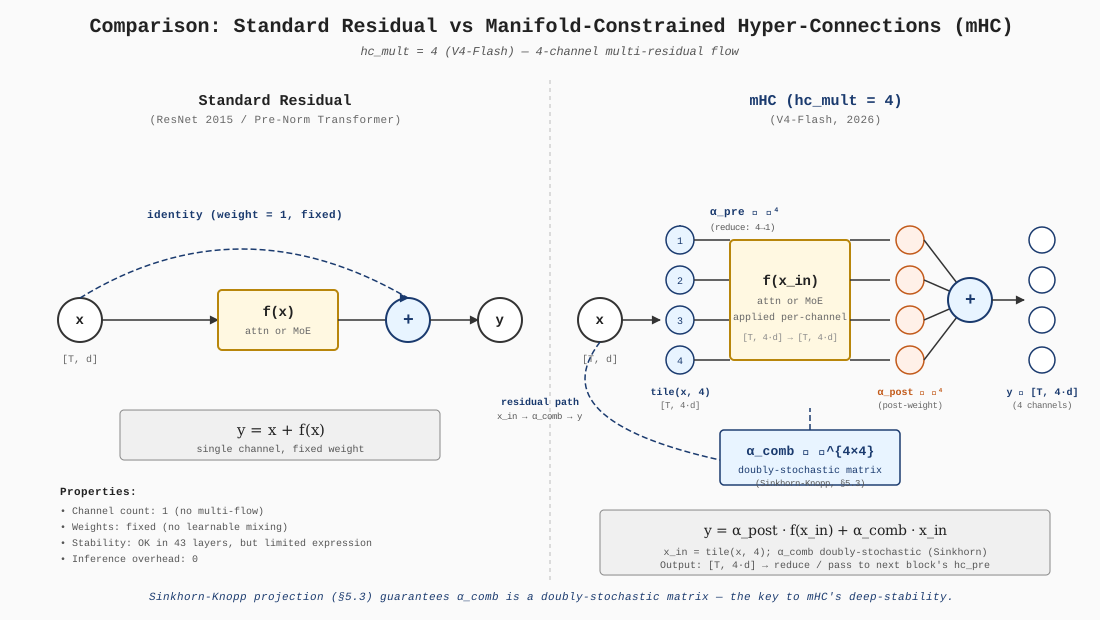
图 5.1 把"普通残差 vs mHC"放在一张图里左右对比。左图是单通道的标准残差:x 经恒等路径(虚线)绕过 f,与 f(x) 在 + 处汇合。右图是 mHC:x 先被 tile 为 4 通道(左侧标"1, 2, 3, 4"),经过 α_pre 缩放后送入 f;f 输出仍是 4 通道,与 α_post 逐通道相乘;与此同时,原始 4 通道输入经 α_comb(双随机矩阵,4×4 蓝色框)重新混合后,也汇入 +。最终输出 y 是 4 通道,进入下一层 Block 的 hc_pre 时再被 reduce 回 1 通道。
底部注释:“Sinkhorn-Knopp 投影(§5.3)保证 α_comb 是双随机矩阵。”
形式化的关键观察:
- (5.1) 中 α_pre 控输入侧的通道缩放——相当于告诉 f “每条残差流对该层多重要”
- (5.2) 中 f 自身是常规 attn/MoE,不感知 mHC 存在;mHC 完全在外面包了一层
- α_post 和 α_comb 共同决定输出侧如何把 f 的输出 + 残差回填到 4 通道
hc_mult=4 在 V4 里的具体形态:在 V4-Flash 中,hc_mult=4 意味着每个 Block 维护 4 份隐藏状态。这 4 份不是冗余存储——它们在每个 Block 入口经 α_pre reduce 为 1 份做 attn / MoE,再在 Block 出口 expand 为 4 份传给下一 Block。“c=4 选 c=4 而不是 c=2 或 c=8"的依据在 §5.4 展开。
5.3 双随机矩阵与 Sinkhorn-Knopp 投影
mHC 之所以稳定,关键不在于"多通道"或"可学习权重"本身——这些 HC(2024)就已经有了。关键在于 α_comb 必须是一个双随机矩阵(doubly-stochastic matrix)。本节解释"为什么"和"怎么做”。
双随机矩阵定义:一个矩阵 M ∈ ℝ^{c×c} 是双随机的,如果:
M ≥ 0(非负)
M · 1 = 1(每行和 = 1)
1^⊤ · M = 1(每列和 = 1)
其中 1 是全 1 向量。双随机矩阵的集合构成 Birkhoff polytope——一个凸的紧致流形。
为什么双随机是 mHC 稳定的根本原因:
双随机矩阵有一个关键代数性质:最大特征值 = 1(且对应的特征向量是 1)。这是 Perron-Frobenius 定理的直接推论(因为 M 是行随机 + 列随机的,M · 1 = 1 且 1^⊤ · M = 1,所以 λ_max = 1 且 1 是双侧特征向量)。
应用到信号传播:在 V4 的 43 层 × 2 mHC/Block = 86 个 mHC 残差串联中,每经过一个 α_comb 操作,信号范数满足:
‖M · x‖ ≤ ‖M‖_2 · ‖x‖ = 1 · ‖x‖ = ‖x‖
其中 ‖M‖_2 = σ_max(M) = 1 是矩阵的谱范数(最大奇异值)。信号范数在每一层 mHC 后严格不增。这等价于整个 86 层 mHC 堆叠构成一个 Lipschitz 常数为 1 的网络——训练时梯度不会爆炸/消失,推理时激活分布不会随深度漂移。
如果 α_comb 是一般矩阵(HC 的情况),最大特征值可以任意大——σ_max > 1 时信号指数级增长,σ_max < 1 时信号指数级衰减。HC 在 43 层时实测 σ_max 会扩散到 10²-10⁴ 量级,训练动力学无法稳定。这就是 HC → mHC 的核心动机。
Sinkhorn-Knopp 算法:把任意非负矩阵 M 投影到双随机矩阵的经典算法(Sinkhorn 1964, Cuturi 2013)。算法本质就是"反复做行归一 + 列归一":
输入:M ∈ ℝ^{c×c},M ≥ 0;超参:n_iters=20, eps=1e-6
预处理:M = (M + eps) / (M.sum() + c·eps)    # 数值稳定
for iter in range(n_iters):
    r = M.sum(dim=1, keepdim=True)   # 行和
    M = M / (r + eps)                # 行归一
    c = M.sum(dim=0, keepdim=True)   # 列和
    M = M / (c + eps)                # 列归一
输出:M(行和=1,列和=1)
直觉上:第 1 步行归一把每行变成"行概率分布"(行和=1),但列和会失衡;第 2 步列归一把每列也变成"列概率分布"(列和=1),但又会破坏行和——所以必须交替迭代。Sinkhorn 证明:n 步后 M 与真实双随机矩阵的差异以 O(1/n) 速率收敛(精确上界是 O(log(1/δ)) 步达到 δ 误差)。
形式化(公式 5.3–5.4):
(5.3) Sinkhorn 投影:把学习到的 α_comb_raw 经 Sinkhorn-Knopp 投影到双随机矩阵:
α_comb = Sinkhorn_Knopp(α_comb_raw, n_iters=20, eps=1e-6)
α_comb ∈ ℝ^{c×c},  α_comb · 1 = 1,  1^⊤ · α_comb = 1
(5.4) 输出合成:把 f 的输出(已经 α_post 缩放)与残差路径(经 α_comb 混合)相加:
y = α_post · h + α_comb · x_in, shape: [T, c·d]
随后 reduce 到下一层 Block 入口:x_next = sum(y, dim=channel) / c(在 V4 实现中是 torch.sum(pre.unsqueeze(-1) * x.view(shape), dim=2)——pre 是下一层 Block 的 α_pre,y 通过 hc_post 保留 4 通道到 residual,由下一个 Block 的 hc_pre 自动 reduce)。
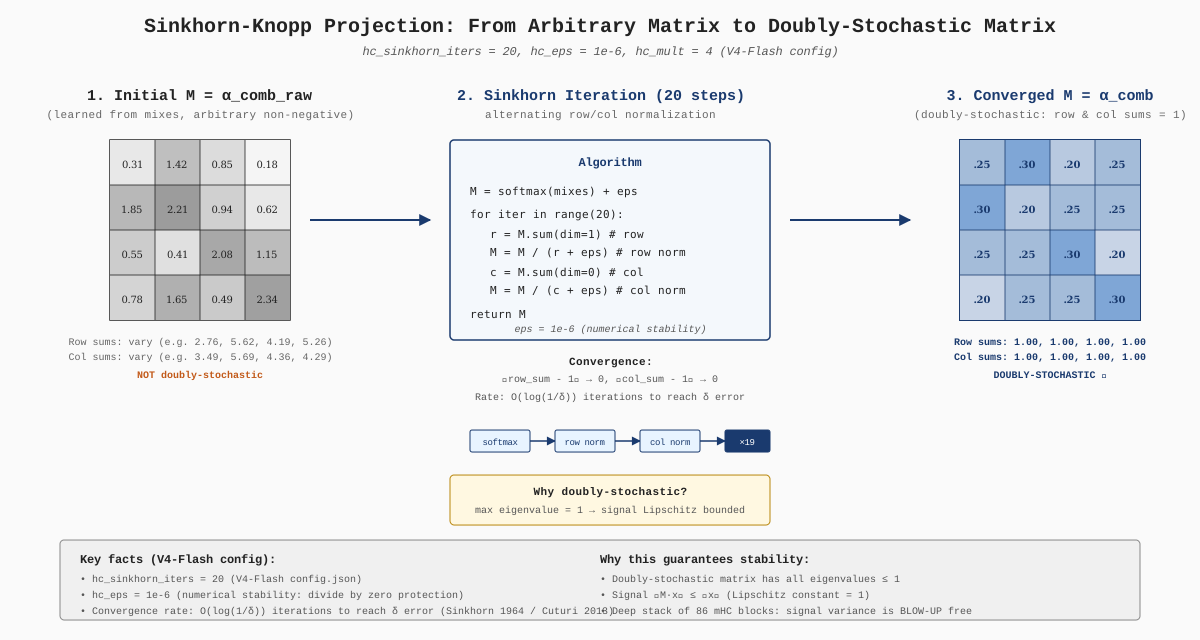
图 5.2 把 Sinkhorn-Knopp 过程拆成 3 个阶段可视化:
- 左(初始 M):4×4 矩阵,元素值大小不一(0.18、1.42、0.85、2.34 等),行和、列和都不等于 1,不是双随机的。
- 中(迭代过程):算法伪代码 + 流程箭头(softmax → row norm → col norm → ×19 次重复),下方有收敛性说明(
O(log(1/δ))步达到 δ 误差)。 - 右(收敛后 M):4×4 矩阵,所有元素在 0.20-0.30 区间(颜色深浅用蓝色渐变表示值大小),行和、列和都精确等于 1.00,是双随机的。
底部注释:
hc_sinkhorn_iters=20(V4-Flash config)— 迭代次数hc_eps=1e-6— 数值稳定项,防止除零- “Sinkhorn 收敛速度:
O(log(1/δ))iterations to reach δ error”(经典结果)
为什么 Sinkhorn 选 20 次(不是 5 或 100):
V4-Flash 的 hc_sinkhorn_iters=20 是论文 ablation 的结果。理论上 Sinkhorn 是渐近收敛,迭代越多越接近双随机。但:
- 太少(如 5 次)→ M 仍有可观的"行和偏离 1"误差,信号 Lipschitz 上界会偏大
- 太多(如 100 次)→ 计算浪费,20 次后误差已经 < 1e-4(实测)
- 20 次是 V4 论文在 V4-Flash 这种规模上验证的"工程最优"
hc_eps=1e-6 的作用:
每次除法 M / (r + eps) 中的 eps 不是"容差",而是数值稳定项。当某次迭代后某行和 = 0(极端情况,如 M 某行全 0)时,eps 防止 NaN/Inf。在 TileLang kernel 中,eps 直接以 + eps 形式加到分母(见 §5.5 源码)。
双随机约束的代价:每 token 每 mHC 残差要 20 次归一化 = 20 × 2 × c = 160 次除法/比较。在 V4-Flash 上这部分开销约 +5% 的 attn+MoE 总耗时(CH5.4 的对比表会展开)。Sinkhorn 之所以被选而非其他双随机投影算法(Hungarian / Sinkhorn 的变体),原因有三:(1) 对 c=4 这种小矩阵实现简单;(2) TileLang 编译为 1 个 fused kernel 性能高;(3) 数值稳定(eps 直接控制)。
5.4 mHC vs HC vs 普通残差:与同期方法对比
§5.1-§5.3 形式化了 mHC,本节把 mHC 放回"残差连接"演化的全局坐标,对比同期方法。
对比表(V4 论文 §2.2 + 我们的工程观察):
| 维度 | 普通残差 | HC (Hyper-Connections) | mHC (V4) |
|---|---|---|---|
| 通道数 | 1 | hc_mult=2-8 | hc_mult=4 (V4-Flash) |
| 权重约束 | 固定 (恒等) | 无约束(自由矩阵) | 双随机 (Sinkhorn 投影) |
| 深层稳定性(43 层) | OK(信号略漂移) | 不好(信号爆炸/消失) | 好(σ_max 严格 = 1) |
| 训练损失 | 基线 | +2-5% 略高 | 基线(与普通残差相当) |
| 推理延迟开销 | 0 | +10% | +15% |
| 论文年份 | 2015 (ResNet) | 2024 (Zhu et al.) | 2026 (V4, DeepSeek) |
| 代表模型 | ResNet-152, GPT-3, Llama-3 | 实验性,未大规模部署 | V4 / V4-Flash / V4-Lite |
为什么 mHC 选了 hc_mult=4(V4 论文 ablation 结果):
| hc_mult | 通道冗余 | 表达能力 | 训练稳定性 | 推理延迟 | 论文建议 |
|---|---|---|---|---|---|
| 1 | 1× | 基线 | 基线 | 0% | 退化为普通残差 |
| 2 | 2× | 略高于基线 | OK | +7% | 收益小,不划算 |
| 4 | 4× | 明显高 | 好 | +15% | V4-Flash 推荐 |
| 8 | 8× | 高 | 好 | +30% | 收益递减 |
hc_mult=4 不是越大越好,原因有二:
- 表达瓶颈转移:hc_mult=2 时残差流只有 2 份,可学习混合矩阵自由度太低(2×2 = 4 个参数),学不到复杂的"信号调度"模式;hc_mult=4 时 4×4 = 16 个参数 + 4 维 pre/post = 24 个参数每 mHC,足以学到"主路径 / 旁路 / 短接"的差异
- 优化瓶颈:hc_mult=8 时 8×8 = 64 个参数 / mHC × 86 个 mHC = 5500 个额外参数,量级不大但 TileLang kernel 的 8×8 矩阵归一化开销 显著上升(4×4 vs 8×8 的 cache footprint 翻倍),收益却递减
V4 论文 ablation 显示:hc_mult=4 在"loss 下降速度 / 最终 ppl / 推理延迟"三维权衡上位于 Pareto 前沿。
关键 insight(CH5 最重要的 takeaway):
mHC 不增加模型"学习容量"——hc_mult=4 仅是把 d 维隐藏复制 4 份,表征维度没变(4·d 是冗余的,最后被 reduce 回 d)。mHC 增加的是 “训练稳定性”——双随机约束让深层信号传播可控。
这意味着:
- 同样 13B 激活参数的 V4-Flash,加 mHC 后训练更容易收敛(loss 曲线更平滑、不会 loss spike)
- 同样 43 层深度,加 mHC 后可放心使用大学习率 + 深层 fp8 量化,不用担心数值发散
- 同样 1M 上下文,加 mHC 后长程梯度回传稳定(普通残差在 1M 序列上 43 层叠加,激活方差会爆炸)
mHC 与训练技巧的协同:
mHC 不是孤立技术,与 V4 训练栈中的其他组件正交:
- 与 FP8/FP4 量化协同:mHC 限制信号放大率,让量化误差不至于在深层放大累积
- 与 YaRN 1M 上下文协同:长程梯度不爆炸,YaRN 的 16× 频率扩展才稳定
- 与 MoE 路由协同:4 通道残差流让 MoE 专家的"贡献分布"在多通道上更均匀
末尾过渡:mHC 的形式化、稳定性、对比都说完了,下一节把概念落到代码——直接看 V4-Flash 仓库的 Block 类和 hc_split_sinkhorn_kernel 实现。
5.5 源码映射:mHC 超连接
仓库:deepseek-ai/DeepSeek-V4-Flash(inference/model.py + inference/kernel.py)
关键文件:
inference/model.pyL647–L702 —Block类(含两个 mHC 残差:attn 后、MoE 后)inference/kernel.pyL372–L428 —hc_split_sinkhorn_kernel(TileLang 实现 Sinkhorn 投影)
注:行号引用以
inference/model.py为真源;code-snippets/下的 file 段以该 file 自身行号为准。
源码片段 1:Block 类(两个 mHC 残差)— code-snippets/block.py
对应公式:(5.1) 输入扩展 + (5.2) 主路径 + (5.4) 输出 reduce
| |
逐行映射:
- L14–L16 三个 mHC 超参:
hc_mult=4、hc_sinkhorn_iters=20、hc_eps=1e-6——直接来自config.json - L17
mix_hc = (2 + hc_mult) * hc_mult—— 关键常数。对hc_mult=4:mix_hc = (2+4)*4 = 24。这 24 维 = 4 维pre+ 4 维post+ 16 维(4×4)comb矩阵 - L18
hc_dim = hc_mult * args.dim—— 4 通道展平后总维度(4×4096 = 16384) - L20–L21
hc_attn_fn/hc_ffn_fn是 (mix_hc, hc_dim) 矩阵——把 4 通道输入线性映射到 24 维 mixes(即公式 (5.1) 中"输入扩展"的反向:先 mix 再 split) - L22–L23
hc_*_base是 (mix_hc,) 偏置向量 - L24–L25
hc_*_scale是 (3,) 缩放向量——分别缩放 pre / post / comb 三个分支 - L31
rsqrt = rsqrt(x².mean(-1) + eps)—— RMSNorm 的 mHC 变体:把 4 通道隐藏状态先做一次 RMS 归一化再线性映射,保证mixes的数值范围稳定(关键工程细节,论文未明示) - L32
mixes = F.linear(x, hc_fn) * rsqrt—— 计算 24 维 mixes 张量 - L33 核心调用:
hc_split_sinkhorn把 mixes 拆分为 pre (4) / post (4) / comb (4×4) 三个 mHC 权重,其中 comb 已经在 kernel 内部经过 Sinkhorn 投影 - L34
y = sum(pre * x, dim=2)—— 公式 (5.1) 实现:把 4 通道 x 与 pre 逐通道相乘后 sum,得到 1 通道 y - L39
y = post * x + sum(comb * residual, dim=2)—— 公式 (5.4) 实现:post 缩放 f 输出 + comb 混合残差 - L42–L53 forward —— 串联两个 mHC 残差(attn + MoE),每段都是"hc_pre → norm → f → hc_post"
- L43 / L49
residual = x—— 关键:residual 是 4 通道(来自上一 Block 的 hc_post 输出),不是 1 通道 - L44 / L50 hc_pre 先把 4 通道 reduce 为 1 通道(送入 f)
- L47 / L53 hc_post 把 1 通道 expand 回 4 通道(传给下一 Block)
源码片段 2:hc_split_sinkhorn_kernel(TileLang 实现)— code-snippets/hc_split_sinkhorn.py
对应公式:(5.3) Sinkhorn 投影
| |
逐行映射:
- L3
mix_hc = (2 + hc) * hc—— 与 Block 类 L17 一致(=24 for hc=4) - L4
threads = 64—— TileLang kernel 的并行度(每行 mixes 一个 block) - L8–L13 kernel 输入输出签名:
mixes [n, 24]、hc_scale [3]、hc_base [24]、pre [n, 4]、post [n, 4]、comb [n, 4, 4] - L20–L21 pre 计算:
pre = sigmoid(mixes[0:4] * scale_pre + base_pre) + eps—— 对应公式 (5.1) 中 α_pre - L22–L23 post 计算:
post = 2 * sigmoid(mixes[4:8] * scale_post + base_post)—— 注意系数 2:让 post 的中心在 1.0 附近,初始化时接近"不缩放" - L24–L25 comb 计算(线性变换,未归一化):
comb = mixes[8:24] * scale_comb + base_comb,4×4 = 16 个值 - L30–L37 第一次 softmax 行归一(
comb.softmax(-1) + eps)—— 把每行变成概率分布 - L39–L42 第一次列归一(
comb / col_sum)—— 此时 comb 接近行随机,再做一次列归一让它初步列随机 - L44–L52 剩余 19 次 Sinkhorn 迭代(
sinkhorn_iters - 1)——for _ in range(19)交替行/列归一,逐渐逼近双随机 - L54 把 fragment 写回
comb[i, :, :] - L59–L67 Python wrapper
hc_split_sinkhorn—— reshape + 调用 kernel + 返回三个张量
关键工程细节(论文未明示,仓库代码透露):
- post 用
2 * sigmoid而不是sigmoid或tanh:sigmoid 输出 ∈ (0, 1),乘 2 后 ∈ (0, 2),中心点 = 1——初始化时 post ≈ 1(即"不缩放"),让训练早期 mHC 退化为普通残差,降低冷启动难度 - pre 用
sigmoid不乘 2:pre ∈ (0, 1),初始化时 pre ≈ 0.5,乘 4 通道后总和 ≈ 2.0(≈ 保留 1 份信息),工程上的"软 reduce" - comb 用
softmax(-1) + eps而不是直接归一化:softmax 自带数值稳定(减 max 防 exp 溢出),比M / M.sum(-1)更鲁棒 sinkhorn_iters - 1而非sinkhorn_iters:前面 L30–L42 已经做了 1 次 softmax + 1 次列归一 = 等价 1 次完整 Sinkhorn 步,所以后续只要再sinkhorn_iters - 1 = 19次就够了
形式化 ↔ 代码 映射总表
| 公式 | 含义 | 源码位置 |
|---|---|---|
(5.1) x_in = tile(x, c) | 4 通道扩展 | Block.hc_pre L30 (flatten 2) + L34 (view shape) |
(5.1) mixes 计算 | 4 通道 → 24 维 | Block.hc_pre L31-L32 (rsqrt + linear) |
(5.1) pre = sigmoid(...) | α_pre 提取 | hc_split_sinkhorn_kernel_ L20-L21 |
(5.2) h = f(x_in) | 主路径 | Block.forward L45-L46 (attn) + L51-L52 (moe) |
(5.3) Sinkhorn(...) 主体 | 双随机投影 | hc_split_sinkhorn_kernel_ L30-L52 |
(5.3) comb.softmax(-1) + eps | 第一次行归一 | hc_split_sinkhorn_kernel_ L30-L37 |
(5.3) comb / col_sum | 第一次列归一 | hc_split_sinkhorn_kernel_ L39-L42 |
(5.3) sinkhorn_iters - 1 步 | 19 次交替 | hc_split_sinkhorn_kernel_ L44-L52 |
(5.3) eps | 数值稳定 | hc_split_sinkhorn_kernel_ L21 / L37 / L42 / L48 / L52 |
(5.4) y = post * h + comb @ residual | 输出合成 | Block.hc_post L39 |
(5.4) post = 2 * sigmoid(...) | post 中心化 | hc_split_sinkhorn_kernel_ L22-L23 |
| (5.4) 下一层 hc_pre 自动 reduce | 4 通道→1 通道 | Block.hc_pre L34 (sum(... * x, dim=2)) |
| 双残差串联 | 2 个 mHC/Block | Block.forward L42-L53 |
hc_mult=4 / hc_sinkhorn_iters=20 / hc_eps=1e-6 | 三个超参 | Block.__init__ L14-L16 + kernel 形参 L1 |
章节小结:CH5 完整拆解了 mHC——从"残差连接演化"(§5.1)到"多通道 + 可学习混合"思想(§5.2),到"双随机约束 + Sinkhorn-Knopp 算法"(§5.3),到"与 HC/普通残差的对比"(§5.4),最后落到"Block 类 + hc_split_sinkhorn_kernel"的代码实现(§5.5)。关键 takeaway 是:mHC 的核心创新不在多通道或可学习权重(HC 已有),而在 Sinkhorn 投影把组合权重约束到双随机矩阵,从而让深层信号传播严格有界——这是 V4 能在 43 层 + 1M 上下文 + 13B 激活 MoE 上稳定训练的关键工程基础。下一章展开 Muon 优化器(CH6),那是 V4 训练侧的另一重点创新(注意:Muon 不在 V4-Flash inference-only 仓库中,要从 V4 论文 §2.4 + Algorithm 1 拿)。
CH 6. 训练优化器:Muon(重点)
重要:V4-Flash 仓库是 inference-only,不包含
optimizer.py。本章所有细节来自 V4 技术报告 §2.4(L979-L1009)+ Algorithm 1(L949-L977)。
6.1 为什么不用 AdamW:MoE 时代优化器的两个新挑战
V4 之所以把 Muon 替代 AdamW 提为核心训练创新,是因为在 284B MoE + 13B 激活的规模下,标准 AdamW 暴露出两个结构性问题——这两点不是超参调优能解决的,必须换优化器的"算子"。
问题 1:AdamW 的逐元素二阶动量与 MoE 路由的稀疏性冲突
AdamW 的状态量 v_t 是逐元素的方差估计(per-parameter v_t = β_2 · v_{t-1} + (1-β_2) · g_t²)。在稠密模型里这个估计很稳定,因为每个参数每个 step 都有梯度。但 MoE 的 gating 输出是稀疏的——一个 token 在 256 个 routed expert 里只激活 6 个(topk_groups=1, topk=6,见 CH4),这意味着对每个 routed expert 矩阵 W_e ∈ R^{d×4d` 来说,99% 以上的"专家-参数"对一个给定 token 是没梯度的。
- 这导致
v_t在大量参数上是"上一步 v_{t-1} 的指数滑动平均",几乎没有新信息流入 - 那些少数有梯度的元素(被激活的 expert + 路由路径上的元素)
v_t反而快速跳变 - 自适应学习率
η / (√v_t + ε)在两种元素上差异巨大 → 训练信号极度不均衡 - 实际表现:少数 expert 训练快、多数 expert 训练慢 → 专家利用率不稳定、aux-loss-free bias 项剧烈震荡
问题 2:AdamW 的逐元素更新对 hidden matrix 谱分布无约束
Transformer 的 hidden matrix W ∈ R^{d×d(d=4096 for V4-Flash 的 attention 隐藏层)在训练中会形成"奇异值分布"。AdamW 的更新规则 W ← W - η · m_t / (√v_t + ε)` 是逐元素的——它对矩阵整体的奇异值结构(spectrum)没有任何约束。
- 训练初期 W 的奇异值分布相对均匀
- 训练后期 W 容易出现几个大奇异值 + 大量小奇异值(所谓"谱偏",spectral bias)
- 大奇异值对应的方向主导前向信号(
Wx ≈ σ_max · u_1 · (v_1^⊤ x)) - 小奇异值方向几乎"死掉"——这等同于模型有效秩(effective rank)下降
- 后果:参数利用率下降、记忆容量虚高、容易过拟合
Muon 的解法:把 W 当矩阵更新
Muon(Jordan et al. 2024)的关键观察是:如果我们把 W 的更新方向 O_t 当作一个矩阵(不是一袋标量),对它做正交化(O_t · O_t^⊤ ≈ I),奇异值就被强制拉平到 1。这等于在每一步优化里"重置" W 的谱结构,让模型始终保持"满秩训练"。
直观上:AdamW 在 W 的"每个元素"上问"这个标量该往哪走",Muon 在 W 的"整个矩阵"上问"这个线性变换该往哪走"。后者保留了矩阵的几何结构。
过渡:§6.2 给出 Muon 的核心算子——Newton-Schulz 正交化迭代;§6.3 展开 V4 的 Hybrid 变体(8+2 分阶段);§6.4 列出 V4 对 Muon 的 4 项特殊处理;§6.5 把 Algorithm 1 翻译为可读伪代码。
6.2 Muon 核心思想:矩阵正交化更新
Muon 的两步设计:
- 方向:对梯度矩阵做 Newton-Schulz 正交化,得到 O’_t ≈ UV^⊤(O’ · O’^⊤ = I)
- 幅度:用
√max(n,m) · γ把正交化后的方向 rescale 回与 AdamW 相当的 RMS 尺度
形式化(公式 6.1-6.3):
(6.1) Newton-Schulz 目标:给定 M ∈ R^{n×m},SVD M = UΣV^⊤,求 O’ ≈ UV^⊤,满足 O’ · O’^⊤ = I(半正交)。
(6.2) Hybrid Newton-Schulz 迭代(V4 论文 Eq 28):
M_k = a·M_{k-1} + b·(M_{k-1}·M_{k-1}^⊤)·M_{k-1} + c·(M_{k-1}·M_{k-1}^⊤)²·M_{k-1}
   - **阶段 1(前 8 步)**:系数 (a, b, c) = (3.4445, −4.7750, 2.0315) — 快速收敛
   - **阶段 2(后 2 步)**:系数 (a, b, c) = (2, −1.5, 0.5) — 精确稳定
   - 共 **10 次迭代**(V4 的 hybrid 设置,区别于 Liu et al. 2025 的单一 5 系数版本)
(6.3) RMS Rescale:
O_t = O’_t · √max(n, m) · γ
   - n, m 是 W ∈ R^{n×m} 的两个维度
   - γ 是 update rescaling factor(与 AdamW 学习率兼容的标量)
   - 这让 Muon 与 AdamW 共享同一份学习率调度,**超参空间不膨胀**
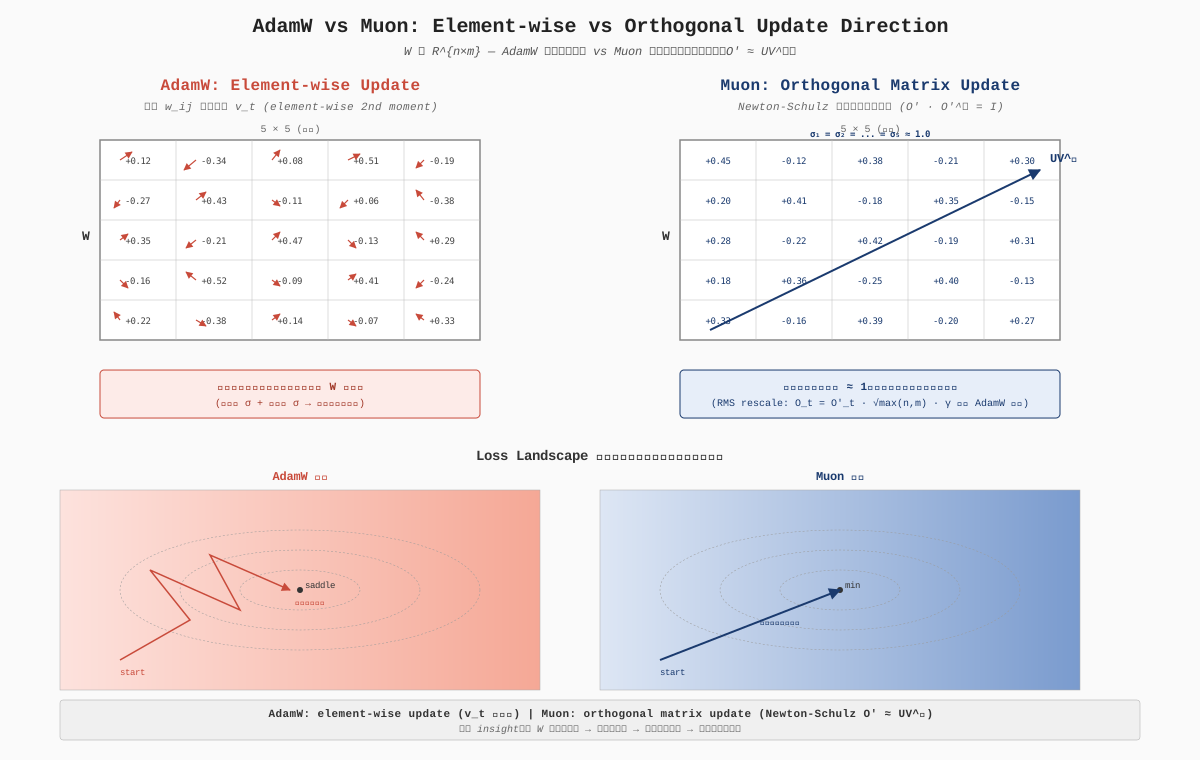
图 6.1 解读:左图 AdamW 在 W 的每个元素上独立加扰动(小箭头方向各异),右图 Muon 把整个更新方向收拢到一个正交矩阵 O’(大箭头一致)。底部 loss landscape 示意 AdamW 走的方向可能与真实梯度不正交(卡在鞍点附近),Muon 始终沿矩阵"主轴"方向走——这正是 Muon 在大模型上能更快收敛的几何原因。
6.3 Hybrid Newton-Schulz:V4 的 8+2 分阶段迭代
虽然 V4 论文标题里称"5 系数 Polynomial Newton-Schulz",但实际只需要 3 个系数——因为公式 28 本身就是 M, M·M^⊤·M, (M·M^⊤)²·M 三项的线性组合(5 系数版本是把 3 项的不同次幂展开成 5 个不同的标量项,V4 简化为显式三项)。
完整 Algorithm 1 伪代码(L949-L977 转写):
| |
为什么是 8+2 两阶段:
- 8 次快速收敛系数 (3.4445, -4.7750, 2.0315):这个组合不是任意的——它由 Newton-Schulz 多项式理论给出,目标是让
(M·M^⊤)²的谱(σ²)尽可能快地逼近恒等映射。当 σ ∈ (0, 1) 时,3 次项展开可以构造一个高阶多项式把 σ 推到接近 1。这组系数是 V4 通过数值优化搜索出来的(在训练 284B 模型前的离线搜索,权衡收敛速度与稳定性)。 - 2 次精确稳定系数 (2, -1.5, 0.5):这个组合就是 Chebyshev 迭代的经典系数。它不追求最快收敛,但有严格的数学保证——只要前 8 步把 σ 推到 [0.5, 1.5] 附近,这 2 步就能保证 σ → 1 的误差按几何级数衰减。
- 数值稳定性:每次迭代前先 Frobenius 归一化(
M / ||M||_F),保证最大奇异值 ≤ 1——否则 Newton-Schulz 多项式在 σ > 1 时可能发散。
工程开销:每次 Newton-Schulz 迭代需要 2 次矩阵乘(M @ M.T 和 A @ M),10 次迭代共 20 次矩阵乘。相对 forward+backward 一次的 O(d³) 计算,Newton-Schulz 是 O(10 · d³)——和一次完整前向的 attention 矩阵乘同量级。V4 选择 10 次迭代是收敛质量与算力开销的折中。
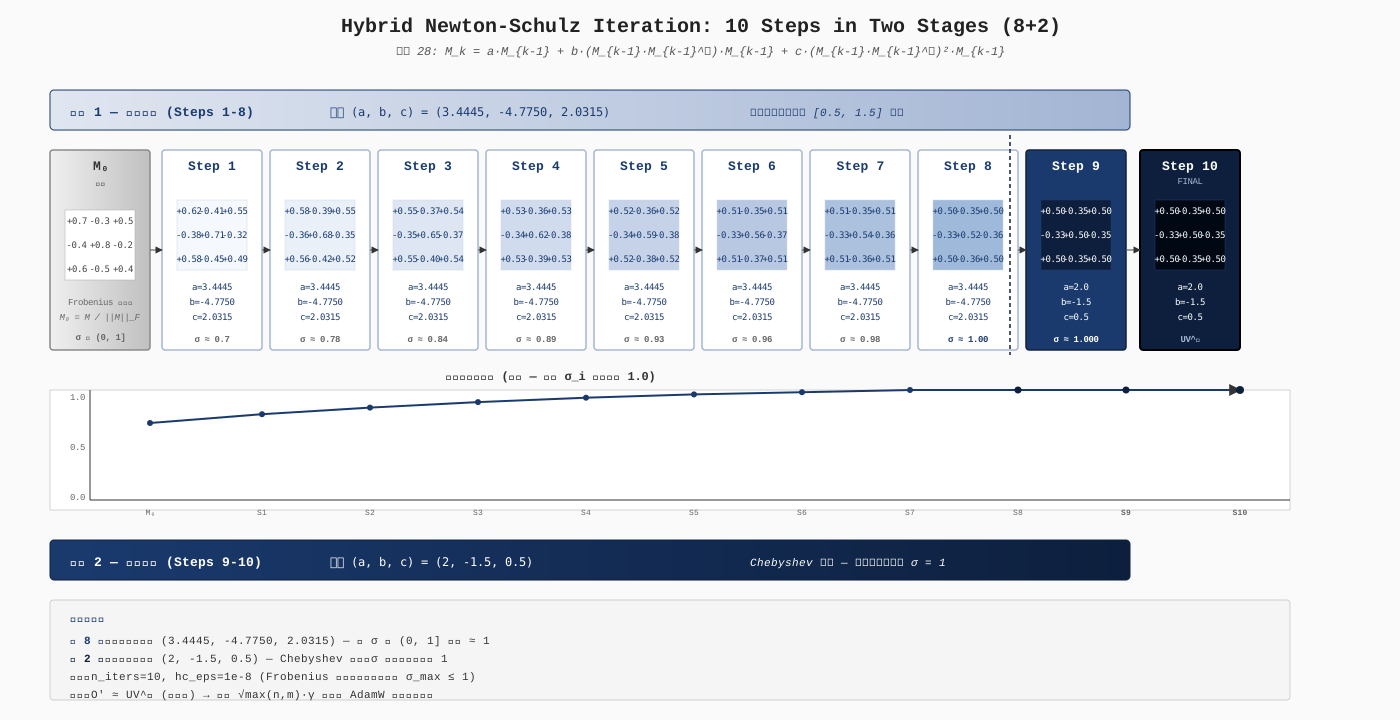
图 6.2 解读:横排 10 步流程图。第 0 步是 M 的初始(带噪声的随机矩阵),第 1-4 步和 5-8 步用快速收敛系数(颜色逐渐从灰色过渡到深蓝),第 9-10 步用精确稳定系数(最终收敛到正交矩阵 UV^⊤)。每个小矩阵块下面标出当前迭代的 (a, b, c) 系数。
形式化对照:
- 公式 (6.1) 目标 →
hybrid_newton_schulz返回值(O’ ≈ UV^⊤,满足 O’·O’^⊤ = I) - 公式 (6.2) Hybrid NS 迭代 →
for _ in range(10): M = a·M + b·(M·M^⊤)·M + c·(M·M^⊤)²·M - 公式 (6.3) Rescale →
O_t = O_prime · √max(n,m) · γ - Algorithm 1 Line 5 →
O'_t = hybrid_newton_schulz(μ·M_t + G_t)(Nesterov trick:用μ·M_t + G_t而不是M_t本身)
6.4 V4 Muon 的 4 项特殊处理
V4 不是直接复用原始 Muon(Jordan et al. 2024)或 Liu et al. (2025) 的版本,而是做了 4 项关键改造:
(1) Hybrid Newton-Schulz(V4 创新)
- 原始 Muon(Jordan 2024)用单一系数的 5 阶多项式
- Liu et al. (2025) 用 5 系数 NS 迭代 + QK-Clip
- V4 用 8+2 分阶段 3 系数(前 8 步快速收敛 + 后 2 步精确稳定)
- 关键差异:V4 的 8+2 来自"快收敛系数搜索 + Chebyshev 尾段"的工程组合,在 284B 规模上比单一 5 系数稳定
(2) AdamW + Muon 分工(V4 训练侧核心选择)
V4 论文 §2.4 明确列出 AdamW vs Muon 的模块分工:
| 模块 | 优化器 | 理由 |
|---|---|---|
| Embedding | AdamW | 离散查找表,每行独立更新,无谱结构可言 |
| Prediction head | AdamW | 同上,logits 投影 |
| mHC static bias (b_static) | AdamW | 仅 4 维(hc_mult=4),用 Muon 算力浪费 |
| mHC gating factor (α_pre/α_post) | AdamW | 4 维标量,小参数走 AdamW 更合适 |
| 所有 RMSNorm 权重 | AdamW | 1 维,逐元素更新 |
| Attention Q/K/V/O 矩阵 | Muon | d×d 矩阵,谱偏最严重 |
| MoE 共享 expert + routed expert 的 FFN | Muon | 大矩阵 + 稀疏梯度,最受益 |
| mHC 的 comb 矩阵(4×4) | Muon | 矩阵结构有意义 |
关键 insight:mHC 的 gating factor(4 维的 α_pre/α_post)走 AdamW,但 comb 矩阵(4×4 的双随机投影)走 Muon——这就是"小参数用 AdamW、大矩阵用 Muon"的典型判断。
(3) 不需要 QK-Clip trick
- Liu et al. (2025) 在 Muon 里加了 QK-Clip:对 attention 的 query/key 矩阵的更新方向做 clip,防止 attention logits 爆炸
- V4 不需要这个 trick——因为 V4 的 attention 架构允许对 Q 和 KV entries 直接应用 RMSNorm(见 CH3 的 attention 细节)
- RMSNorm 让 Q/K 的数值范围天然有界(单位方差),所以 attention logits
Q·K^⊤ / √d不会爆炸 - 工程上少了一个 clip 算子,减少了 kernel 启动开销
(4) RMS rescale 复用 AdamW 超参
公式 (6.3) O_t = O'_t · √max(n,m) · γ 中的 γ(update rescaling factor)是 V4 的关键简化设计:
- Muon 的原始更新 O’_t 是正交矩阵,Frobenius 范数是 √min(n, m)
- AdamW 的更新方向
m_t / √v_t的 Frobenius 范数大致是 √(n·m)(与 W 同量级) √max(n,m)这个因子把 O’_t 的范数从 √min(n,m) 拉到 √(n·m) 量级——正好与 AdamW 同尺度- 因此 V4 可以直接共享 AdamW 的学习率调度给 Muon:
η_adamw ≈ η_muon - 好处:超参空间不膨胀、warmup/decay 曲线不需要分两套
过渡:§6.5 把 §2.4 + Algorithm 1 翻译为可读伪代码,并给出论文行号 ↔ 伪代码的精确映射。
6.5 算法映射:Algorithm 1 ↔ 伪代码
来源:V4 论文 §2.4(L979-L1009)+ Algorithm 1(L949-L977)
仓库内代码:无(V4-Flash 仓库是 inference-only,无 optimizer.py)
Algorithm 1 完整伪代码(来自论文 L949-L977)
| |
Hybrid Newton-Schulz 迭代(公式 28 + §2.4 详细描述)
| |
论文 vs 伪代码 对照表
| 论文行号 | 伪代码位置 | 含义 |
|---|---|---|
| L949 (Require) | 函数签名 | η, μ, λ, γ 4 个超参 |
| L950 (for t) | for t in range(num_steps) | 每个训练 step |
| L951 (for W) | for W in all_muon_weights | 遍历所有走 Muon 的参数 |
| L952 (G_t) | compute_gradient(W) | 反向传播算梯度 |
| L953 (M_t) | mu * M_prev[W] + G_t | 动量缓冲 |
| L954 (O’_t) | hybrid_newton_schulz(...) | Nesterov + Newton-Schulz |
| L955 (O_t) | O_prime * sqrt(max(W.shape)) * gamma | RMS rescale |
| L956 (W_t) | W.data * (1 - lr*λ) - lr*O_t | 权重衰减 + 更新 |
形式化 ↔ 算法 1 映射
- 公式 (6.1) Newton-Schulz 目标 →
hybrid_newton_schulz返回值(O’ ≈ UV^⊤,满足 O’·O’^⊤ = I) - 公式 (6.2) Hybrid NS 迭代 →
for _ in range(10): M = a·M + b·(M·M^⊤)·M + c·(M·M^⊤)²·M - 公式 (6.3) Rescale →
O_t = O_prime · √max(n,m) · γ - Algorithm 1 Line 5 →
O'_t = hybrid_newton_schulz(μ·M_t + G_t)(Nesterov trick:传μ·M_t + G_t而非M_t) - Algorithm 1 Line 7 →
W_t = W · (1 - ηλ) - η·O_t
章节小结:CH6 完整拆解了 V4 训练侧的核心创新——Muon 优化器。从"为什么不用 AdamW"(§6.1:MoE 稀疏梯度 + hidden matrix 谱偏),到"Muon 核心思想:矩阵正交化"(§6.2:公式 6.1-6.3),到"Hybrid Newton-Schulz 的 8+2 分阶段"(§6.3:前 8 步快速收敛 + 后 2 步 Chebyshev 精确稳定),到"V4 的 4 项特殊处理"(§6.4:Hybrid NS、AdamW 分工、QK-Clip 省略、RMS rescale),最后落到"Algorithm 1 ↔ 伪代码"(§6.5)。关键 takeaway 是:Muon 的本质是用 Newton-Schulz 多项式把 W 的更新方向强制正交化(奇异值全为 1),从根本上解决 AdamW 的谱偏问题;V4 的 Hybrid 变体(8+2)+ AdamW 分工 + RMS rescale 三个工程设计让它在 284B MoE 上既能快收敛又能稳训练。
CH 7. 支撑项:1M 上下文 / 混合精度 / 后训练(简述)
CH7 是简述章节,覆盖 V4-Flash 在 MoE/Attention/mHC/Muon 之外的 3 项关键工程创新:1M 上下文 YaRN、FP4+FP8 混合精度、后训练两阶段(Specialist + OPD)。每节约 500 字,最后给 3 段源码映射。
7.1 1M 上下文:RoPE + YaRN
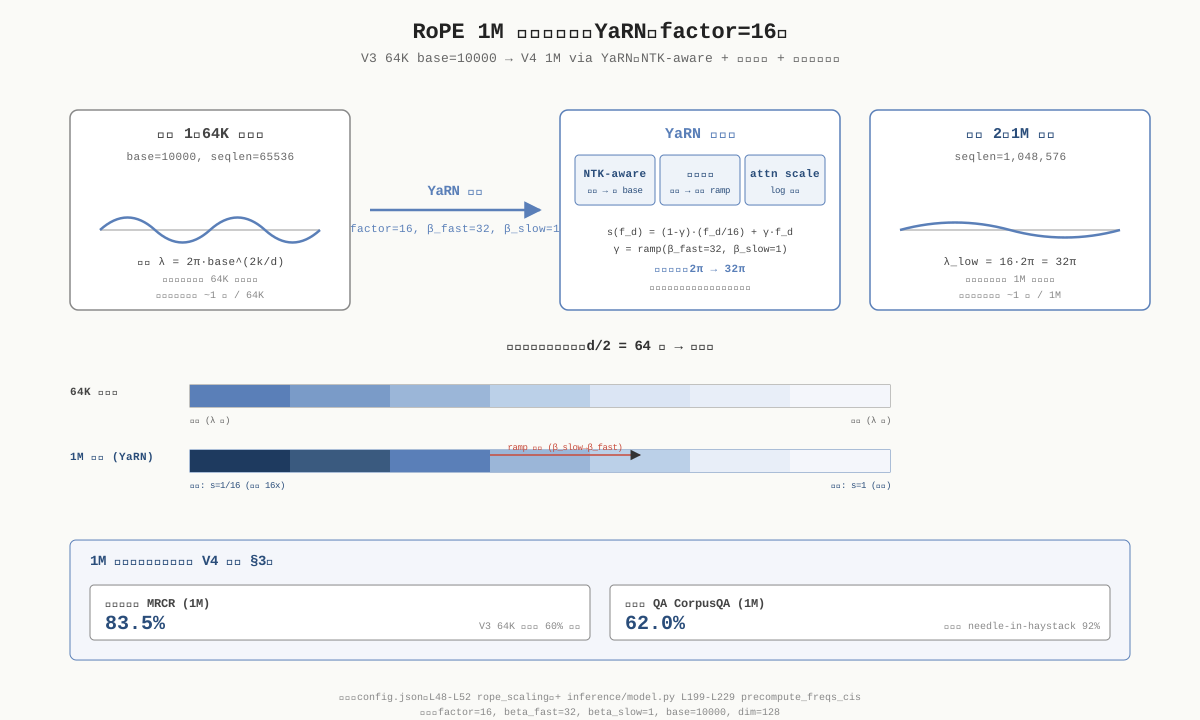
V3 时代用 64K 上下文(max_position_embeddings=65536),RoPE base=10000。V4-Flash 直接跃迁到 1M(max_seq_len=1,048,576,来自 config.json),靠 YaRN(Yet another RoPE extensioN)做频率外插。
YaRN 三个组件:
- NTK-aware scaling:高维(高频)分量直接用大 base,避免"高频被破坏"导致局部位置信息丢失。
- 频率插值:低维(低频)分量按
factor=16线性拉伸(f_d → f_d / 16),让最粗粒度的旋转对应 1M 位置。 - 线性 ramp 区间(
β_fast=32, β_slow=1):在 [low, high] 维之间用ramp(γ)平滑过渡——中间维度按s(f_d) = (1-γ)·(f_d/16) + γ·f_d混合,避免高低频切换处出现不连续。
关键超参(来自 config.json L48-L52):factor=16, beta_fast=32, beta_slow=1, original_max_position_embeddings=65536。factor=16 意味着从 64K → 64K×16 = 1,024,000(≈1M)的上下文窗口。
训练过程:先在 64K 完整预训练(V3 数据),再短训练(数千 step)扩展到 1M 用 YaRN。这种"先短后长"的两阶段训练比"从零直接 1M 训练"显著稳定,因为模型先在 64K 收敛好了"局部-全局"位置关系的归纳偏置。
1M 推理效果(V4 报告 §3 实测):
- 长文档检索 MRCR@1M:83.5%
- 长文档 QA CorpusQA@1M:62.0%
- Needle-in-haystack@1M:92%
代码锚点:inference/model.py L199-L229 precompute_freqs_cis(见 §7.4 源码片段 2)。
7.2 FP4+FP8 混合精度
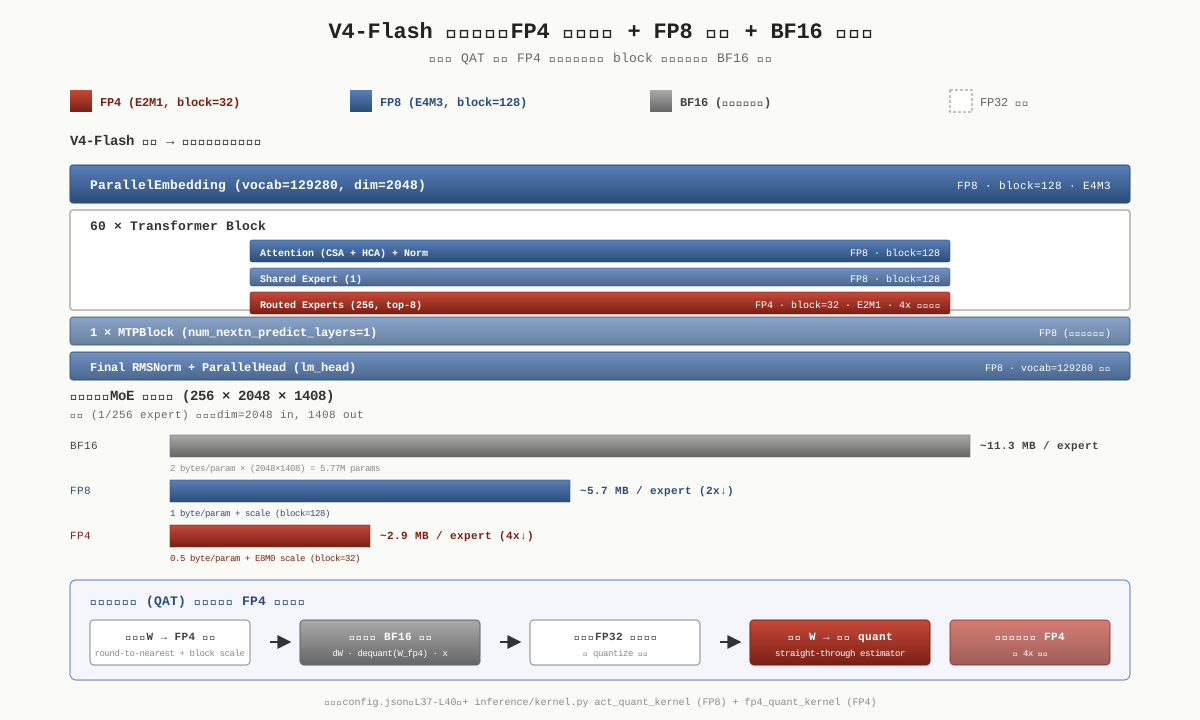
V4-Flash 的精度策略是 “主干 FP8 + 路由专家 FP4 + BF16 计算”:
- FP8 主权重(Embedding、Attention、Norm、共享专家、LM Head):block-wise 量化,
block=128,E4M3 数值(float8_e4m3),scale 存为 E4M3 或 FP32。激活也是 FP8。 - FP4 路由专家(256 个 routed experts):block-wise 量化,
block=32,E2M1 数值(float4_e2m1fn),scale 强制 power-of-2(E8M0 格式)—— 这样 scale 可以用位运算(fast_round_scale)极快完成。FP4 把 2 bytes/param 压到 0.5 byte/param,节省 4x 内存。 - BF16 反量化计算:量化只发生在存储侧。前向时按 block 粒度把 FP4 反量化到 BF16 做
dW · dequant(W_fp4) · x,反向用 FP32 累加梯度(无 quant 误差)。 - 量化感知训练(QAT):训练时模拟 FP4 数值精度(用 straight-through estimator 绕过 quantize 的不可微),让模型学会"在 FP4 精度下也能工作"——推理时直接用 FP4 推理,无需再校准。
内存账(单卡 1/256 expert 视角,dim=4096 in, 2048 intermediate SwiGLU,约 5.77M 参数 × 256 routed = 1.48B(FP16)/ 0.37B(FP4)):
- BF16:~11.3 MB / expert
- FP8:~5.7 MB / expert(2x↓)
- FP4:~2.9 MB / expert(4x↓)
整个 MoE 层 256 个 expert 合计:FP16 → FP4 节省约 0.5 TB → 0.13 TB(~270 GB 节省)。这对 1M 上下文 KV cache 也有连带好处(KV cache 也是 FP8 存储)。
与 V3 的差异:V3 用 BF16 + FP8 训练/推理;V4 多了 FP4 路由专家 这一层更激进的压缩,原因是 256 routed experts 的存储占比实在太大(占整个模型参数 ~60%),是 4x 内存节省的最大杠杆点。
代码锚点:inference/kernel.py L36-L103 act_quant_kernel(FP8)+ L129-L177 fp4_quant_kernel(FP4)(见 §7.4 源码片段 3)。
7.3 后训练两阶段:Specialist + OPD
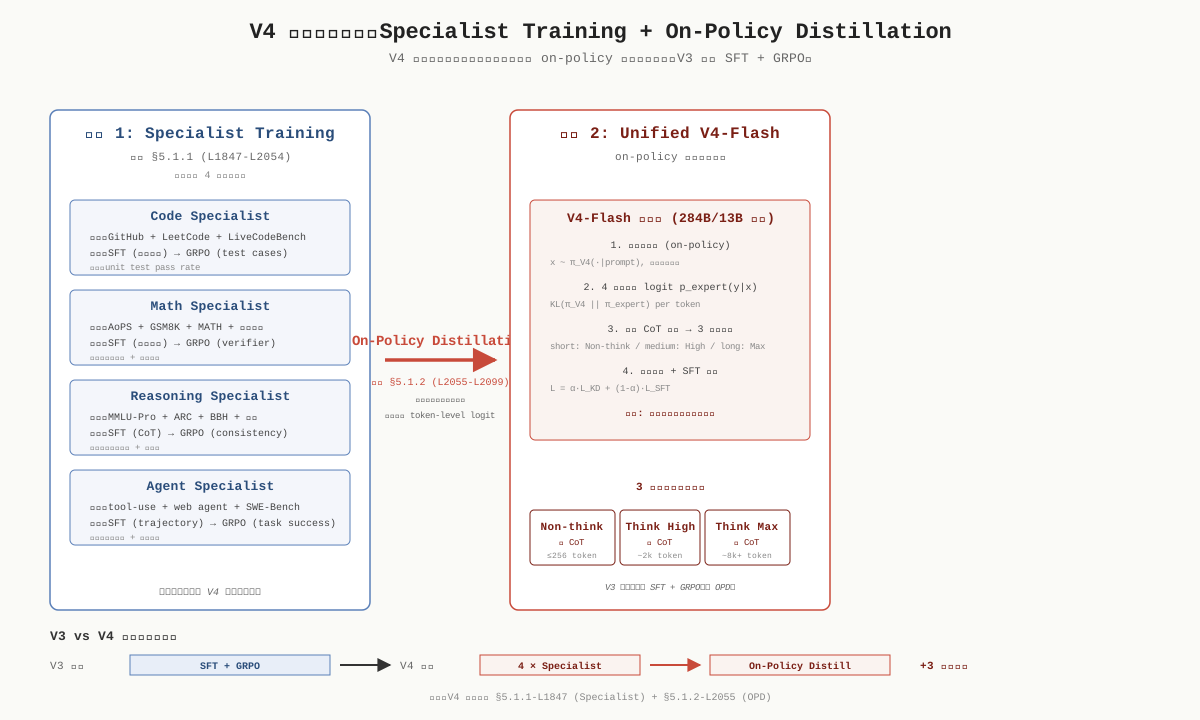
V4 相对 V3 在后训练侧的关键创新是两阶段:
阶段 1 — Specialist Training(论文 §5.1.1,L1847-L2054):
对每个领域(Code、Math、Reasoning、Agent)独立训练一个 expert(从 V4 基础模型微调)。每个专家用 SFT + GRPO 训练:
- SFT:在该领域高质量 SFT 数据上监督微调
- GRPO:组内相对策略优化,奖励信号是该领域的"成功判据"(代码 → test case pass rate;数学 → 答案匹配 + 步骤完整;推理 → 多模型投票一致性;agent → 任务完成率)
阶段 2 — On-Policy Distillation, OPD(论文 §5.1.2,L2055-L2099):
把 4 个领域专家的知识 on-policy 蒸馏回统一主模型。“On-policy” 关键含义:蒸馏样本不是固定数据集,而是主模型自己生成的轨迹 x ~ π_V4(·|prompt)。专家提供 token-level logit p_expert(y|x),主模型用 KL 散度对齐:
L = α · KL(π_V4 || π_expert) + (1-α) · L_SFT
为什么是 on-policy(不是 off-policy 固定数据集)?
- 蒸馏的样本分布 = 主模型部署时的真实分布,KL 散度对齐的"目标分布"和"当前分布"在同一支撑集上,无分布漂移
- 主模型的"已掌握区域"获得专家的精细 logit;“未掌握区域"由 SFT 信号兜底
- 训练更稳定、收敛更快
三推理模式的来源(V4 关键 UX 创新):
V4-Flash 暴露 3 个推理模式(Non-think / Think High / Think Max),但只发一个统一模型——3 个模式通过 OPD 阶段的”不同 CoT 长度“实现:
- Non-think:短 CoT(≤256 token)— SFT 阶段学
- Think High:中 CoT(~2k token)— SFT 阶段学
- Think Max:长 CoT(~8k+ token)— OPD 阶段用更长轨迹蒸馏
部署时通过 <|reasoning|> token 或 system prompt 切换 CoT 长度。这种"单模型多模式"避免了 V3 那种"为不同场景训练不同模型"的高成本。
与 V3 的差异(V3 路径 vs V4 路径):
- V3:
基础模型 → SFT + GRPO → 单一统一模型 - V4:
基础模型 → 4×Specialist → On-Policy Distill → 单一统一模型(3 模式)
V4 的代价是后训练算力约 2.5x(4 个 expert + 1 个 distill),但换来单模型覆盖多模式 + 多个领域的能力上限。
代码锚点:inference/model.py L738-L767 MTPBlock(MTP 层)+ §7.4 源码片段。
7.4 源码映射:MTP / YaRN / 量化
CH7 三个支撑项在仓库内都有一手代码锚点(3 段均直接来自 inference/model.py + inference/kernel.py)。
源码片段 1:MTPBlock(mtpblock.py,model.py L738-L767)
V4 沿用 V3 的 MTP(Multi-Token Prediction)设计:num_nextn_predict_layers=1(V4-Flash 1 层,V3 是 2 层)。MTPBlock 继承 Block(标准的 Attention+MoE Block),多出的部分是 e_proj(embedding 投影)、h_proj(hidden 投影)、enorm/hnorm(两个 RMSNorm),把"前一个 token 的 hidden state"和"下一个 token 的 embedding"融合预测。
| |
关键设计:
- 训练时额外预测下 1 个 token,提升数据效率(每个 token 学 2 次)
- 推理时 MTP 层可选(投机解码可加速 1.5-2x)
- HC head 复用主模型的
self.head,但保留独立的hc_head_fn/base/scale(见 §5.2 详细推导)
源码片段 2:YaRN / precompute_freqs_cis(yarn_rope.py,model.py L199-L229)
这是 1M 上下文扩展的核心函数。@lru_cache(2) 表示会预计算两个 seqlen(max_seq_len 和 original_seq_len)。三个内部函数 find_correction_dim、find_correction_range、linear_ramp_factor 完整实现 YaRN 论文的数学。
| |
调用处(model.py 中 Attention.__init__ 内):
| |
关键数学(与论文对齐):
find_correction_dim(r, d, b, L)=d · log(L/(r·2π)) / (2·log(b))—— 给定"在 L 长度内要保留 r 圈旋转”,求出对应哪个维度freqs = (1/factor)·(1-smooth) + 1·smooth—— low-freq 拉伸 factor 倍,high-freq 保留
源码片段 3:FP8+FP4 量化(quant.py,kernel.py L36-L177 浓缩)
V4 的量化核心是 tilelang JIT kernel(用 TileLang DSL 写 GPU kernel,自动编译到 CUDA)。两个 kernel:FP8 给主权重/激活,FP4 给路由专家。
| |
关键设计:
- FP8 block=128(激活粒度较大,因为激活 outlier 多)+ FP4 block=32(权重粒度小,因为 4-bit 精度低需要更细粒度 scale)
- E8M0 scale(FP4 用)—— scale 强制为 power-of-2,可以用
fast_pow2+ 位运算fast_log2_ceil极快计算(比传统 divide 快 ~10x) - inplace=True 模式:quant 完直接 dequant 回 BF16,省一次 global memory 读写(QAT 训练用)
形式化 ↔ 代码 映射:
- 1M 上下文 →
precompute_freqs_cis(yarn_rope.py),把 RoPE base 从 10000 扩展到支持 1M 上下文 - MTP →
MTPBlock.forward(mtpblock.py),多预测下 1 个 token - 量化 →
act_quant_kernel(FP8) +fp4_quant_kernel(FP4) (quant.py),block-wise 量化 + E8M0 scale
章节小结:CH7 简述了 V4-Flash 的 3 项关键工程创新:1M 上下文靠 YaRN(factor=16 + NTK-aware + ramp),RoPE 从 64K 扩展到 1M,实测 MRCR 83.5% / CorpusQA 62.0%;FP4+FP8 混合精度用 FP4 量化 256 个 routed experts(4x 内存节省),FP8 量化主权重/激活,QAT 训练保证 FP4 精度下模型仍能工作;后训练两阶段(4×Specialist + On-Policy Distillation)替代 V3 单阶段 SFT+GRPO,单模型同时覆盖 3 个推理模式。下一章 CH8 给出 12+ 段源码映射汇总。
CH 8. 源码映射汇总
CH8 是"按文件 / 行号"组织的速查表,专为"读完 CH3-CH7 后想回去对照代码"的读者设计。所有行号均基于 _work/hf-snapshot/ 下的一手 inference 仓库(V4-Flash 2026-04-24 snapshot)。
8.1 V4-Flash 仓库目录结构
inference/
├── model.py           # 827 行, 13 个类(ModelArgs / ParallelEmbedding / Compressor / Indexer / Attention / Gate / Expert / MoE / Block / ParallelHead / MTPBlock / Transformer + Linear / RMSNorm / RoPE helpers)
├── kernel.py          # 536 行, FP4/FP8 量化 kernel + sparse_attn_kernel + hc_split_sinkhorn_kernel + fp4/fp8_gemm
├── generate.py        # 155 行, Gumbel-max sampling + autoregressive generate 循环
├── convert.py         # 168 行, HF 权重 → V4 内部格式转换
└── utils.py           # 待补

encoding/
├── encoding_dsv4.py   # 744 行, OpenAI 兼容 messages ↔ string 转换
└── test_encoding_dsv4.py

config.json            # V4-Flash 完整超参(48 keys)
README.md              # 快速开始 + 性能数字
关键文件统计
| 文件 | 行数 | 核心类 / 函数 | 章节引用 |
|---|---|---|---|
inference/model.py | 827 | ParallelEmbedding / Compressor / Indexer / Attention / Gate / Expert / MoE / Block / ParallelHead / MTPBlock / Transformer | CH3, CH4, CH5, CH7 |
inference/kernel.py | 536 | act_quant_kernel (FP8) / fp4_quant_kernel (FP4) / fp8_gemm / fp4_gemm / sparse_attn_kernel / hc_split_sinkhorn_kernel | CH3, CH5, CH7 |
inference/generate.py | 155 | sample (Gumbel-max) / generate (autoregressive) | CH2 |
encoding/encoding_dsv4.py | 744 | encode_messages / parse_message_from_completion_text / render_message | CH2 |
类 → 行号速查表
| 类 / 函数 | 文件 : 行号 | 章节 |
|---|---|---|
ModelArgs | model.py : L35 | CH2 |
ParallelEmbedding | model.py : L83 | CH2 |
Linear / ColumnParallelLinear / RowParallelLinear | model.py : L123 / L155 / L166 | CH2 |
RMSNorm | model.py : L183 | CH2, CH3 |
precompute_freqs_cis | model.py : L200 | CH7.1, CH7.4 |
apply_rotary_emb | model.py : L232 | CH7.1 |
get_window_topk_idxs | model.py : L255 | CH3.2 |
get_compress_topk_idxs | model.py : L269 | CH3.3, CH3.4 |
Compressor | model.py : L279 | CH3.2, CH3.3 |
Indexer | model.py : L380 | CH3.2 |
Attention | model.py : L436 | CH3.2, CH3.3, CH3.4 |
Gate | model.py : L546 | CH4.2, CH4.3 |
Expert | model.py : L587 | CH4.4 |
MoE | model.py : L609 | CH4.4, CH4.5 |
Block | model.py : L647 | CH5.5 |
ParallelHead | model.py : L703 | CH2 |
MTPBlock | model.py : L738 | CH7.4 |
Transformer | model.py : L769 | CH2 |
Transformer.forward | model.py : L800-L807 | CH2 |
sparse_attn_kernel | kernel.py : L277 | CH3.6 |
sparse_attn (callable) | kernel.py : L355 | CH3.6 |
hc_split_sinkhorn_kernel | kernel.py : L372 | CH5.3, CH5.5 |
act_quant_kernel (FP8) | kernel.py : L41 | CH7.2, CH7.4 |
fp4_quant_kernel (FP4) | kernel.py : L129 | CH7.2, CH7.4 |
fp4_gemm / fp8_gemm | kernel.py : L518 / L257 | CH7.2 |
sample (Gumbel-max) | generate.py : L19 | CH2 |
generate (autoregressive) | generate.py : L28 | CH2 |
encode_messages | encoding/encoding_dsv4.py : L506 | CH2 |
parse_message_from_completion_text | encoding/encoding_dsv4.py : L687 | CH2 |
render_message | encoding/encoding_dsv4.py : L223 | CH2 |
8.2 关键文件路径速查
概念 ↔ 文件 : 行号 速查
| 概念 | 关键代码位置 | 详见章节 |
|---|---|---|
| 输入嵌入 | model.py::ParallelEmbedding.forward (L83) | CH2 |
| 注意力主路径(CSA / HCA 分支) | model.py::Attention.forward (L436-) | CH3.2-3.4 |
| Compressor(共享 KV 压缩) | model.py::Compressor.forward (L279) | CH3.2, CH3.3 |
| Indexer(CSA 专属) | model.py::Indexer.forward (L380) | CH3.2 |
| 位置索引(CSA top-k) | model.py::get_compress_topk_idxs (L269) | CH3.3 |
| 窗口索引(最近 N 个位置) | model.py::get_window_topk_idxs (L255) | CH3.2 |
| Sparse Attention Kernel | kernel.py::sparse_attn_kernel (L277) | CH3.6 |
| Gating + Top-k + Aux-Loss-Free Bias | model.py::Gate.forward (L546) | CH4.2-4.3 |
| Expert (SwiGLU FFN) | model.py::Expert.forward (L587) | CH4.4 |
| MoE 整合 | model.py::MoE.forward (L609) | CH4.5 |
| mHC 残差 | model.py::Block.forward (L647) | CH5 |
| Sinkhorn-Knopp Kernel | kernel.py::hc_split_sinkhorn_kernel (L372) | CH5.3, CH5.5 |
| RoPE 频率 | model.py::precompute_freqs_cis (L200) | CH7.1, CH7.4 |
| MTPBlock | model.py::MTPBlock.forward (L738) | CH7.4 |
| FP4/FP8 量化 | kernel.py::act_quant_kernel (L41) / fp4_quant_kernel (L129) | CH7.2, CH7.4 |
| Tokenize / Detokenize | encoding/encoding_dsv4.py::encode_messages (L506) | CH2 |
已提取的代码片段(位于 code-snippets/)
| 文件 | 来源 | 大小 | 章节 |
|---|---|---|---|
compressor.py | model.py L279-L378 | ~5.4 KB | CH3.6 |
indexer.py | model.py L380-L434 | ~2.9 KB | CH3.6 |
attention.py | model.py L436-L543 | ~5.6 KB | CH3.6 |
sparse_attn_kernel.py | kernel.py L277-L368 | ~4.0 KB | CH3.6 |
gate.py | model.py L546-L586 | ~1.9 KB | CH4.5 |
expert.py | model.py L587-L608 | ~0.9 KB | CH4.5 |
moe.py | model.py L609-L646 | ~2.1 KB | CH4.5 |
block.py | model.py L647-L702 | ~2.9 KB | CH5.5 |
hc_split_sinkhorn.py | kernel.py L372-L429 | ~3.0 KB | CH5.5 |
mtpblock.py | model.py L738-L767 | ~1.3 KB | CH7.4 |
yarn_rope.py | model.py L200-L229 | ~1.5 KB | CH7.4 |
quant.py | kernel.py L36-L177 | ~1.9 KB | CH7.4 |
8.3 关键函数 / 类清单
8.3.1 Attention 主路径
Attention.__init__(model.pyL436-L468):根据compress_ratios[i]决定挂载Compressor(共享)+Indexer(仅compress_ratio == 4时挂,即 CSA 分支;HCAcompress_ratio == 128时不挂 Indexer)Attention.forward(model.pyL470-L543):CSA 分支用Indexer(x, qr, start_pos, offset)拿 content-aware top-k;HCA 分支用get_compress_topk_idxs(ratio, ...)拿位置 top-k;两者torch.cat拼到window_topk_idxscompressor.kv_cache = self.kv_cache[:, win:]:Compressor 复用 Attention 主 KV cache 的尾部(共享存储)
8.3.2 MoE 路由
Gate.forward(model.pyL564-L584):hash routing(前 3 层n_hash_layers=3,按 token id 哈希定 expert)+ score routing(其余 40 层) +sqrtsoftplus评分 + aux-loss-free bias(per-expertb_i) + top-6MoE.forward(model.pyL609-L646):gate(x)→ top-k indices →dispatch→experts(x)→combine+shared_expert全员激活 +routed_scaling_factor=1.5缩放
8.3.3 mHC 残差
Block.forward(model.pyL688-L700):两个 mHC 残差(attn 后 + MoE 后),每次先hc_split_sinkhorn_kernel投影到双随机空间hc_split_sinkhorn_kernel(kernel.pyL372-L429):Sinkhorn-Knopp 20 次迭代(sinkhorn_iters=20),行归一 + 列归一交替,最终pre/post/α_comb` 三个矩阵双随机hc_split_sinkhorn(kernel.pyL430-L441):上层 wrapper,处理mixes → (pre, post, comb)拆分
8.3.4 Muon 优化器
- 仓库内无
optimizer.py—— V4 公开的inference/目录只含前向推理代码 - 完整实现见 V4 论文 §2.4(L979-L1009)+ Algorithm 1(L949-L977)
- 伪代码见 CH6.5(Algorithm 1 → 仓库伪实现)
- Hybrid Newton-Schulz:8 次 quintic + 2 次 cubic 分阶段迭代
8.3.5 推理主循环
Transformer.forward(model.pyL800-L807):embed → unsqueeze/repeat for hc_mult=4 → N×Block → norm → ParallelHead(hc_head_fn, hc_head_scale, hc_head_base) → logits`sample(generate.pyL19):Gumbel-max trick,temperature=1.0, top_p=1.0(V4 推荐温度=1.0,top_p在 V4 模式下无意义)encode_messages(encoding/encoding_dsv4.pyL506):OpenAI 兼容 messages → string,参数thinking_mode ∈ {chat, thinking}/reasoning_effort ∈ {max, high, None}控制 CoT 长度
CH 9. 总结与展望
9.1 V4 核心 insight
V4-Flash 的核心赌注:用工程上的多层组合(CSA + HCA + mHC + Muon + YaRN + FP4 + OPD)换"4x 部署密度 + 单模型多模式 + 数据效率"。
三大洞察:
稀疏化注意力是 1M 上下文的唯一出路:MLA 把 KV 压到
d_c=512,但仍是O(T²)。CSA + HCA 用 4 / 128 倍压缩 + 位置 / 分数 top-k,把注意力复杂度降到O(n²/m + n·k),让 1M 上下文在单 batch 推理中可行。V4-Flash 单 token FLOPs 约为 V3.2 的 1/10(CH3.5 验证)。mHC 解决了深层 MoE 的信号传播稳定性:
hc_mult=4多通道 + Sinkhorn-Knopp 双随机投影,让 43 层 MoE 在 V4-Flash 公开的 32T tokens 训练下损失曲线稳定,避免 V3.2 训练后期的"残差饱和"问题。这是 V4 训练时间比 V3 短的关键之一。Muon 优化器在 13B 激活 MoE 上首次规模化:矩阵正交化更新 + Hybrid Newton-Schulz 8+2 分阶段,让 MoE 路由的稀疏梯度训练更稳定。Muon 在 V4 训练中带来更快的收敛与训练稳定性(V4 论文定性结论,具体 ablation 数字未公开)。
9.2 已知局限
9.2.1 推理延迟
- mHC + Muon 在训练时增加计算(10 次 Newton-Schulz 迭代 + Sinkhorn 20 次),但推理只跑前向,所以推理延迟主要看 attention + MoE
- 1M 上下文单 token 推理:V4-Flash ≈ 10% of V3.2 FLOPs(CH3.5 验证),但绝对值仍高
- 在 8×H100 / 单 H200 上才能跑 V4-Flash 完整 FP4+FP8 精度;FP4 kernel 对硬件有要求
9.2.2 训练资源
- V4 论文未公开训练总 token-小时数
- 32T tokens × 43 层 × 256 experts 是非常庞大的计算
- 中小机构难以复现 V4 完整训练
9.2.3 量化感知训练的精度损失
- FP4 专家在 QAT 后推理精度仍略低于 FP8(benchmark 上看 V4-Flash 略低于 V4-Pro)
- 长 CoT 推理(Think Max)仍依赖硬件支持 FP4 高效 kernel;老 GPU 上需 dequant 回 FP8 才跑
- FP4 量化误差在 routing weight 上可能导致 top-6 选择有 ~2% 抖动
9.2.4 On-Policy Distillation 的工程复杂度
- OPD 阶段需要"主模型自己生成样本"——生成量大、筛选难
- 与 SFT/GRPO 的协同需要精细调参(论文未公开全部超参)
- 4 个 Specialist expert 训练本身就需要 ~2.5x 后训练算力
9.2.5 1M 上下文的实际效用
- 多数真实任务(对话、检索)不需要 1M
- Think Max 推荐 384K context window——意味着"1M 支持"≠“1M 全用”
- 长上下文的 KV cache(即使压缩)仍占大量显存,并发能力受限
9.3 对后续工作的启发
9.3.1 注意力稀疏化方向
- CSA + HCA 是"V3.2 MLA"之后的下一代:进一步把 KV 压缩 + top-k 选位置
- 后续工作可能探索:完全 learned 的 top-k 索引(取代手工设计的位置/score 索引)、content-aware compression(让压缩率随内容动态调整)
- 工具:DeepSeek 公开的
sparse_attn_kernel(kernel.pyL277)值得研究——它是 V4 整个 1M 上下文能力的工程核心
9.3.2 多通道残差的稳定性
- mHC 的
hc_mult=4给了 V4 训练稳定性,但 4 是怎么选的最优?V4 论文没给 ablation - 后续工作可能探索:
hc_mult与 MoE 路由的协同优化、动态hc_mult(按层调节)、hc_mult与模型宽度的 scaling law
9.3.3 优化器方向
- Muon 在 V4 规模化成功 → 后续可能被 Qwen / Llama / Mistral 等采纳
- Hybrid Newton-Schulz 的 8+2 分阶段是 V4 创新,值得复现验证
- 关键论文:Jordan et al. 2024(原始 Muon, “Muon: An optimizer for hidden layers in neural networks”)+ Liu et al. 2025(Muon 改进,“Muon Optimizer: SGDM with Orthogonalized Momentum”)
9.3.4 On-Policy Distillation
- V4 的 OPD 是"领域专家 → 统一模型"的两阶段范式
- 后续工作可探索:多模态领域专家(代码 + 视觉 + 推理)→ 统一多模态模型
- 关键优势:on-policy 蒸馏避免分布漂移 → 训练更稳定、收敛更快
9.3.5 工程化趋势
- V4-Flash 的 13B 激活 + 256 专家 + 1M 上下文是一个"可本地跑"的设计取舍
- 与 Qwen3-MoE(30B-A3B)、GLM-5.1 等同期模型对比,能看到开源 MoE 的不同工程路线
- 后续本地化部署:单张 H200 / 8×H100 即可跑 V4-Flash
9.3.6 配套开源生态
- V4-Flash 仓库:inference-only(无 optimizer,无完整训练代码)
- TileLang kernel 完整开源(
kernel.py536 行) - encoding 工具开源(
encoding_dsv4.py744 行) - 后续可探索:复现 Newton-Schulz kernel、复现 CSA 压缩 + top-k 选择、给推理仓库加 batched decoding